What Is a DID Number and How Is It Different From a Main Line?
By Jamila Parker · · 7 min read

A DID number lets callers reach a specific person or destination directly. Learn how DID numbers work, how they differ from a main business line, and when to use each.
Key takeaways
- A DID number lets an outside caller reach a specific employee, extension or configured destination directly.
- A main business line is usually the public-facing number that acts as the company's primary entry point.
- DID numbers can reduce unnecessary transfers and help customers reach the right person faster.
- A business can use both a main line and multiple DID numbers as part of the same phone system.
- DID numbers are especially useful for sales, support, executives, departments and distributed teams.
What Is a DID Number?
DID stands for Direct Inward Dialing. A DID number is a business phone number configured so an incoming caller can reach a specific destination without first going through a receptionist auto attendant or general queue. Twilio describes DID as a service that allows a number to ring directly to a specific phone instead of requiring the caller to navigate a menu or dial an extension.
In a traditional PBX environment, DID technology maps an external number to an internal extension. Cisco describes DID as allowing an external caller to reach a specific extension without assistance from an operator or automated attendant. In a modern cloud phone system, the same idea can be implemented through software-based call routing, SIP infrastructure or registered VoIP endpoints.
How Does a DID Number Work?
The basic process is straightforward. A business receives or purchases a phone number and assigns it to a person, extension, department or another destination in its phone system. When a customer dials that number, the system identifies the number that was called and applies the configured routing rule.
- Customer dials the employee's DID number.
- The carrier or VoIP service passes the called-number information to the business phone system.
- The phone system matches the number to its configured destination.
- The call rings the assigned user, device, extension, group or other destination.
Cisco documentation describes this routing concept as using the called number to determine the destination, allowing direct one-stage routing rather than requiring additional digit collection.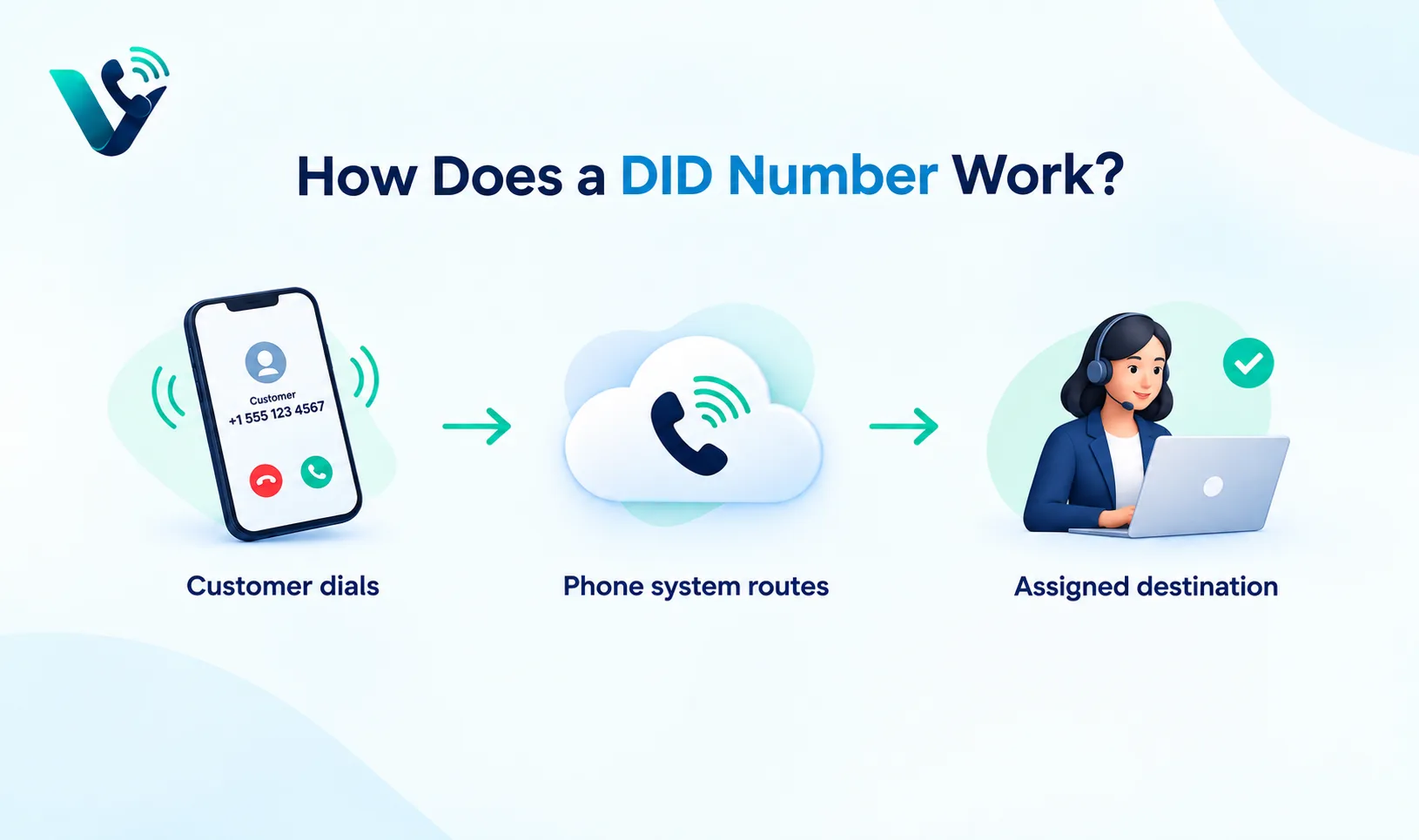
What Is a Main Business Line?
A main line is the primary phone number a business presents to the public. It is commonly used on a website, Google Business Profile, advertisements, invoices, email signatures and other customer-facing materials. When someone calls the main line, the call may be answered by a receptionist, auto attendant, call queue or general business group.
The main line is therefore usually designed as a shared front door for the company. It does not necessarily identify one individual. Instead, it can provide access to the business and then direct the caller to the right team or person.
DID Number vs Main Line: What Is the Difference?
Feature |
DID Number |
Main Line |
Typical Purpose |
Primary destination |
Specific user, extension or configured destination |
Business-wide entry point |
Direct vs general access |
Caller experience |
Usually reaches the intended destination directly |
May go through receptionist, IVR or queue |
Fast access vs guided routing |
Public use |
Often assigned to individuals or teams |
Usually the main published business number |
Personalised vs central contact |
Scaling |
Multiple DIDs can be assigned across a team |
One main number can serve the whole business |
Individual reachability vs shared access |
Example |
Sales rep's direct number |
Company reception number |
Direct sales contact vs general enquiries |
DID Number Example
Imagine a company has one main number for reception and separate DID numbers for its sales representatives. A new customer who does not know who to contact can call the main line and choose Sales from the menu. An existing customer working with a particular sales representative can call that representative's DID directly.
This creates two useful entry points the main line for general enquiries and DID numbers for direct relationships. The business can still manage both through one cloud phone system.
Why Do Businesses Use DID Numbers?
Faster access to the right person
DID numbers can reduce the number of transfers a caller needs to make. Customers who already know their contact can bypass a general menu or receptionist. Twilio notes that DID can allow callers to skip a queue or phone tree and reach a specific person.
Better customer experience
When customers can contact the person or team they already work with, the interaction can feel more direct and less repetitive.
Professional individual numbers
A business can give salespeople, consultants, account managers or executives their own business numbers without requiring separate physical phone lines.
Flexible routing
A DID does not necessarily have to ring one physical desk phone. In a cloud system, it can be routed to configured endpoints or destinations, depending on the provider and setup. Twilio supports DID routing through SIP trunks and SIP registration.
Easier team management
DID numbers can be reassigned or routed according to business rules when staff change roles, locations or devices.
Does a DID Number Need Its Own Physical Phone?
No. A DID number is a number and routing configuration, not necessarily a separate physical handset. Depending on the phone system, a DID can be associated with a desk phone, softphone, mobile application, SIP endpoint, queue, group or another supported destination.
This is one reason DID numbers are useful in cloud communications. The business can provide direct numbers without giving every employee a separate traditional phone line or desk setup.
Can One DID Ring More Than One Person?
Yes, depending on the phone system. Although a DID can be mapped to one specific extension, it can also be configured to route to a group, hunt group, auto attendant or other destination. Cisco documentation gives examples of DID numbers being mapped to internal extensions as well as groups and automated call-handling destinations.
This means the practical difference between a DID and a main line is not simply whether multiple phones can ring. The more important distinction is how the number is positioned and routed a DID is generally associated with a direct destination, while the main line is generally the company's general entry point.
DID vs Extension: Are They the Same?
No. An extension is usually an internal identifier, while a DID is an externally dialable number. For example, an employee might have extension 204 inside the company phone system and a DID number that customers can dial from outside. The DID can be mapped to extension 204.
Cisco describes this relationship as a mapping between DID numbers and internal extensions.
When Should a Business Use a Main Line or a DID?
Situation |
Better starting point |
Why |
General enquiries |
Main line |
One public entry point keeps routing simple. |
Existing customer has a dedicated contact |
DID |
The customer can reach the person directly. |
Small team with shared responsibilities |
Main line |
Calls can be distributed among the team. |
Sales team with individual account ownership |
DIDs |
Customers can contact the assigned representative. |
Large organisation with departments |
Both |
Main line handles general calls while DIDs provide direct access. |
Best Practice: Use Both Instead of Choosing Only One
For many businesses, the main line and DID numbers work best together. The main line gives new or unknown callers a simple, memorable entry point. DID numbers give existing customers and contacts a faster route to specific people or teams.
A well-designed phone system can therefore have one published main number plus a controlled range of individual DIDs. This creates a balance between simplicity for new callers and direct access for established relationships.
Try this on your own numbers
Local numbers in 118 countries, AI call notes and one shared inbox. Live the same day, no contract.
The Bottom Line
A DID number is an externally reachable business number configured to send an incoming call directly to a specific person, extension or destination. A main line is the company's general public-facing number and is more commonly used as the first point of contact.
The two are not competing technologies. In a modern VoIP system, they can work together the main line provides the company's front door, while DID numbers create direct paths to the people and teams customers need. For businesses that handle regular customer, sales or support calls, that combination can make the calling experience easier to manage and easier for customers to navigate.
Frequently asked questions
- What does DID stand for in phone systems?
- DID stands for Direct Inward Dialing. It refers to a phone service or configuration that lets an external caller reach a specific internal destination directly.
- What is the difference between a DID number and a main line?
- A DID is generally configured for direct access to a specific person, extension or destination, while a main line is the general public-facing number used to connect callers with the business.
- Can a DID number be a VoIP number?
- Yes. DID functionality is widely used with VoIP and cloud phone systems. Twilio, for example, supports DID routing through SIP trunking and SIP registration.
- Does every employee need a DID number?
- No. It depends on the business. Employees who regularly receive direct customer calls may benefit from DIDs, while other staff can be reached through the main line, an extension or a shared team destination.
- Can a DID number ring a team instead of one person?
- Depending on the phone system, yes. DID numbers can be configured to route to groups, hunt groups, auto attendants or other destinations.
- Is a DID number the same as an extension?
- No. An extension is normally an internal number, while a DID is an externally dialable number that can be mapped to that extension.