Getting an Australian Virtual Number: Rules and Requirements
By Jamila Parker · · 4 min read

Understand Australian virtual phone number types, area codes, provider checks, routing and practical requirements for business voice services.
Key takeaways
- Choose the number type and routing model around the customer journey, not just the country name.
- Capture source, ownership and next action as soon as a lead arrives.
- Check current numbering and compliance requirements before publishing a local or geographic number.
- Use reporting to compare qualified outcomes, not only call volume.
- Test voice, routing, fallback and CRM behaviour before launch.
Getting an Australian Virtual Number Rules and Requirements is primarily a question of matching phone infrastructure to a real customer and sales workflow. For businesses using Australian virtual number, the practical priorities are eligibility, clear routing, accurate customer-facing information, fast follow-up and measurable attribution. The sections below explain the implementation in a way that can be used as a publishing and operations checklist.
Australian number types at a glance
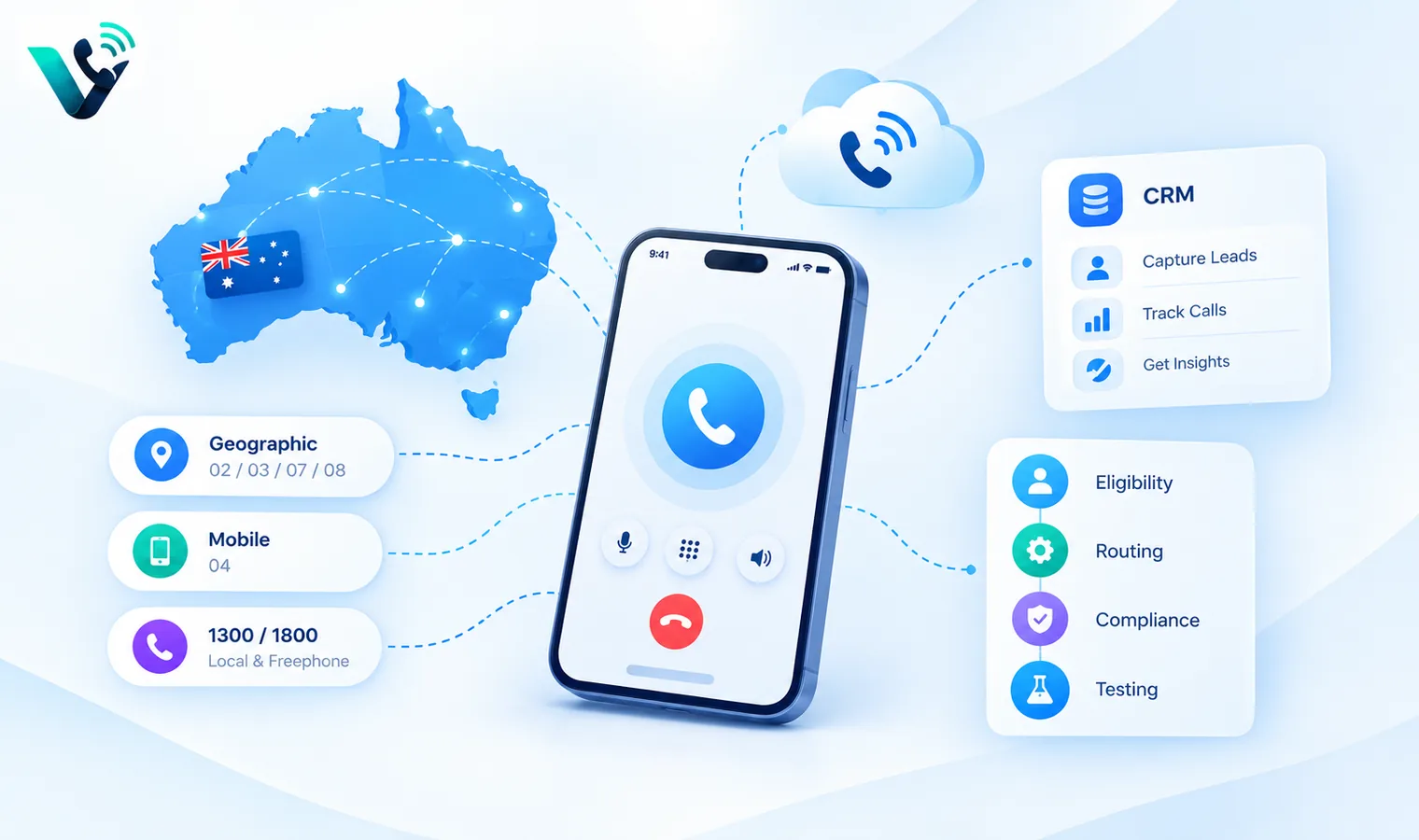
The Australian Communications and Media Authority lists several main phone-number categories, including geographic numbers beginning 02, 03, 07 and 08, mobile numbers beginning 04, local-rate numbers such as 13 and 1300, and freephone numbers such as 1800. The correct option depends on whether the business needs a city or state-linked geographic presence, a nationwide customer number or a mobile-style service.
Choose the number for the service model
A geographic number can make sense when the business serves a defined region. A 1300 or 13 service can be suitable when callers are expected to reach a business without the company presenting a single city as its identity. An 1800 number can be useful for services where the business wants to offer a freephone experience to callers. The commercial and regulatory details should be confirmed with the provider before publication.
Virtual does not mean unregulated
A number being delivered through VoIP does not remove numbering rules. The provider still operates within the Australian numbering framework, and some number types can have allocation or service conditions. Businesses should ask the provider what documentation is required, whether an Australian address is needed for the chosen range, and whether the service can be used by a team located overseas.
How to set up an Australian virtual number
Start by defining the target geography and call pattern. Choose the number type, confirm eligibility, activate the number and configure the destination. Add business hours, overflow, voicemail and callback rules. If the number will be used for advertising, connect it to call tracking or the CRM so the team can see which campaign generated the enquiry.
Area code strategy for Australian markets
Geographic numbers can communicate regional context, but businesses should avoid selecting an area code simply to create a misleading impression. If a company genuinely serves Sydney, Melbourne, Brisbane or another market remotely, a geographic number may support that service model. For nationwide operations, a national or non-geographic option can reduce the need to maintain separate regional numbers.
1300 and 1800 considerations
ACMA distinguishes local-rate and freephone services from ordinary geographic numbers. These ranges can be useful for customer support and national campaigns because they are not tied to one local area in the same way. Before choosing one, compare caller costs, business costs, routing capabilities, porting, call recording and analytics. The cheapest number type is not necessarily the best fit for the customer journey.
Connect calls to your CRM
The phone number should create an accountable workflow. Record the source, caller, owner, outcome and next action. If the number is dedicated to one campaign, store that relationship. If the number is used nationally, use additional campaign fields. LeadMino's CRM guidance emphasises source capture and ownership because a lead without an owner can sit unnoticed even when the phone system itself is working correctly.
Compliance and customer expectations
Businesses should comply with applicable Australian telecommunications, privacy and marketing rules for their use case. The number should identify the business accurately, and outbound calling should follow applicable consent and contact rules. For customer support, publish business hours and provide a realistic response path. Virtual telephony should make service easier, not obscure who the customer is contacting.
Testing before advertising
Call from multiple Australian networks if possible and test international routing if the team is overseas. Verify the displayed caller ID, voicemail, transfer, queue and after-hours behaviour. Test whether the CRM receives the call activity. If the number is used in Google or other advertising platforms, keep the public number consistent with the tracking configuration so attribution does not break.
Try this on your own numbers
Local numbers in 118 countries, AI call notes and one shared inbox. Live the same day, no contract.
The final selection checklist
Confirm number type, target geography, provider eligibility, documentation, caller costs, business costs, routing, porting, recording, analytics and CRM integration. Australian numbering has multiple options, so there is no single virtual number that is right for every business. The best setup is the one whose number type and service behaviour match the market the business is actually serving.
Practical implementation checklist
Element |
Purpose |
What to check |
02/03/07/08 |
Geographic services |
Choose around target region |
13/1300 |
Local-rate services |
Compare caller and business costs |
1800 |
Freephone |
Consider national support use cases |
CRM |
Lead management |
Track source and follow-up |
Frequently asked questions
- What Australian number types are available?
- ACMA lists geographic, mobile, local-rate, freephone and other number categories.
- Which area code should a business choose?
- Choose based on the geography you genuinely serve and the number type required.
- Can an Australian virtual number be answered overseas?
- Many services support remote answering, but provider terms and number requirements must be checked.
- Are 1300 and 1800 numbers the same?
- No. They are different service categories with different caller-cost and service characteristics.
- Does VoIP remove numbering rules?
- No. Virtual delivery does not remove the underlying numbering framework.
- Should I connect the number to a CRM?
- Yes, especially when the number is used for marketing or sales, because source and follow-up need to be tracked.