Hong Kong Virtual Phone Number for Business
By Jamila Parker · · 8 min read

A business guide to Hong Kong virtual phone numbers, covering +852 formats, IP telephony classes, routing, number selection, remote teams and OFCA considerations.
Key takeaways
- Hong Kong uses country code +852 and generally eight-digit telephone numbers.
- OFCA distinguishes classes of IP telephony service; Class 1 can have attributes similar to conventional telephony.
- A virtual number is most useful when routing, failover, business hours and customer ownership are designed before launch.
- Number capability and documentation can differ by provider, so verify the exact range rather than relying on generic country-page claims.
Quick answer: What is a Hong Kong virtual phone number?
A Hong Kong virtual phone number for business is a +852 number that can be delivered through an IP or cloud communications service and routed to agents, queues, SIP systems or approved destinations. It gives customers a Hong Kong contact point without requiring every call to terminate on one traditional office line.
Hong Kong’s Office of the Communications Authority (OFCA) regulates telecommunications numbering and IP telephony. That makes provider selection important: The number should come through a legitimate service arrangement, and the company should know what class of service and feature set it is actually buying.
Hong Kong number format and IP telephony
Hong Kong telephone numbers are generally eight digits and use the +852 country code internationally. OFCA explains that Class 1 IP Telephony Service has attributes similar to conventional telephone service. For fixed IP telephony, eight-digit numbers can use prefixes such as 2 or 3, while mobile-related ranges use other prefixes under the numbering plan.
For a business buyer, prefixes matter less than verified functionality. The provider should explain whether a number is fixed, mobile-style, IP-based, toll-free or another category, and whether it supports inbound calls, outbound presentation, SMS, portability and emergency-related functions.
Where a Hong Kong number fits in an international operation
A +852 line can serve as the main contact number for a Hong Kong market page, a dedicated sales line, a support entry point, or a route for suppliers and partners. International companies often centralise answering in a regional or global team while presenting one stable Hong Kong contact identity to customers.
That model works best when customer expectations are explicit. Publish service hours in Hong Kong time, make after-hours behaviour predictable and route high-value customers intelligently. A local number that always reaches voicemail creates less trust than an international number that is answered consistently.
Designing the call flow
Start with the smallest useful call flow. A compact business may need only sales and support queues. Larger companies can route by language, account type, customer tier or CRM owner. Queue overflow should move to a trained backup destination rather than repeatedly ringing unavailable agents.
If teams answer from multiple countries, test latency and transfer behaviour. Call recording and analytics should also follow the same governance rules across agents, especially when calls contain personal or financial information.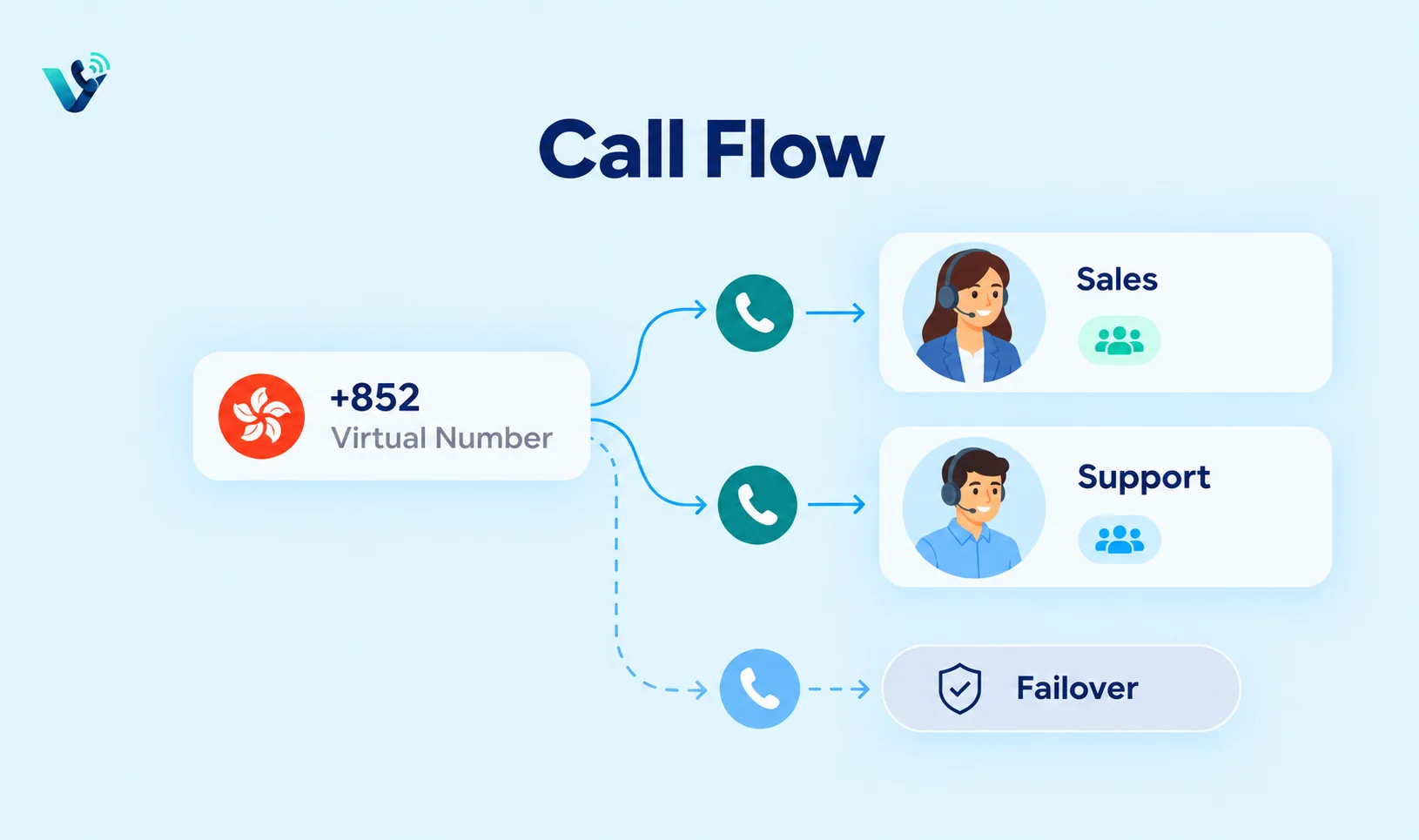
OFCA and provider checks
OFCA maintains the Hong Kong numbering plan and provides guidance on IP telephony. Before ordering, ask the provider to identify the number category, service class where relevant, carrier relationship and any documentation requirements. Avoid relying on claims such as “no documents ever required” unless they are specific to the exact product and current policy.
If outbound calls are important, ask how caller-ID presentation works. Never assume that a number available for inbound routing can automatically be presented as outbound caller ID from any location or network.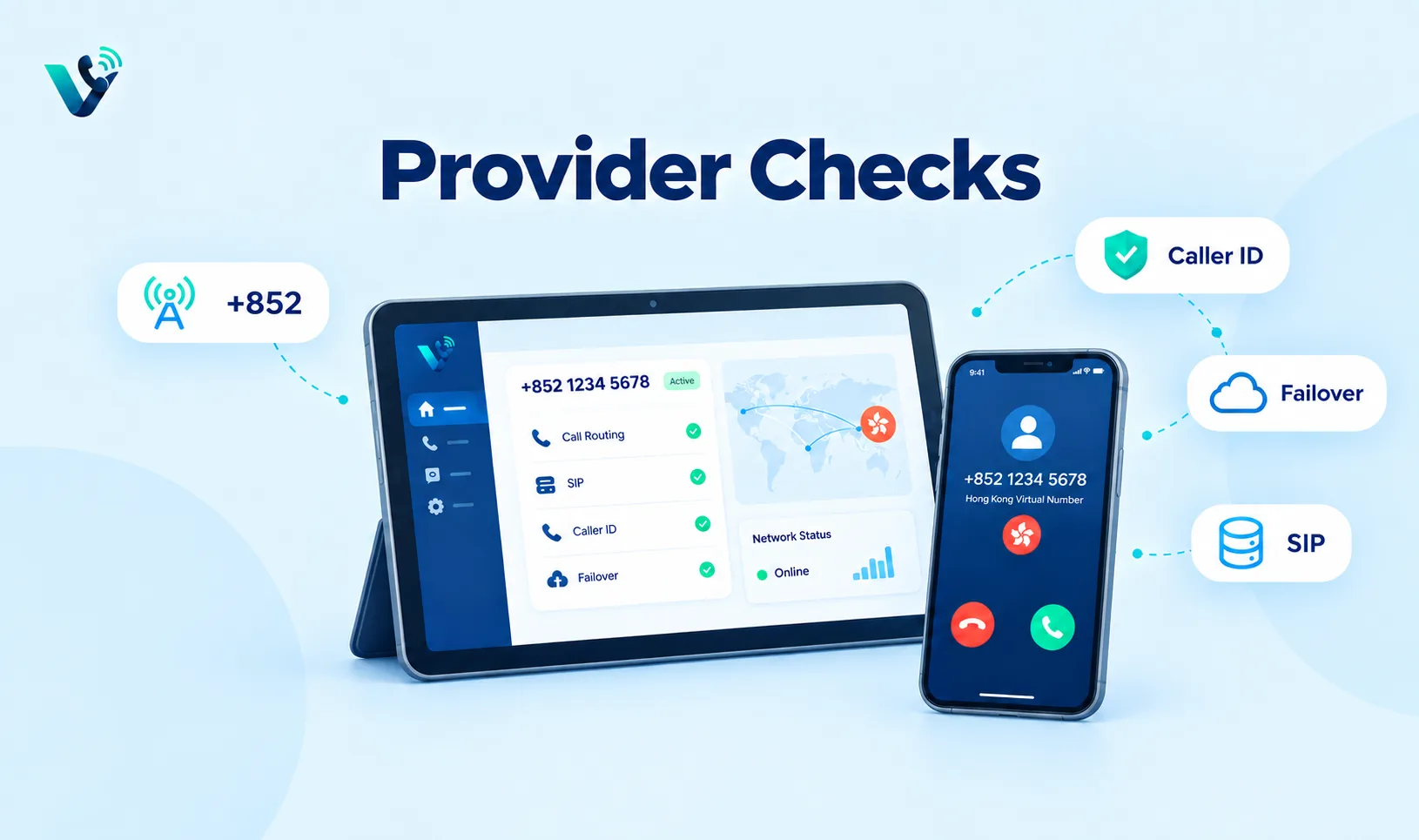
Business use cases: Sales, Support and Market Entry
Sales teams can use a Hong Kong number on local landing pages and campaign materials, then route qualified calls to account executives. Support teams can use IVR and queueing to share coverage across APAC. Market-entry teams can measure inbound demand before deciding whether to add more lines, languages or local staff.
For channel or partner operations, a dedicated number can separate Hong Kong partner traffic from general customer support. This improves reporting and gives the team a clearer view of why people are calling.
How to choose the right provider
Evaluate number inventory, compliance support, porting, inbound and outbound capabilities, SIP integration, concurrent call limits, call recording, analytics, failover and support hours. Ask where the provider has network infrastructure and how it handles a carrier outage.
For pricing, model a realistic month. Include number rental, inbound minutes, outbound minutes, forwarding, recording storage and contact-centre licences. A low monthly rental is not meaningful if the routing path creates expensive per-minute forwarding charges.
Launch checklist
Complete any verification, provision the number, configure routing and publish business hours. Test calls from Hong Kong mobile and fixed networks where possible, not only from your own internal softphone. Confirm audio in both directions, transfers, DTMF in IVR, voicemail notifications and failover.
After launch, track missed calls, average speed to answer, queue abandonment, transfers and conversion or resolution. These metrics tell you whether the number is improving customer access or merely adding another channel to manage.
Using a Hong Kong number with CRM and help-desk tools
Integrations are useful when they remove manual work rather than merely adding another dashboard. For sales, log inbound and outbound calls against the correct account, capture disposition and schedule follow-up. For support, attach the call to the ticket or customer profile and make recordings accessible only to authorised roles.
Keep the phone number independent of any single employee. If an account manager leaves, the number and call history should remain controlled by the business and route to the next owner without forcing customers to update their contacts.
Procurement questions to ask before committing
When evaluating Hong Kong virtual phone number for business, ask the provider to answer the commercial and technical questions in writing. Confirm the exact number type, current inventory, monthly rental, inbound and outbound call rates, included channels, overage pricing, minimum term, cancellation process and whether the number can be ported later. Then ask which capabilities are tied to the exact number rather than to the platform in general. This distinction matters because a dashboard may support SMS, recording or outbound caller ID even when a particular country range does not.
Compliance questions deserve the same treatment. Ask which carrier or licensed operator supplies the number, what KYC or business documents are required, whether a local address or entity is needed, and whether any intended-use restriction applies. Hong Kong uses country code +852 and generally eight-digit telephone numbers. A provider that can explain these dependencies clearly is usually easier to work with than one that promises universal instant activation without qualifying the number type or market.
Test the complete customer journey before launch
A successful Hong Kong virtual phone number for business deployment should be tested from the customer side, not only from the admin portal. Place calls from the networks your customers are likely to use, listen for post-dial delay, confirm two-way audio, press IVR keys, transfer between agents, leave voicemail and trigger after-hours routing. If the workflow includes outbound calling, verify that the intended caller ID is presented correctly and that callbacks return to a monitored destination. If SMS is important, test sending and receiving with the real number instead of assuming support from a feature list.
Also test failure conditions. Temporarily make the primary queue unavailable and confirm that overflow or failover works. Check what happens when all agents are busy, when a call arrives outside business hours and when the destination system is offline. OFCA distinguishes classes of IP telephony service; Class 1 can have attributes similar to conventional telephony. These tests are inexpensive compared with discovering a broken route after the number has been printed on a campaign, customer portal or product packaging.
Measure the first 30 days and adjust
After launch, treat Hong Kong virtual phone number for business as an operating channel with measurable outcomes. Track total calls, unique callers, answer rate, missed calls, average speed to answer, abandoned calls, call duration, transfer rate and the business result that matters for the use case. For sales that might be qualified meetings or revenue; for support it may be first-contact resolution, reopen rate or customer satisfaction. Segment performance by number so the team can see whether the chosen market or number type is actually useful.
Review cost at the same time. Include rental, usage, forwarding, recording, contact-centre licences and any carrier surcharges, then compare that total with the value created. If the number receives little traffic, consider whether it still serves a brand or compliance purpose. If demand is high, add channels or more specialised routing before adding more public numbers. Good virtual numbers / hong kong strategy usually comes from improving a small number of well-managed customer entry points rather than accumulating numbers with no clear owner.
Try this on your own numbers
Local numbers in 118 countries, AI call notes and one shared inbox. Live the same day, no contract.
Final operational check before scaling
Before scaling Hong Kong virtual phone number for business, run one final review with sales, support, IT and whoever owns telecom compliance. Confirm who owns the number, where calls route, which hours are covered, what happens during an outage, how recordings or customer data are handled, and how the number will be retired if the market strategy changes. A short cross-functional review catches problems that are easy to miss when procurement, routing and customer experience are handled by separate teams.
Bottom line
A Hong Kong virtual phone number can give an international business a stable +852 contact point while keeping the answering team flexible. The number itself is only one layer. The durable setup combines an appropriate OFCA-aligned service, clear routing, realistic service hours and strong operational ownership.
Frequently asked questions
- What is the country code for Hong Kong?
- Hong Kong uses the international country code +852.
- How many digits are Hong Kong phone numbers?
- Hong Kong telephone numbers are generally eight digits, with specific prefixes used for different service categories.
- Does Hong Kong regulate IP telephony?
- Yes. OFCA provides guidance and numbering arrangements for IP telephony services.
- Can a Hong Kong virtual number ring outside Hong Kong?
- Cloud and IP telephony services can route calls to remote teams or SIP systems, depending on provider capabilities and service conditions.
- Can I use the same Hong Kong number for outbound caller ID?
- Sometimes, but not automatically. Confirm outbound presentation for the exact number and route with the provider.
- What should I compare between Hong Kong number providers?
- Compare number category, documentation, inbound/outbound support, SMS, porting, SIP, call quality, concurrency, failover, analytics and total traffic cost.