How Many Numbers Does a Sales Team Actually Need?
By Jamila Parker · · 9 min read

Find out how many business phone numbers a sales team may need for reps, departments, locations and campaigns without creating unnecessary number sprawl.
Key takeaways
- There is no universal number of business phone numbers for sales team use.
- Start with the calling workflow and customer journey, not headcount.
- Use one stable main business number where possible.
- Add department, rep, local, toll-free, or campaign numbers only when they solve a clear problem.
- Check geographic, regulatory, verification, and porting requirements before activation.
- Keep number ownership, routing, caller ID, and CRM reporting organised to prevent number sprawl.
There is no single correct number of business phone numbers for a sales team. A small team may work well with one shared business number and individual extensions, while a larger or more distributed team may need separate numbers for departments, locations, campaigns, or specific reps. The right answer comes from the calling workflow rather than the headcount alone.
That is why planning business phone numbers for sales team use should start with customer experience. Ask how prospects will discover the number, who should answer, what caller ID should appear on outbound calls, how missed calls should be handled, and how activity should be recorded in the CRM. If those questions are clear, the number plan usually becomes much easier.
The main risk is number sprawl. Adding a new number for every rep, campaign, city, and department can feel organised at first, but it can quickly make routing, reporting, caller identity, ownership, and porting harder to manage. The goal is not to use as few numbers as possible. The goal is to use enough numbers to make the workflow clear without creating unnecessary complexity.
Why business phone numbers matter to a sales workflow
A business phone number is more than a contact detail. It affects how inbound calls are routed, how outbound caller ID is presented, how customers recognise the business, and how the team understands who owns a conversation. In a cloud-phone environment, the same public number can often be connected to apps, browser calling, forwarding, IVR, or shared team routing, depending on the provider and local rules.
For sales teams, this flexibility is useful because the phone number does not have to be tied to one physical handset. A shared sales number can reach several people, a department number can be routed to the correct group, and an individual rep may still make outbound calls through a managed business identity.
This is also why business phone numbers for sales team planning should be treated as part of the broader sales process. If a prospect calls after seeing an advert, the number should lead to the right person and the CRM should retain enough context for the next action. A phone system that connects the call but loses the source or ownership is only solving half of the problem.
Start with one main business number
For many teams, one main business number is the best starting point. It gives customers a consistent contact point and reduces the number of phone identities the company has to maintain. That number can then be routed to sales, support, reception, or another destination according to the business workflow.
A main number is especially useful when several people can handle the same type of enquiry. Instead of publishing a separate number for every employee, the business can keep the public contact simple while using extensions, routing rules, or queues behind the scenes.
The main number should stay stable wherever possible. It may appear on the website, customer records, directories, proposals, marketing material, and saved contacts. Replacing it frequently creates unnecessary friction. If the business later adds more business phone numbers for sales team workflows, the main number can remain the anchor while other numbers serve specific purposes.
When individual sales reps may need their own numbers
Individual numbers can be useful when customers build a direct relationship with a specific rep, when outbound caller ID needs to identify the rep consistently, or when the business wants direct callbacks to return to the same owner.
They can also help privacy. A sales rep can use a business-managed number rather than giving prospects a personal mobile number. In a cloud-phone setup, that business identity may be usable through a mobile or desktop app without requiring a separate physical handset.
But individual numbers are not automatically necessary for every rep. If most inbound calls should go to a shared team and direct callbacks can be handled through extensions or managed routing, assigning a unique number to every employee may create more administration than value.
When departments should have separate numbers
A separate number can make sense when sales, support, billing, recruitment, or another department has a clearly different workflow. The question is whether the separation helps customers reach the right team and helps the business manage ownership.
For example, a dedicated sales number can feed a sales routing flow while a support number follows a different schedule or team. The advantage is operational clarity. The downside is that every additional number must be monitored, configured, documented, and kept consistent across the places where it is published.
Before adding a department number, check whether IVR or routing on the main number could solve the same problem. If it can, keeping one public number may be simpler. If the departments genuinely need different caller journeys, separate numbers can be justified.
Local, toll-free, and location-based numbers
Sales teams serving different locations may consider local or toll-free numbers. A local number can align with a particular market where geographic identity matters, while a toll-free number can support a broader national contact model. The correct choice depends on the customer base, the provider, and any geographic or regulatory requirements attached to the number.
Do not assume every virtual number is available for every country, service, or verification flow. International numbers can have country-specific eligibility, identity checks, KYC, address-proof, and usage requirements. These conditions should be confirmed before the number is used in campaigns or published on the website.
If the business sells in several markets, business phone numbers for sales team use should be planned around genuine customer needs. Adding a local number for a market can be useful, but adding numbers simply because they are available can create a portfolio that becomes difficult to maintain.
Campaign numbers: Useful, but easy to overuse
Campaign-specific numbers can help separate enquiries from different marketing sources. A business may use a dedicated number for a major campaign, event, landing page, or advertising channel when that separation provides useful attribution.
The problem begins when every small campaign gets a permanent number. Over time, the business may end up with numbers that are still receiving callbacks even though nobody remembers where they were published. Routing and reporting become harder, and customers may save different numbers for the same company.
Use a campaign number when it creates a clear measurement or workflow benefit. Document the purpose, destination, owner, and planned lifecycle of the number. If the same result can be achieved with campaign tags or another tracking method, a new number may not be necessary.
A practical way to estimate how many numbers you need
Instead of starting with a fixed ratio such as one number per rep, build the number plan from the jobs each number needs to perform. A simple decision framework is:
- List the customer groups and locations the sales team needs to serve.
- Identify whether each workflow needs inbound calling, outbound calling, or both.
- Choose one main public number unless a separate customer journey clearly requires another.
- Add department numbers only where routing or ownership is meaningfully different.
- Add individual user numbers only where direct relationships, callbacks, or privacy justify them.
- Add local, toll-free, or campaign numbers only where they support a real market or measurement requirement.
- Confirm provider eligibility, verification, and porting before the number is published.
This approach keeps business phone numbers for sales team operations tied to real workflows. A five-person team may need one public number, while another five-person team with several markets and campaigns may reasonably need more. Headcount alone does not answer the question.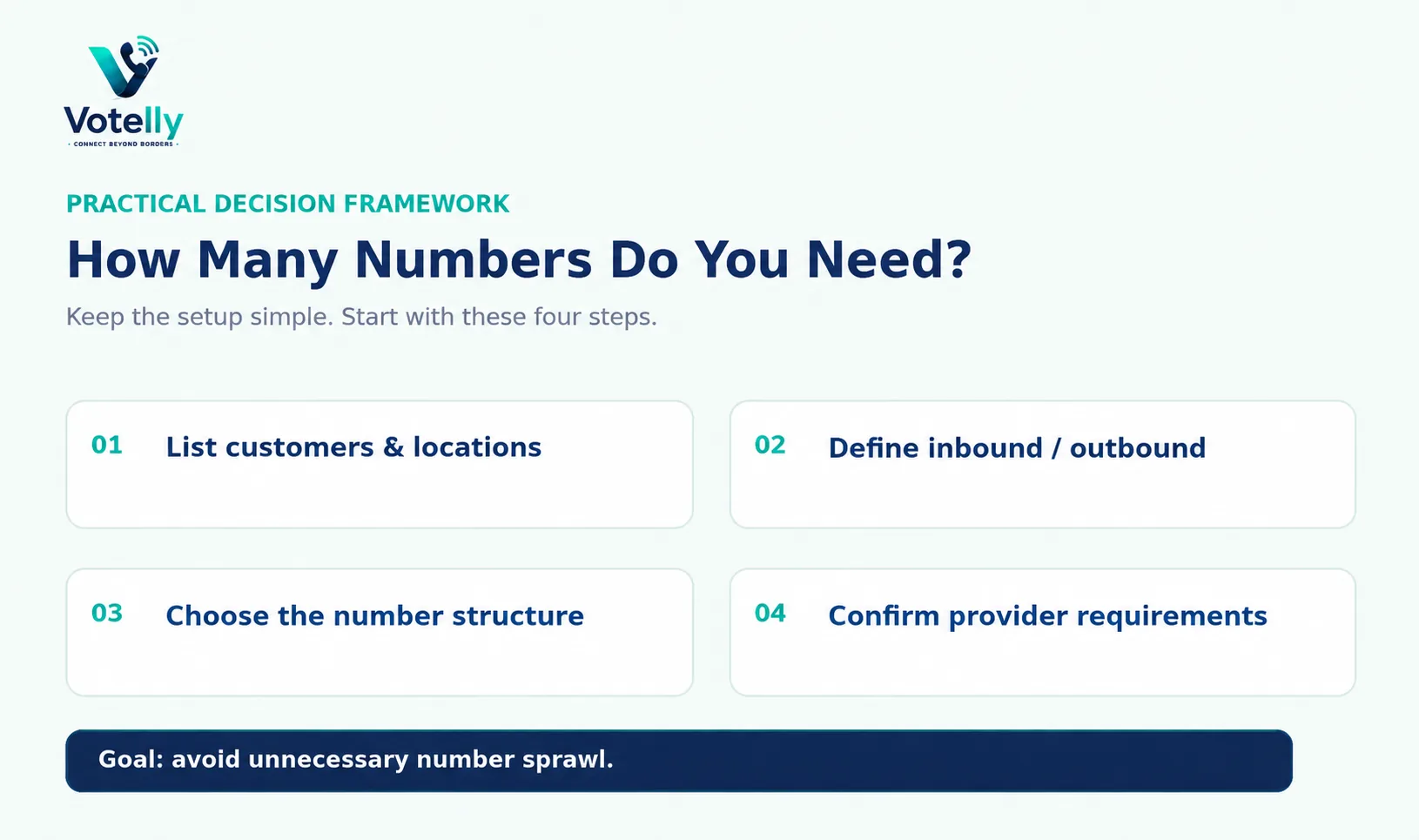
How to prevent number sprawl
Number sprawl happens when a business keeps adding phone numbers without a clear system for ownership, purpose, or retirement. It can make caller ID inconsistent, routing rules harder to understand, and reporting less reliable.
- Give every number a documented purpose and owner.
- Record where the number is published.
- Use consistent naming inside the phone platform.
- Review unused or low-value numbers regularly.
- Keep a stable main business number wherever possible.
- Check the impact before porting, replacing, or retiring a public number.
A clean number inventory also makes provider changes easier. If the business knows exactly which numbers are active, where they route, and which customer journeys depend on them, porting and migration decisions are easier to plan.
How CRM and reporting should fit into the number plan
A phone number is most useful when the business can connect it to the customer record. When calls are linked with CRM activity, teams can see who called, which number or source was involved, who owns the next action, and whether the conversation progressed.
If the company uses multiple business phone numbers for sales team workflows, reporting should make those numbers understandable rather than simply listing call counts. The team should know whether a number represents a department, market, campaign, or individual user.
This is another reason to avoid creating numbers without a clear purpose. A large inventory can produce more data while making the meaning of that data less clear.
Try this on your own numbers
Local numbers in 118 countries, AI call notes and one shared inbox. Live the same day, no contract.
What to check before choosing a provider
The provider should support the number strategy the business actually wants to run. Check number availability, monthly costs, calling rates, caller ID, routing features, mobile and desktop apps, CRM integrations, porting support, recording options, verification requirements, and international coverage.
The exact features and eligibility can vary by provider and country. A number that is available in one market or for one use case may not be available in another. Confirm current provider documentation before purchase.
Also think ahead. If the team grows, can the provider support more users, more routing options, and additional numbers without forcing the business to rebuild the entire setup? The simplest system today should still have a sensible path for growth.
Common mistakes sales teams make
- Giving every rep a number before deciding whether they actually need one.
- Publishing different numbers everywhere without documenting where each one appears.
- Adding local or international numbers without checking geographic or regulatory requirements.
- Assuming every virtual number supports every verification or service flow.
- Using too many campaign numbers and losing track of their purpose.
- Changing caller ID or public numbers frequently and confusing returning prospects.
- Keeping phone activity separate from the CRM and losing ownership after the call.
Most of these mistakes come from treating numbers as isolated assets. A better approach treats each number as part of a customer journey: where the customer sees it, what happens when they call, who owns the conversation, and how the next step is recorded.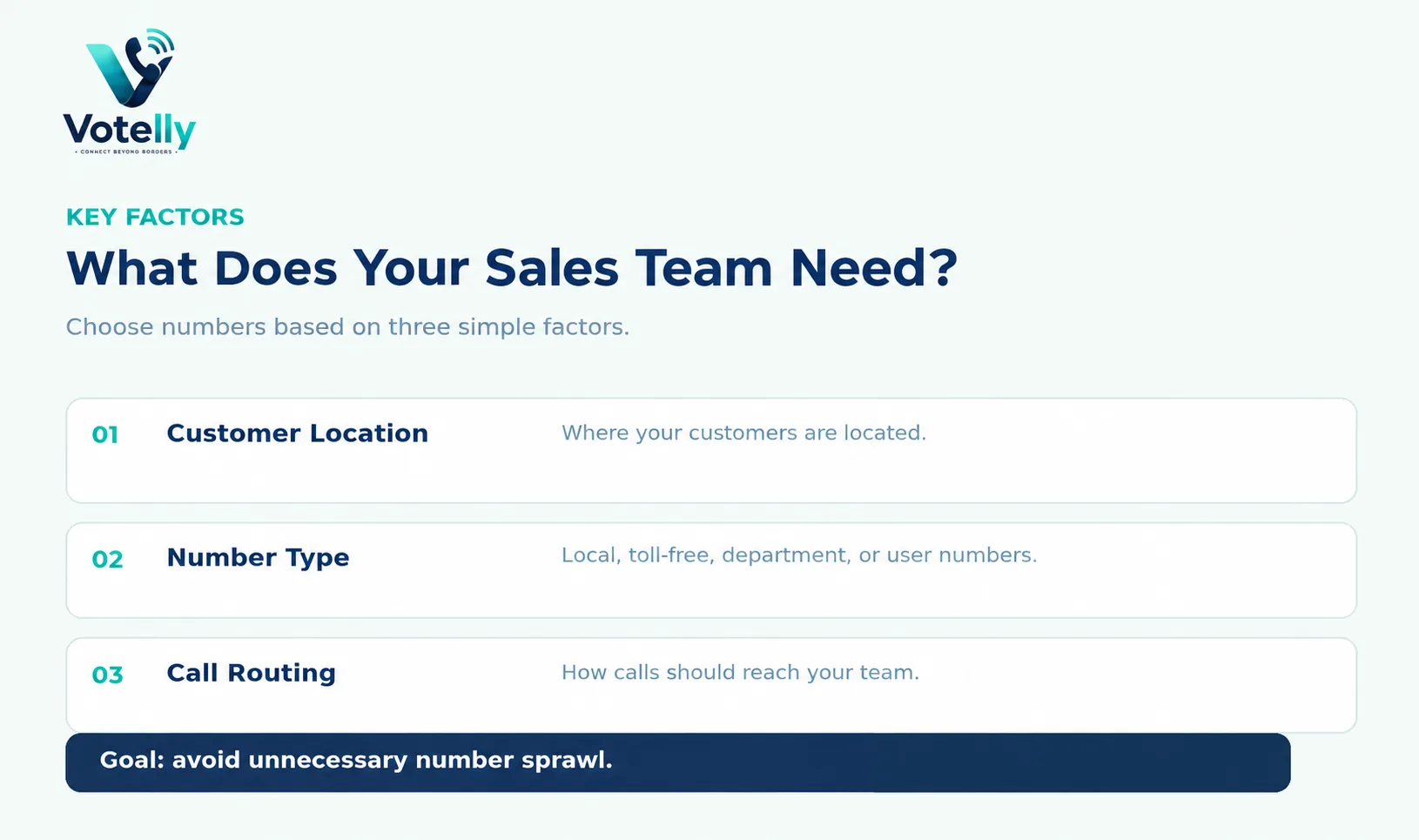
Frequently asked questions
- How many business phone numbers does a sales team need?
- There is no fixed number. The answer depends on customer locations, inbound and outbound workflows, departments, individual rep needs, campaigns, and provider requirements. Start with one main number and add others only where they create a clear operational benefit.
- Does every sales rep need a separate business number?
- Not always. Individual numbers can help with direct callbacks, privacy, and rep-specific caller ID, but shared routing or extensions may be enough when the team handles calls collectively.
- Can one business number ring several sales reps?
- In many cloud-phone setups, a business number can be routed to several users or teams through shared routing features, depending on the provider.
- When should a sales team use local numbers?
- A local number can be useful when the business genuinely serves a specific location and local identity matters to the customer journey. Check geographic and provider requirements before activation.
- Should marketing campaigns use separate phone numbers?
- Only when a dedicated number creates useful attribution or a distinct workflow. Too many campaign numbers can create unnecessary number sprawl.
- What should I check before buying business phone numbers?
- Check availability, pricing, routing, caller ID, CRM integrations, porting, verification requirements, international coverage, and the provider's current documentation.