Indian Virtual Numbers and TRAI Rules Explained
By Jamila Parker · · 8 min read

Understand Indian virtual numbers, cloud telephony, commercial communications and current TRAI rules around consent, preferences, traceability and business calling.
Key takeaways
- Indian telecom compliance is broader than simply obtaining a virtual number.
- TRAI maintains rules for commercial communications, preferences, consent and traceability.
- Voice and SMS workflows should be designed around the applicable communication category.
- Provider and licensed-network arrangements matter for cloud telephony.
- Keep consent, source, ownership and communication history visible in the CRM.
Indian virtual numbers should be planned as part of a broader communication-compliance workflow. The source makes clear that obtaining cloud telephony does not remove the need to understand the communication category, consent or preference context, traceability and the licensed-provider arrangement. The business process should connect provider configuration, customer permission and CRM history from the start.
What an Indian virtual number means
An Indian virtual number is a business number delivered through a cloud or IP communications platform instead of being tied to a traditional desk phone. It can support inbound calls, business queues, IVR, call recording where permitted, routing and CRM workflows. But the word “virtual” does not remove Indian telecom rules. The business still needs to understand what type of communication it is making and which licensed provider or telecom framework carries that traffic.
An Indian virtual phone number can support cloud-based routing, queues and CRM workflows, but the technology does not define the compliance position by itself. The business should document whether the number is used for inbound support, service communication, transactional contact or promotional outreach and then confirm the permitted provider setup for that use.
Why TRAI rules matter for business calling
TRAI maintains a detailed regulatory framework for telecom services and commercial communications. Its consolidated regulations include the Telecom Commercial Communications Customer Preference Regulations, 2018 and subsequent amendments. TRAI also publishes consumer guidance on unsolicited commercial communication and mechanisms for managing preferences and consent. For businesses, this means a virtual number should be treated as part of a communication-compliance system, not as a shortcut around telecom obligations.
The source points to TRAI's framework for commercial communications, preferences and consent. For a business, the practical implication is that a calling platform should not be treated as permission to contact every record in a database. The compliance context needs to travel with the lead so the team can see why a person is being contacted and what restrictions or preferences apply.
Commercial communication is not one single category
A business may make transactional, service-related, customer-support and promotional communications. The applicable rules can differ according to the purpose and channel. Before launching an outbound campaign, document why the customer is being contacted, what permission or relationship exists, what sender identity is being used and how an opt-out or preference will be handled. The CRM should preserve that context so the sales team does not accidentally treat every phone number as permission for every type of communication.
Separate customer-support, service, transactional and promotional workflows in the operating model. A contact may be appropriate for one type of communication and not another. Add a clear purpose field or campaign category in the CRM so agents know why the outreach exists and so suppression or opt-out logic can be applied consistently.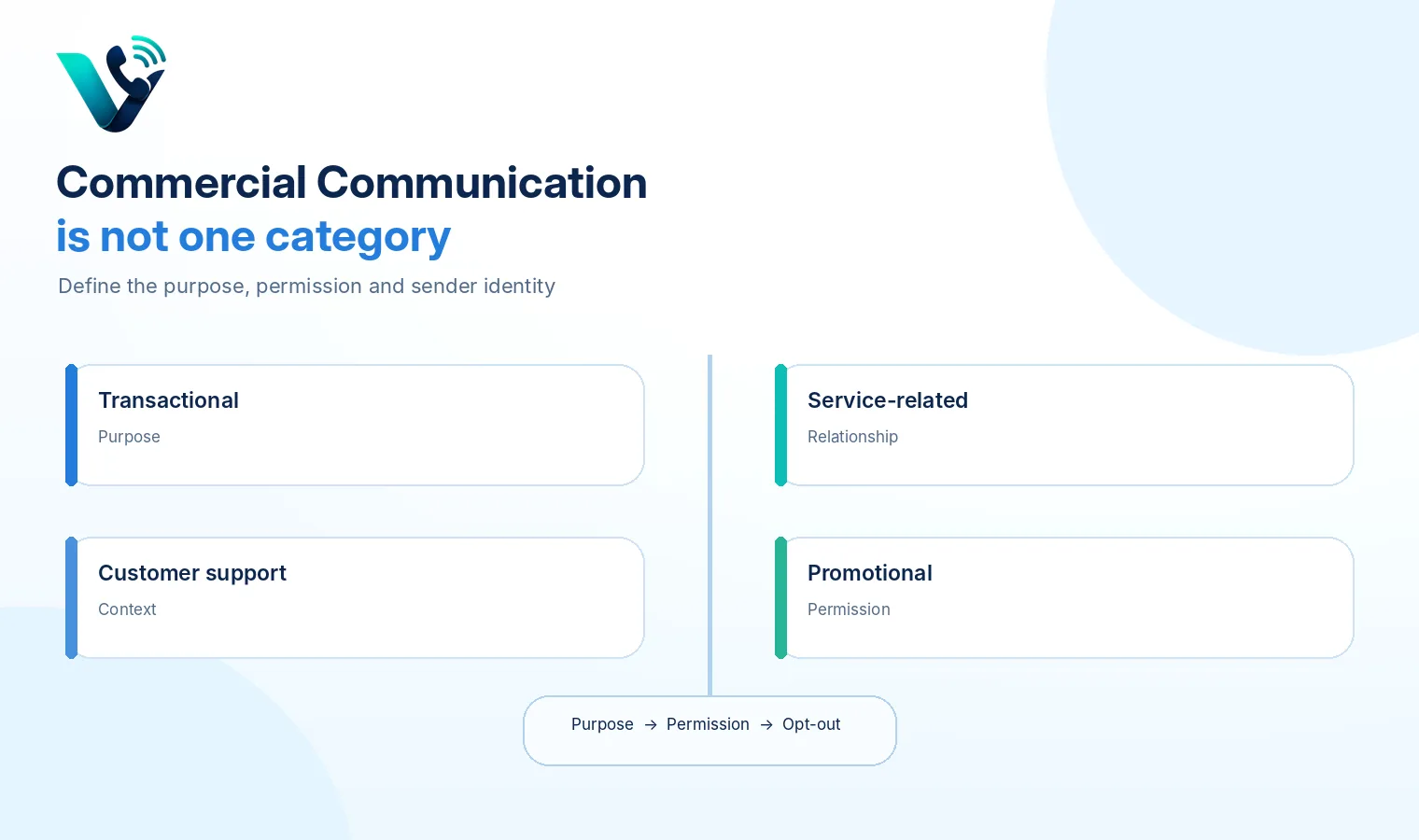
TRAI’s focus on preference and consent
TRAI’s customer guidance explains that users can register preferences for commercial communication and manage consent. This is particularly important for businesses running outbound campaigns at scale. A cloud calling system can technically place many calls, but technical ability is not the same as regulatory permission. Build the campaign process so contacts can be suppressed when they should not be called or messaged and so complaints can be investigated with a clear history.
At scale, preference and consent management should be designed before the first campaign. Define how a contact enters the eligible audience, how the record is suppressed, how complaints are reviewed and who is responsible for updating the status. The phone system and CRM should work together so a technically callable number is not automatically treated as permission.
Voice telemarketer and traceability considerations
TRAI guidance for telemarketers discusses voice-calling functions and the use of virtual identities in secure IP-based environments with access providers. The broader principle is traceability: the telecom ecosystem needs to know which entity is responsible for a communication. Businesses should therefore ask providers how the number and calling identity are registered, what records are maintained and how complaints are handled. Avoid systems that make it impossible to identify the business responsible for a call.
Traceability means the business should be identifiable as the entity responsible for the communication. Ask the provider how calling identity is registered, what logs are maintained and how complaints can be investigated. Avoid configurations that make it difficult to connect a call back to the campaign, team and business that initiated it.
SMS has its own compliance layer
Commercial SMS in India is governed through a structured framework involving sender identity, headers, content templates and preference mechanisms. TRAI publishes information and directions around commercial communications and has also introduced mechanisms related to voice and artificial-intelligence based detection of unsolicited communications. If the business plans to combine an Indian virtual number with SMS, verify the current registration and template requirements instead of assuming that a voice number automatically provides unrestricted messaging.
Do not extend a voice workflow into SMS without a separate check. The source notes structured sender identity, template and preference mechanisms for commercial messaging. If the business wants to combine an Indian virtual number with SMS, document the message purpose and confirm the current registration and template process with the provider before sending at scale.
Cloud telephony and provider selection
When choosing an Indian virtual-number provider, ask which telecom operator or licensed framework underpins the service, what number types are available, whether outbound calling is supported, how caller identity is displayed and what compliance features are included. Also ask how call recordings and customer data are handled. A low-cost number is not useful if the business cannot operate it within the communication rules that apply to the intended campaign.
Price should come after compliance fit. Ask which licensed operator or framework underpins the service, which number types are available, how outbound caller identity works, what compliance controls are provided and how recordings or customer data are handled. A cheap India business phone number is not useful if it cannot support the intended workflow correctly.
Connect the Indian number to the CRM
The phone system should pass the lead source, owner, call outcome and next action into the CRM. For regulated communications, also preserve relevant consent or preference information. LeadMino's workflow content emphasises capturing website sources and assigning ownership quickly. The same design works for phone leads: when the call becomes a lead, the record should show where it came from and what the team is allowed or expected to do next.
Use the CRM to preserve source, owner, outcome, next action and the relevant consent or preference context. When a phone lead becomes an opportunity, the record should show both the commercial history and the communication history. This reduces the chance that one team recontacts a person without understanding what happened earlier.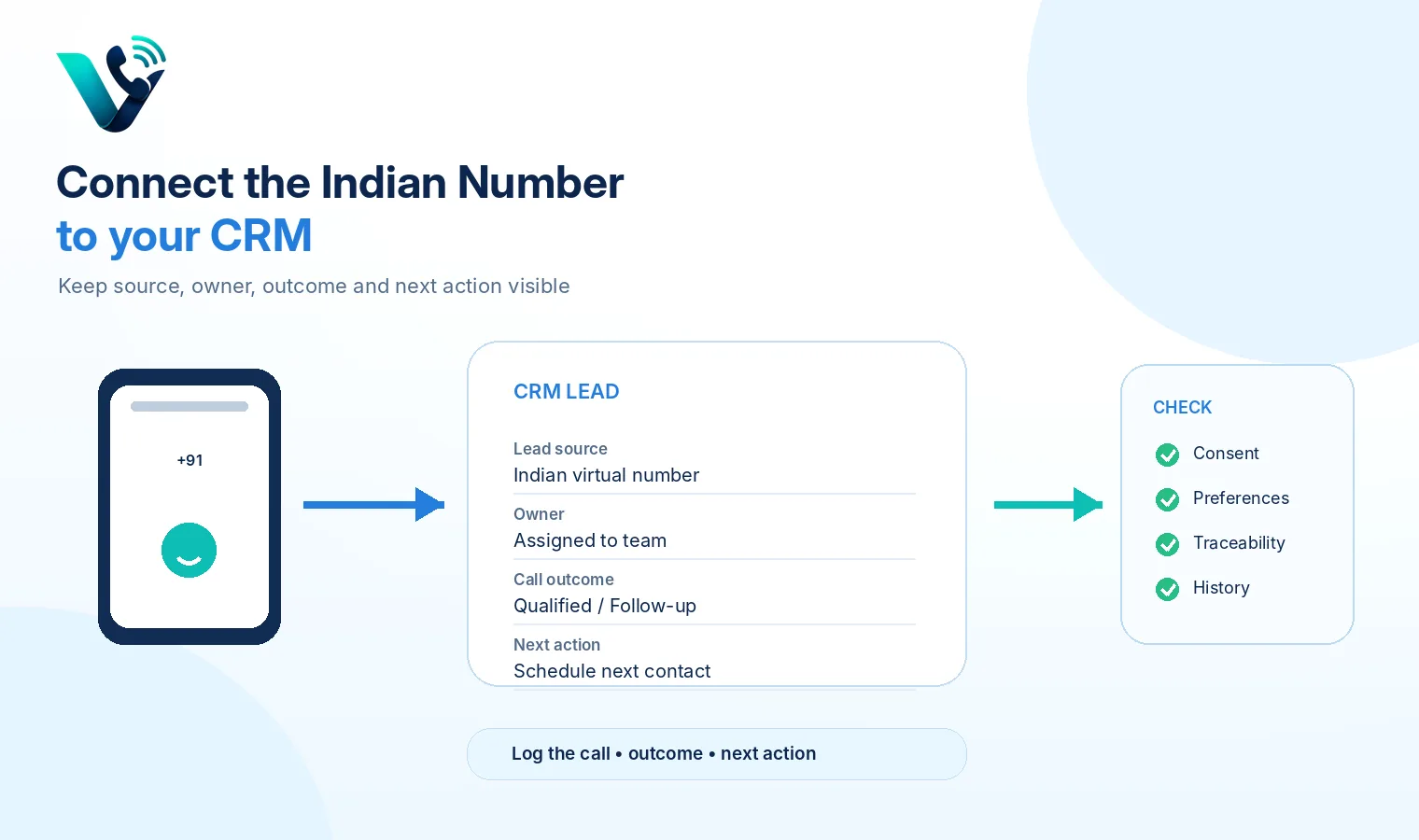
How to build a compliant outbound workflow
Start with a contact policy. Define which contacts can be called, for what purpose, during which hours and by which team. Use the provider's approved number and identity configuration. Log the call, outcome and next action. Make suppression and complaint handling accessible to the team. Periodically review call patterns, failed deliveries and customer complaints. This is more sustainable than trying to solve compliance after a campaign has already generated issues.
Start with an internal contact policy. Define eligible audiences, communication purpose, calling windows, approved identity, suppression handling and complaint escalation. Then configure the provider and CRM to follow that policy. Review the workflow periodically because campaign scale, provider features and regulatory guidance can change over time.
Indian virtual number checklist
Before launch, confirm number type, provider and telecom relationship, business verification, caller ID, outbound permissions, SMS requirements, consent and preference handling, recording policy, data retention and CRM integration. TRAI's rules and directions evolve, so the final compliance check should use the current official material and the provider's current implementation guidance. A virtual number can make Indian operations easier, but only when the communications process around it is equally disciplined.
Before launch, confirm number type, licensed-provider arrangement, inbound/outbound capability, caller identity, consent/preference handling, SMS requirements, recording/data handling, routing and CRM fields. Test normal and exception paths and keep the current provider guidance with the campaign documentation.
Try this on your own numbers
Local numbers in 118 countries, AI call notes and one shared inbox. Live the same day, no contract.
Common mistakes to avoid
- Treating cloud telephony as a compliance shortcut: The communication purpose and applicable TRAI framework still matter.
- Using one permission model for every communication: Separate service, transactional and promotional contexts.
- Ignoring suppression and preference data: Make opt-out and complaint handling visible to the team.
- Choosing a provider on price alone: Confirm the licensed framework and controls supporting the service.
- Keeping call history outside the CRM: Preserve communication context with the lead and opportunity record.
Practical implementation checklist
Area |
Purpose |
Check |
|
Voice |
Commercial communication |
Confirm applicable category |
|
SMS |
Headers/templates/preferences |
Check current TRAI requirements |
|
CRM |
Consent/source/owner |
Keep communication history visible |
Frequently asked questions
- What is the main thing to check about Indian virtual numbers?
- Check the exact number type, provider eligibility, required documentation and the communication features you actually need.
- Can a remote team use the number?
- Often yes, if the provider supports the routing and the number is eligible for the intended service.
- Does a virtual number automatically support SMS?
- No. SMS capability is separate and should be verified for the exact number.
- Do I need a local office?
- Not necessarily, but some number types or markets can require local presence or address evidence.
- Can I connect the number to a CRM?
- Yes. Connecting calls and messages to a CRM helps preserve ownership, source, status and next action.
- What should I test before publishing it?
- Test inbound and outbound calling, caller ID, business hours, overflow, SMS if needed, and the CRM workflow.
- Does an Indian virtual number automatically allow promotional calling?
- No. The source indicates that commercial communications are governed by purpose, preference, consent and traceability requirements in addition to the phone technology.
- Should SMS and voice use the same compliance checklist?
- Use a shared customer policy, but validate SMS requirements separately because messaging has its own sender, template and preference controls.