Local Phone Number vs Toll-Free Number: Which Gets Better Results?
By Jamila Parker · · 9 min read

Compare a local phone number vs toll-free number across customer trust, geography, accessibility, cost, routing, marketing attribution and business growth strategy.
Key takeaways
- A local number communicates geographic context; a toll-free number communicates broad customer access.
- There is no universal winner in the local phone number vs toll-free number comparison - the right choice depends on the customer journey and service model.
- Local numbers can work well for city- or region-focused sales, while toll-free numbers can support broader national service or support operations.
- Compare the full cost structure, not only the monthly number rental.
- Either number type can support call tracking, campaign attribution and CRM workflows.
- Measure qualified leads, response time, customer experience and commercial outcomes instead of assuming one prefix converts better.
The local phone number vs toll-free number decision is not really about which format looks more professional. It is about which number type best matches the customer experience, geographic strategy, routing model and measurement needs of the business. A local number can reinforce regional relevance, while a toll-free number can create one broad contact point for customers across a larger market.
The better result comes from fit rather than from the prefix alone. A local number can underperform when calls are missed or the geographic signal does not match the real service area. A toll-free number can perform well when customers want a simple national contact point, but it can also be unnecessary for a business that operates mainly in one city.
This guide compares local phone number vs toll-free number options across trust, geography, customer access, cost, routing, attribution and international expansion. It also explains how to test the choice using real lead and call outcomes instead of relying on assumptions.
Local and toll-free numbers solve different problems
A local business phone number is generally associated with a geographic area. That makes it useful when location matters to the customer journey: a regional service business, a city-focused campaign, or a team testing demand in a particular market may benefit from a familiar geographic number.
A toll-free business number is designed around broad customer access. Under the relevant service model, the caller is not charged in the same way as a standard local call, while the business typically carries the service cost. That can make toll-free a natural fit for national support, centralised sales or a brand that does not want to emphasise one city.
So the local phone number vs toll-free number comparison should begin with one question: what should the number communicate to the customer? Geography, accessibility and service scope matter more than choosing a number because it sounds more established.
When a local phone number makes sense
A local phone number can be useful when the business is strongly connected to a city, region or defined service area. Customers looking for a local contractor, clinic, agency, consultant or service provider may find a familiar area code more relevant to the way they search and buy.
Local numbers can also support regional campaign segmentation. A company can publish a number associated with a target market while routing calls to the same central or remote team. This lets the customer see a market-relevant number without requiring a separate physical phone system in every location.
The business should still keep the public story accurate. A geographic number should support a genuine service relationship with the market, not create a false claim about a physical office that does not exist.
When a toll-free number makes sense
A toll-free number can make sense when customers are spread across a country and the business wants one consistent contact point. It can be useful for customer support, larger companies, nationwide campaigns and services where regional identity matters less than convenience and accessibility.
Toll-free can also simplify branding. Instead of maintaining several regional numbers, the business can promote one central line and route calls internally by department, language, customer type or business hours.
However, toll-free should not automatically be treated as international. Toll-free reachability is often tied to the country or service range, so businesses serving customers across borders should confirm how callers in each market can reach the number before using it as a global contact strategy.
Local vs toll-free number: Trust depends on context
Trust is not created by a phone prefix alone. A familiar local area code can feel appropriate to a customer looking for a nearby provider, while a toll-free number can feel normal for a national company or central support line. Both signals can be credible when they match the business model.
Customers also judge the website, caller identity, response quality, reviews, business information and the actual conversation. A local number with slow response or inconsistent branding can damage trust. A toll-free number with clear business information and reliable service can perform strongly.
This is why local phone number vs toll-free number decisions should be evaluated alongside the rest of the customer journey rather than as a standalone conversion trick.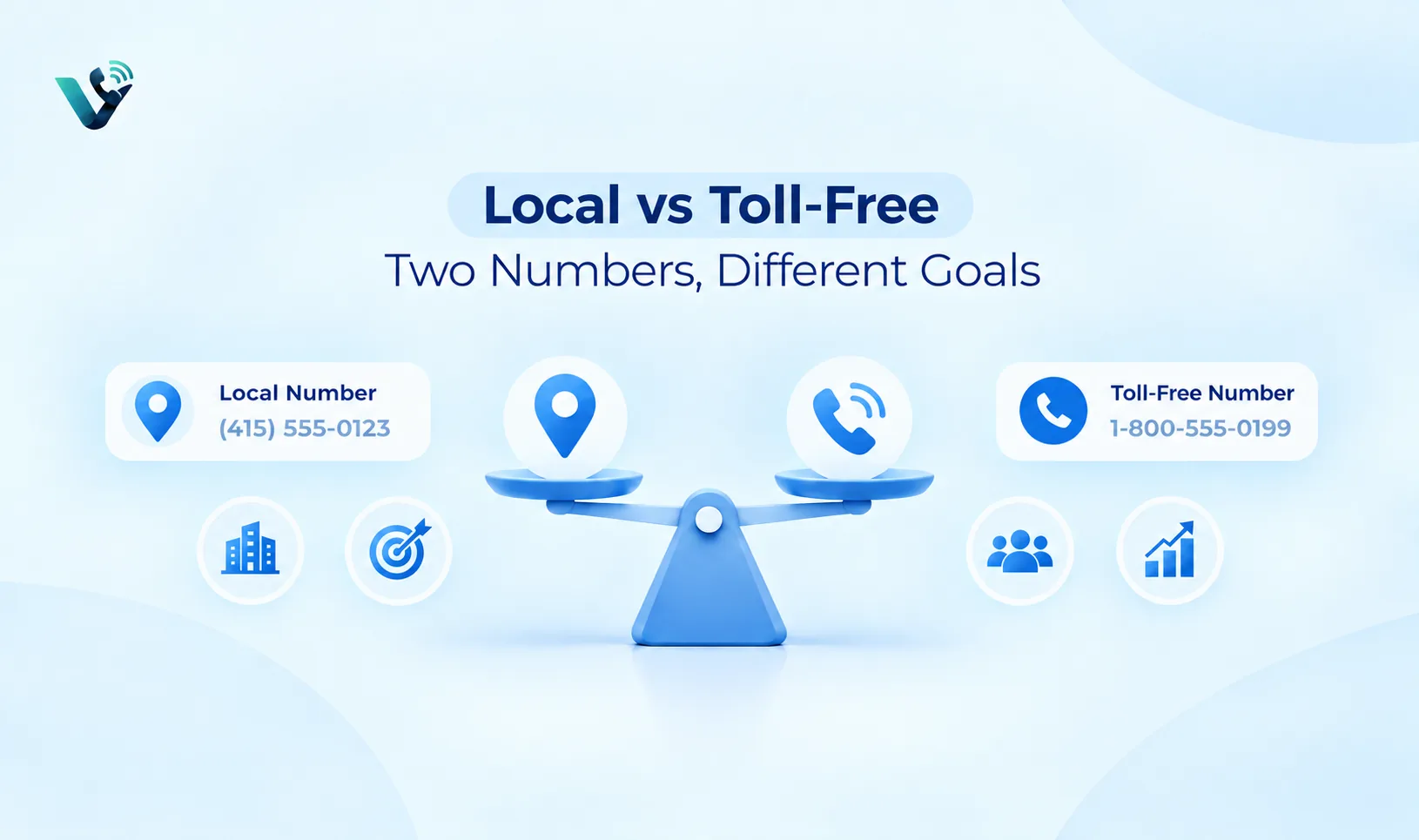
Cost: Compare the full operating model
The cost structure can differ between local and toll-free services and between countries. Toll-free service generally shifts more of the calling cost toward the business, while local numbers can have different customer and provider charges depending on the market and carrier.
Do not compare options using only the monthly number rental. Include inbound minutes, outbound calling, call forwarding, international routing, SMS where supported, recordings, analytics, porting, setup fees and any provider-specific charges.
A cheaper number can become more expensive if the routing model creates missed calls or if the business needs extra numbers later. The stronger comparison looks at total operating cost together with customer outcomes.
Marketing attribution works with both number types
Either a local phone number or a toll-free number can be part of a call-tracking strategy. The main business line can remain stable while selected campaigns use separate tracking numbers that route into the same team.
For websites, dynamic number insertion can display different numbers based on visitor source or campaign. For offline campaigns, a dedicated number can identify the brochure, billboard, event or advertisement that generated the call.
The important step is connecting the call record to the CRM. Marketing should be able to see not only that a call occurred but whether the caller became a qualified lead, meeting, opportunity or customer. That makes the local phone number vs toll-free number comparison measurable instead of subjective.
Routing and customer access
The public number is only the entry point. Behind it, the business still needs a routing model. Local and toll-free numbers can both route to users, queues, remote teams, departments or supported forwarding destinations depending on the provider.
Define business hours, after-hours handling, overflow, voicemail and callback ownership before the number is published. A local-looking number does not help if no one answers it, and a toll-free line does not improve accessibility if missed calls have no follow-up process.
For teams serving multiple regions, the same number can route differently based on time of day, customer type or internal responsibility. The routing design should make the customer's next step predictable.
Geography and international expansion
Local numbers can be useful when a business enters a new country or region and wants to test demand in a specific market. They can support a market-focused landing page and give the team a clear source for regional enquiries.
Toll-free can be useful after the business expands to broader national coverage and wants one central contact route. Some companies may use both: local numbers for regional sales and a toll-free number for national customer support.
Country-specific numbering rules still matter. Local and toll-free numbers can have different allocation, documentation and reachability requirements, so the provider and relevant official guidance should be checked before either number type is advertised.
Which one should you choose?
Use a local number when geographic relevance is a meaningful part of the customer journey. Use a toll-free number when broad access and national coverage matter more than one local identity. Use both when the business has a clear reason for each number and can maintain the routing and reporting cleanly.
A practical local phone number vs toll-free number decision should consider target geography, customer expectations, number availability, caller cost, business cost, routing, SMS needs, campaign attribution, CRM workflow and the accuracy of the public business information.
The simplest setup that meets those requirements is usually better than maintaining a large number pool without a clear operational reason.
Test instead of guessing
If both number types are available and the business has enough traffic to compare them, a controlled test can provide useful evidence. Keep the offer, landing page, audience and response process as consistent as possible so the main changed variable is the number format.
Measure answered calls, missed calls, qualified leads, meetings, opportunity value, response time and downstream commercial outcomes. Raw call volume alone is not enough because one number can generate more calls while producing fewer valuable conversations.
Do not change several variables at once. A phone-number test only becomes useful when the business knows which number the customer used and what happened after the call.
Try this on your own numbers
Local numbers in 118 countries, AI call notes and one shared inbox. Live the same day, no contract.
Common mistakes to avoid
- Choosing based on appearance alone: Do not assume that a local prefix always feels more trustworthy or that toll-free always looks more professional.
- Using a local number to imply a false office: Keep the public geographic story accurate and tied to the market the business actually serves.
- Ignoring the full cost structure: Compare usage, routing, forwarding, SMS, analytics and provider fees, not only monthly rental.
- Tracking calls without tracking outcomes: Connect calls to the CRM so marketing can compare qualified results instead of raw call counts.
- Publishing before routing is ready: Set business hours, overflow, voicemail and ownership before customers start calling.
- Assuming toll-free works globally: Confirm domestic and international reachability for the exact toll-free service.
Decision framework: Local phone number vs toll-free number
Factor |
Local phone number |
Toll-free number |
|
Geographic signal |
Strong regional or city context |
Broad, non-local customer access |
|
Typical fit |
Regional sales and local service |
National support and broader campaigns |
|
Customer cost |
Depends on local market and carrier |
Usually designed to reduce caller cost under the service model |
|
Business cost |
Varies by provider and usage |
Business typically carries more of the inbound service cost |
|
Marketing attribution |
Can use tracking numbers or DNI |
Can use tracking numbers or DNI |
|
Routing |
Can route to local or remote teams |
Can route to central or distributed teams |
|
International use |
Useful for market-specific entry |
Reachability can be country/service specific |
|
Best decision metric |
Qualified regional outcomes |
Qualified national outcomes |
Practical implementation checklist
- Define the target geography and customer service model.
- Choose local, toll-free, or a combination based on a real customer need.
- Confirm number availability and provider eligibility.
- Check caller cost, business cost, routing fees and any SMS requirements.
- Configure business hours, overflow, voicemail and callback ownership.
- Connect the phone number to CRM source and lead ownership.
- Preserve campaign attribution when using tracking numbers.
- Test inbound and outbound calling before publishing.
- Measure qualified leads, response time, customer satisfaction and commercial outcomes.
Frequently asked questions
- What is the main difference between a local phone number and a toll-free number?
- A local number communicates geographic context, while a toll-free number is designed around broad customer access and a service model where the business generally carries the inbound calling cost.
- Which gets better results: local phone number vs toll-free number?
- There is no universal winner. The better option depends on customer geography, service model, routing quality, trust signals and measured lead outcomes.
- Can a remote team use either number type?
- Often yes when the provider supports the routing and the number is eligible for the intended service.
- Can I use both a local and toll-free number?
- Yes. A business may use local numbers for regional sales and a toll-free number for national support when each number has a clear role.
- Can either number type be used for marketing attribution?
- Yes. Tracking numbers and dynamic number insertion can be layered onto local or toll-free strategies, depending on the provider and campaign setup.
- Does a virtual number automatically support SMS?
- No. Messaging capability can be separate and should be confirmed for the exact number and provider.
- Do I need a local office to use a local number?
- Not always, but some countries or number types may require local presence, address evidence or other documentation. Check current requirements before publishing the number.
- What should I test before publishing a number?
- Test inbound and outbound calling, caller ID, business hours, overflow, voicemail, SMS if needed, and the CRM workflow.