Local presence dialling: the compliance line you should not cross
By Jamila Parker · · 8 min read

Local caller ID can reduce international friction, but local presence dialling must never become deceptive caller ID spoofing. Build the workflow around authorised numbers, consent, suppression and accurate identity.
Key takeaways
- Local presence dialling should use numbers the business is authorised to present, not invented or misleading caller IDs.
- A familiar local caller ID does not replace permission, do-not-call screening, calling-hour rules or a clear opt-out process.
- Compliance changes by market, so treat geography as a policy input before a campaign starts, not after complaints arrive.
- Keep the displayed number callable and connected to a real business route so prospects can verify who contacted them.
- Log number used, market, consent or lawful-contact basis, outcome and opt-out status in the CRM for an auditable calling history.
Local presence dialling is the practice of presenting an authorised local or in-market business number when a sales rep calls a prospect in that market. Used well, it can remove the small hesitation that comes with an unfamiliar international number and can give the prospect a practical number to return. Used badly, it can cross into deceptive caller ID behaviour, damage number reputation and create regulatory risk. The compliance line is not complicated in principle: The identity shown to the called party should be legitimate, controlled by or assigned to the business, and used in a way that does not mislead the recipient about who is calling.
That distinction matters because the technology can make two very different practices look similar on a screen. A compliant local caller ID can be a number the business owns in the prospect's market and answers through a cloud phone system. Caller ID spoofing is the manipulation of identity information so the displayed number is false, unauthorised or misleading. In the United States, the FCC's Truth in Caller ID framework targets knowingly misleading or inaccurate caller ID when used with intent to defraud, cause harm or wrongfully obtain value. The FTC's Telemarketing Sales Rule also requires caller ID transmission and imposes do-not-call and calling-hour controls for covered telemarketing. Local presence dialling should be designed around those responsibilities, not treated as a shortcut around them.
What compliant local presence dialling looks like
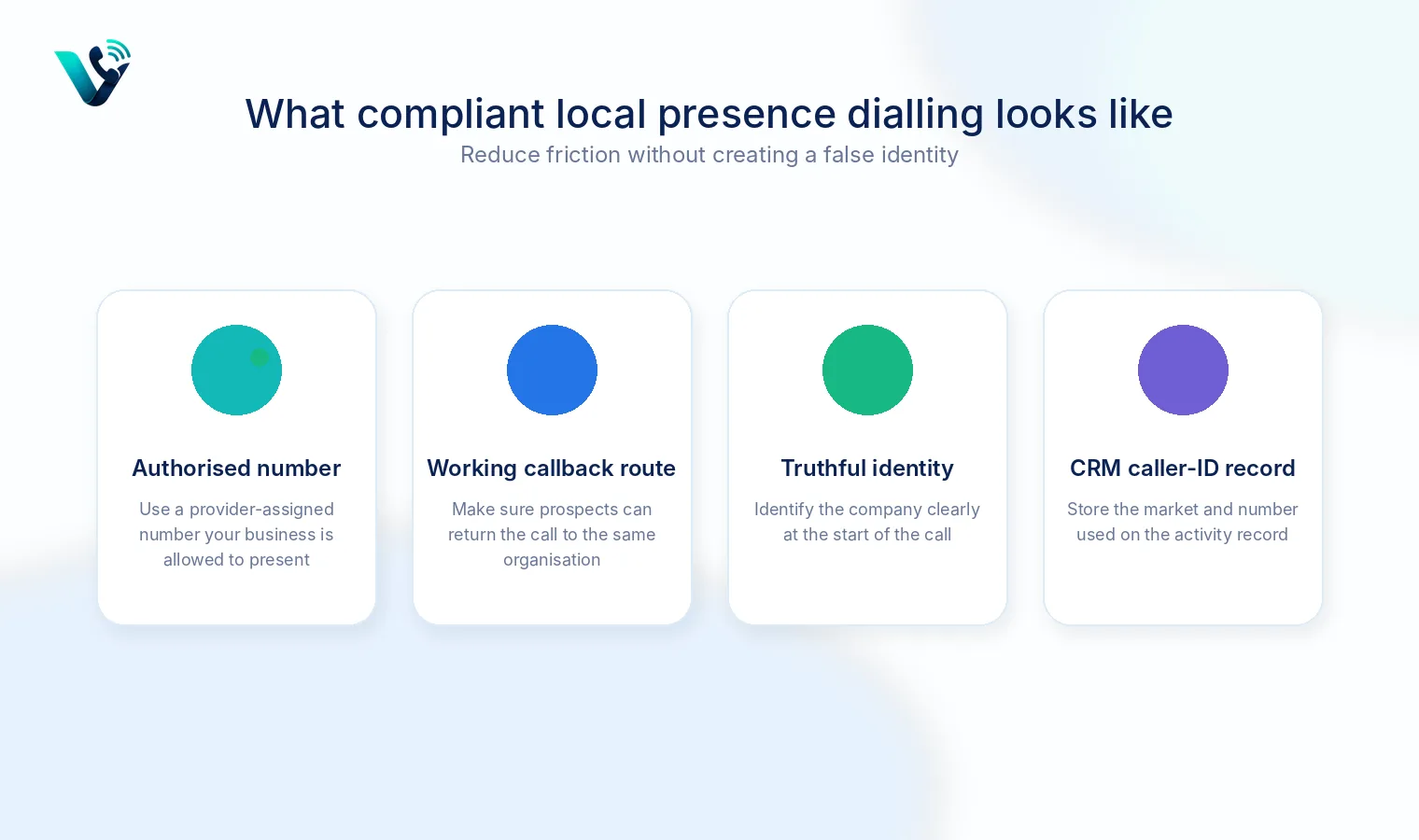
A clean local presence dialling setup starts with number ownership and purpose. The business obtains a real local, national or toll-free number through an approved provider, verifies any market-specific documentation, and configures that number as an outbound identity only where the provider and local rules allow it. The number should lead back to the same organisation when a prospect returns the call. If the route changes by time of day, the greeting, queue or voicemail should still make the business identity clear.
Local presence is strongest when it reduces friction without inventing a location story. A company can serve a market remotely and still offer a local contact route, but it should not imply a staffed physical office that does not exist. This is especially important in countries where geographic numbers have eligibility or address requirements. Votelly's own guidance for Japan and South Korea makes the same operational point: Treat local number eligibility as a condition to satisfy, not something to bypass.
-
Use a provider-assigned number that your organisation is permitted to present.
-
Make sure the number can receive return calls or routes to a clear business callback path.
-
Identify the company truthfully at the start of the call.
-
Store the market and caller ID used on the CRM activity record.
-
Retire or quarantine numbers that develop reputation or deliverability problems instead of rotating identities deceptively.
The line you should not cross: Familiarity cannot become deception
The temptation behind aggressive local presence dialling is easy to understand: If local numbers get answered more often, why not display any nearby number that looks familiar? Because the moment the number is not genuinely assigned, authorised or accurately connected to the caller, the strategy stops being local presence and starts resembling spoofing. Even where a particular caller ID substitution can be technically or legally permitted, the safe operating rule is to use only verified numbers under the business's control and avoid any identity that could falsely suggest a specific person, government body, bank, hospital or unrelated local organisation.
There is also a reputational problem. Consumers have been trained to distrust unexpected local numbers because scammers have used "neighbour spoofing" and other caller ID tricks for years. A sales team that looks deceptive may increase short-term pickup while destroying long-term trust. The better goal is not simply to look local. It is to look recognisable, reachable and consistent across calls, website details, voicemail and follow-up email.
Local caller ID does not replace do-not-call screening
Number presentation is only one layer of compliant outbound calling. Before a live sales campaign starts, the team needs a documented process for who may be called. In the United States, covered telemarketers need to account for the National Do Not Call Registry and their own company-specific do-not-call requests. In the UK, ICO guidance says live marketing callers should screen against the TPS or CTPS where applicable, respect previous objections, identify the organisation and display a contact number. Australia maintains its own Do Not Call Register and telemarketing standards, including calling-time restrictions.
For an international sales team, this means the CRM cannot treat "has phone number" as equivalent to "eligible to call". Eligibility should be a separate state. Store the prospect's market, source, relevant consent or preference status, internal suppression status and any previous objection. Then apply the correct audience rule before the dialler loads the record.
Build a market policy before you build a campaign
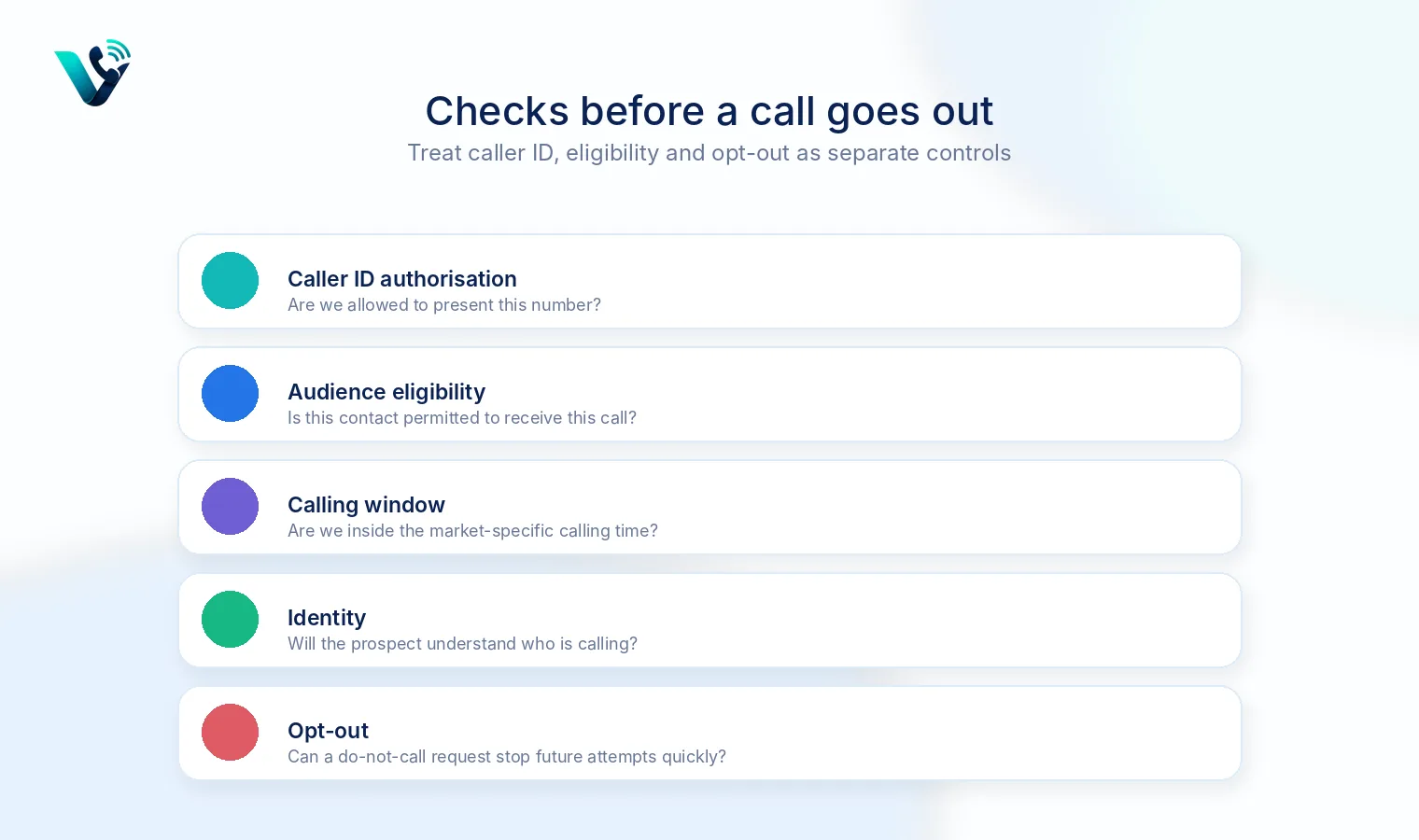
A scalable local presence dialling programme needs a market policy that sales, RevOps and compliance can all understand. Start with the countries you actually call, not a theoretical global matrix. For each market, document the permitted caller ID types, local-number eligibility, do-not-call or preference screening, allowed calling windows, required disclosures and the process for an opt-out. Link the policy to the provider configuration so a rep cannot accidentally use an unapproved number for the wrong region.
Control |
Question before launch |
CRM or dialler evidence |
|
Caller ID authorisation |
Are we allowed to present this number for outbound calls? |
Number ID, provider, market, approval status |
|
Audience eligibility |
Is this contact permitted to receive this type of call? |
Consent/preference field, suppression check |
|
Calling window |
Are we calling inside the market-specific window? |
Prospect timezone, local-time scheduler |
|
Identity |
Will the prospect understand who is calling? |
Rep/company name, callback route |
|
Opt-out |
Can a "do not call" request stop future attempts quickly? |
Disposition plus suppression timestamp |
Treat opt-outs as a system event, not a rep note
One of the most common operational failures is recording an opt-out as free text. A rep writes "do not call" in notes, but the number stays active in another sequence, another territory list or a new imported file. A compliant workflow needs suppression to be durable. The prospect's request should create a structured do-not-call status that is checked before every future campaign, even if the contact is imported again.
The same idea applies to number changes and ownership. If a prospect says the number belongs to somebody else, mark the phone data as invalid or reassigned. Do not keep redialling because the contact record still has commercial value. Local presence dialling works only when data quality and preference handling are part of the same system.
Protect caller ID reputation as an operating asset
Compliance is the floor, not the entire job. Carriers and call-screening services also use behavioural signals to decide whether calls look suspicious. A newly activated local number that suddenly produces a high volume of short unanswered attempts, complaints or rapid retries can develop a poor reputation even if the business owns it. Sales operations should monitor answer rate, spam labels, complaint volume, opt-out rate, short-duration calls and return-call behaviour by number.
Avoid the instinct to solve reputation problems by constantly rotating numbers. That can make the pattern look more suspicious and weakens continuity for prospects who want to call back. A better approach is controlled traffic, accurate audience data, reasonable cadence rules, clear identification and stable numbers that the business can support.
A practical local presence dialling launch checklist
- Confirm the exact markets and audience types for the campaign.
- Obtain only eligible, provider-approved local numbers and keep verification documents with the account record.
- Map each market to its approved outbound caller ID and local-time calling window.
- Screen contact lists against applicable preference registers and the company suppression list.
- Make company identity clear in the opening and keep a working callback route on every displayed number.
- Create structured dispositions for opt-out, wrong number, callback requested, not interested and qualified.
- Sync call identity, outcome and suppression status into the CRM automatically.
- Test return calls, voicemail, after-hours behaviour and number presentation before scaling.
- Review complaint and spam-label signals weekly during the first month.
- Get jurisdiction-specific legal advice when the campaign, audience or number type creates uncertainty.
Try this on your own numbers
Local numbers in 118 countries, AI call notes and one shared inbox. Live the same day, no contract.
Audit evidence matters when the campaign scales
A compliant outbound policy should produce evidence that can be reviewed later. Keep the provider number inventory, market eligibility documents, calling-window logic, suppression process and training material together. The CRM should show which rep called, which business number was presented, the contact status at the time and the final outcome. If a complaint arrives, operations should be able to reconstruct the path without searching through personal spreadsheets.
Auditability also helps when a campaign changes owners. A new manager can see why a particular local number exists, which audience it is approved for and when it should be retired. This reduces the risk that an old number is reused in a market or campaign it was never configured to support.
How to apply this with Votelly
Votelly positions local presence dialling alongside virtual numbers, power dialling and automatic call logging. For a compliant workflow, the important design is to connect those capabilities rather than use them independently. The approved local number should be tied to a market, the dialler should call only eligible records, and the CRM log should preserve which number was displayed and what happened on the call.
Use www.votelly.com as the product starting point and review the number requirements for each market before launch. Review it before every campaign.
Frequently asked questions
- What is local presence dialling?
- Local presence dialling uses an authorised local or in-market business number as outbound caller ID when contacting prospects in that market. The number should be legitimately assigned and connected to the business.
- Is local presence dialling the same as caller ID spoofing?
- No, local presence can be legitimate when the caller is authorised to use the displayed number. Spoofing involves manipulated or inaccurate caller ID; legal treatment depends on jurisdiction and intent.
- Does a local caller ID mean I can call anyone?
- No. Do-not-call, consent, objection, calling-hour and sector-specific rules can still apply. Audience eligibility should be checked separately from caller ID.
- Should the local number accept return calls?
- Yes, as a strong operational practice. A working callback route improves trust and lets prospects verify the organisation that contacted them.
- How should opt-outs be stored?
- Use a structured suppression or do-not-call field that is checked before future campaigns. Do not rely only on notes or a rep remembering the request.
- How can Votelly fit into local presence dialling?
- Votelly can provide the cloud calling layer where its live product supports the required number and dialling workflow. Confirm market eligibility and configure CRM logging and suppression around the approved numbers.