Routing Inbound Leads to the Right Rep in Under 10 Seconds
By Jamila Parker · · 8 min read

A practical inbound lead routing workflow that assigns high-intent enquiries by territory, ownership, product and availability in seconds without duplicate follow-up.
Key takeaways
- Fast routing begins with clean fields and a small set of deterministic rules.
- Ownership, territory, product and availability should not conflict silently.
- Every routing rule needs a fallback when the preferred rep is unavailable.
- Routing speed is not useful if two reps contact the same lead.
- Measure assignment latency separately from human response time.
What inbound lead routing is?
Inbound lead routing is the logic that decides who owns a new enquiry after it enters the business. The lead may come from a form, call, chat, campaign, marketplace, partner or another source. Routing translates the data on that enquiry into one clear owner or queue.
The under-10-seconds target is an operational design goal rather than a universal industry requirement. Modern systems can make a routing decision very quickly when the necessary fields already exist and the rules are deterministic. The harder part is making the decision accurate, visible and resilient when the preferred rep is unavailable.
Fast inbound lead routing supports speed to lead because it removes the period where a lead exists but nobody knows who should act on it.
Start with the minimum fields the router needs
Routing becomes slow and fragile when the system depends on fields that are missing, inconsistent or filled manually. Identify the smallest set of reliable inputs that change ownership.
- Account or email domain for named-account ownership.
- Country, region or postcode for territory.
- Product or enquiry type.
- Language where it changes the responsible team.
- Existing customer or open-opportunity status.
- Lead source or campaign where a specialist team handles it.
- Rep availability or shift where real-time response matters.
Every field used in a routing rule should have a defined source and fallback. If the region is blank, what happens? If the email domain matches an existing account but the owner is inactive, who receives the lead? Designing those answers upfront keeps routing from stopping on exceptions.
Use a clear rule hierarchy
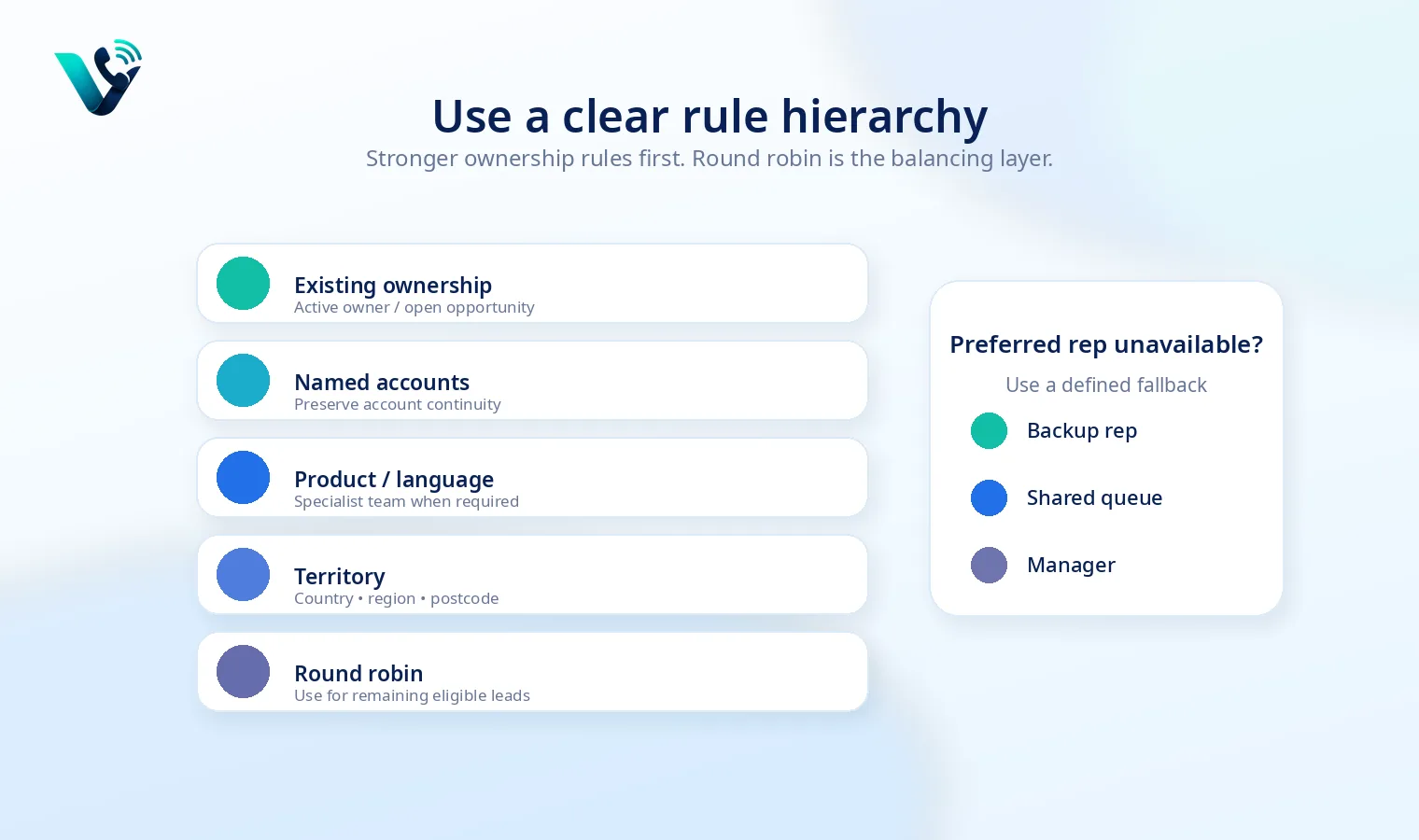
Rules can conflict. A lead may be in one territory, linked to an account owned by another rep and requesting a product handled by a specialist team. Decide which rule wins before launch.
A common hierarchy starts with existing ownership: If the person or company already has an active owner or opportunity, preserve continuity. Next may come named accounts, then specialised product teams, then territory, then round robin. The correct order depends on the business.
Document the hierarchy in plain language. If a sales manager cannot explain why a lead routed to a particular rep, the automation is too opaque.
Named-account ownership should usually beat round robin
When the business already has a relationship with the company, sending a new enquiry to a random rep can create duplicate conversations and internal conflict. Check for existing accounts, contacts and open opportunities before treating the record as a brand-new lead.
This matching must be careful. Email domains can be useful but not perfect, especially for large groups, subsidiaries and personal email addresses. Use the strongest identifiers available and allow an exception workflow for uncertain matches.
If an existing owner is unavailable for an extended period, the routing policy should specify whether the lead goes to a backup, team queue or manager rather than remaining untouched.
Territory routing needs a fallback
Territory rules can be simple by country or complex by postcode, account size and segment. The fastest system uses a clean mapping table and avoids ambiguous overlaps.
Every territory needs a default owner or queue. If a new region appears that is not in the map, the router should not fail silently. Put unknown territories into a visible exception queue with an SLA for review.
Territory changes should be versioned and communicated. A lead routed correctly under yesterday’s map can look wrong tomorrow if nobody knows the territory assignments changed.
Product and language routing should be explicit
If different reps or teams handle different products, use a structured product field from the form or source rather than asking a manager to interpret free text. The same applies to language where it changes the service team.
Do not create specialist routes for every minor variation. Complexity increases exception rates. Use a specialist rule only when it materially changes who can handle the enquiry.
When the prospect selects the wrong product or language, the receiving rep should be able to reassign without losing the original response-time history.
Round robin is the final balancing layer
Round robin works well when several reps are equally qualified and the business wants even distribution. It should usually operate after stronger ownership rules have been checked.
The distribution should consider availability if fast response is the goal. Assigning a lead to the next person in sequence even though they are off shift produces fair allocation on paper and slow customer response in practice.
Weighted round robin can be useful when reps have different capacity, but keep the logic transparent. If nobody can explain why one rep receives twice as many leads, the rule will create distrust.
Availability and shift awareness make routing real-time
An inbound lead router should know whether the preferred owner can respond. Availability can come from schedules, presence states, calendar blocks or team shifts depending on the system.
The fallback may be immediate for very high-intent leads or delayed for named accounts where continuity matters more. Define that policy by lead type rather than creating one rule for every source.
The objective is not to steal leads from owners. It is to avoid situations where the automation assigns perfectly and the customer still waits because the person is unavailable.
Prevent duplicate outreach
Fast routing can create duplicate follow-up when the same person submits several forms, calls after submitting a form, or exists in more than one campaign. Deduplication should happen before new ownership or sequence enrolment where possible.
Check recent activity, open opportunities and active sequences. If a lead is already being worked, update the existing record and alert the owner instead of creating another independent task.
Duplicate prevention is part of the customer experience. Two reps calling within minutes can make a fast sales team look disorganised.
A sub-10-second routing flow
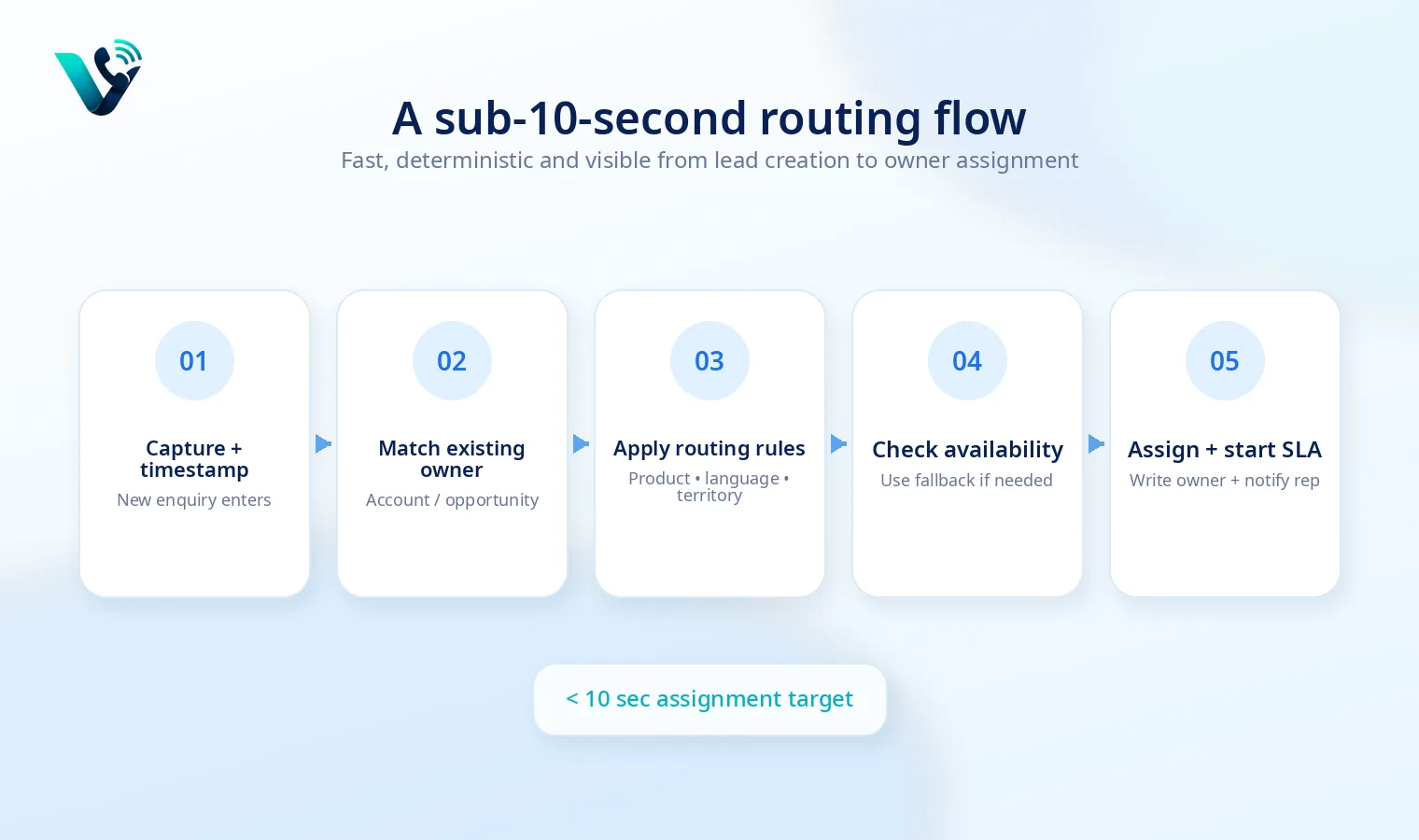
- Receive the event and timestamp it.
- Normalise essential fields such as email, phone, country and product.
- Match against existing contacts, accounts and open opportunities.
- Apply named-account and ownership rules.
- Apply specialist product, language or segment rules.
- Apply territory rules.
- Use round robin or a shared queue for the remaining eligible leads.
- Check availability and apply the defined fallback.
- Write the owner to CRM, notify them and start the response SLA.
When these steps are implemented as system rules rather than manual decisions, the assignment itself can happen quickly. The team should measure each step so it knows whether the ten-second target is being missed by data processing, matching or a slow integration.
Measure assignment time and response time separately
Assignment latency is the time from lead creation to owner assignment. Speed to lead is the time from enquiry to meaningful response. They are related but not the same.
- Median assignment latency.
- Percentage assigned within 10 seconds.
- Exception-queue volume.
- Reassignment rate.
- Median human response time after assignment.
- Duplicate-contact incidents.
- Qualified outcome by routing path.
A router can be technically fast and commercially weak if it assigns to the wrong people. Quality and speed must be reviewed together.
Keep the routing map maintainable
Assign an owner to the routing logic itself. Territory changes, staff turnover, new products and new lead sources will otherwise create outdated rules.
Use a test set before every major change: existing customer, named account, unknown territory, off-shift rep, duplicate lead and a normal round-robin lead. Confirm where each record goes before publishing the new map.
The best inbound lead routing system is not the most complex. It is the one that makes a fast, explainable decision and has a visible path for exceptions.
Try this on your own numbers
Local numbers in 118 countries, AI call notes and one shared inbox. Live the same day, no contract.
Design the exception queue before launch
Every routing map eventually receives a lead it cannot classify cleanly. The country is missing, the account owner is inactive, the product field contains a new value or the company cannot be matched confidently. Those records need a deliberate destination.
Create one visible exception queue with a short review SLA and an owner responsible for fixing the underlying data or rule. Do not let unclassified leads disappear into an admin inbox that nobody checks.
Track the reasons leads enter the exception queue. If one source creates the same problem repeatedly, fix the form, integration or mapping upstream. A good inbound lead routing system becomes faster over time because exceptions teach the team where the rules need improvement.
Use routing data to improve capacity planning
Routing reports can show where the organisation is under-covered. If one territory constantly triggers fallbacks, the problem may be staffing rather than logic. If a specialist product queue receives very few leads, the team may not need a dedicated route.
Compare lead volume, response time and qualified outcomes by route. That helps sales operations decide whether to change capacity, territory design or the routing hierarchy itself.
The routing engine should therefore be treated as an operational dataset, not just an automation. It shows how demand actually reaches the sales team.
Frequently asked questions
- What is inbound lead routing?
- It is the process of assigning a new inbound enquiry to the correct rep or team based on rules such as ownership, territory, product, language and availability.
- Can lead routing happen in under 10 seconds?
- Yes, when the required fields are available and the assignment is automated. The exact speed depends on integrations and processing.
- What routing rule should come first?
- Existing ownership or active opportunities often deserve priority, followed by the business’s named-account, specialist, territory and balancing rules.
- Should round robin be the default?
- It is useful as a final balancing layer when several reps are equally qualified, but it should not overwrite stronger ownership or specialist rules.
- How do I handle an unavailable owner?
- Define a fallback by lead type: Backup rep, shared queue, manager or delayed reassignment depending on the need for continuity and response speed.
- What should I measure?
- Measure assignment latency, response time, exception volume, reassignments, duplicate outreach and qualified outcomes by route.