List hygiene: why bad data costs more than bad reps
By Jamila Parker · · 9 min read

Bad sales data wastes dials, pollutes CRM reporting and makes good reps look weak. Build a list hygiene process for phone numbers, duplicates, ownership, suppressions and stale records.
Key takeaways
- List hygiene should happen before records reach a rep, not after a week of failed calls reveals the database is weak.
- Invalid numbers, duplicates, stale job titles and missing ownership create both productivity loss and misleading sales performance data.
- Suppression data is part of list quality: An accurate phone number is still unusable if the contact should not be called.
- Measure list quality by connectability and decision usefulness, not by the number of rows in the database.
- Create a repeatable hygiene pipeline for validation, deduplication, enrichment, segmentation, ownership and ongoing decay checks.
List hygiene is the unglamorous sales operation that decides whether every other outbound metric can be trusted. A rep can have a strong opener, solid discovery skills and excellent objection handling, but none of that matters when the phone number belongs to a former employee, the same contact appears three times, the territory owner is wrong or the record should have been suppressed. Bad data turns sales effort into noise.
The cost is larger than a few failed dials. Dirty data distorts connect rates, inflates activity counts, creates duplicate outreach and sends managers toward the wrong coaching conclusions. If one rep receives a clean list and another receives stale scraped contacts, comparing their meetings per dial is not a fair performance test. Salesforce's guidance on dirty CRM data makes the broader point that accurate, timely and accessible data is foundational to a strong sales programme. List hygiene converts that principle into an outbound workflow: Make the record usable before you ask a human to spend time on it.
Define a clean list by what a rep can do with it
A clean prospecting list is not simply a spreadsheet with no blank cells. It is a set of records that can support a confident next action. For calling, that means the contact is the right person or role, the number is plausibly current, the company fits the intended segment, the market is known, ownership is clear, and any contact restrictions are visible.
This definition changes list hygiene from cosmetic cleanup into sales readiness. A record with perfect formatting but the wrong person is not clean. A record with a verified direct dial but an active do-not-call request is not clean for outbound. A contact with the right role and number but no assigned territory owner will still create operational conflict.
Bad phone data has a compounding cost
Every invalid phone number creates more than one wasted moment. The rep spends time dialling, waiting, dispositioning and often trying again later because the first result is ambiguous. If the number belongs to somebody else, the rep may add a note, search for a replacement and interrupt another person who never belonged in the campaign. Multiply that across thousands of records and data quality becomes a capacity problem.
Bad phone data also weakens automatic systems. A power dialler can move through records faster, but speed magnifies poor inputs. If 15 percent of a list is unusable, automation simply reaches those unusable records more efficiently. List hygiene has to move upstream of the dialler so higher call volume produces more real conversations rather than more wrong numbers.
The five failure types to clean first
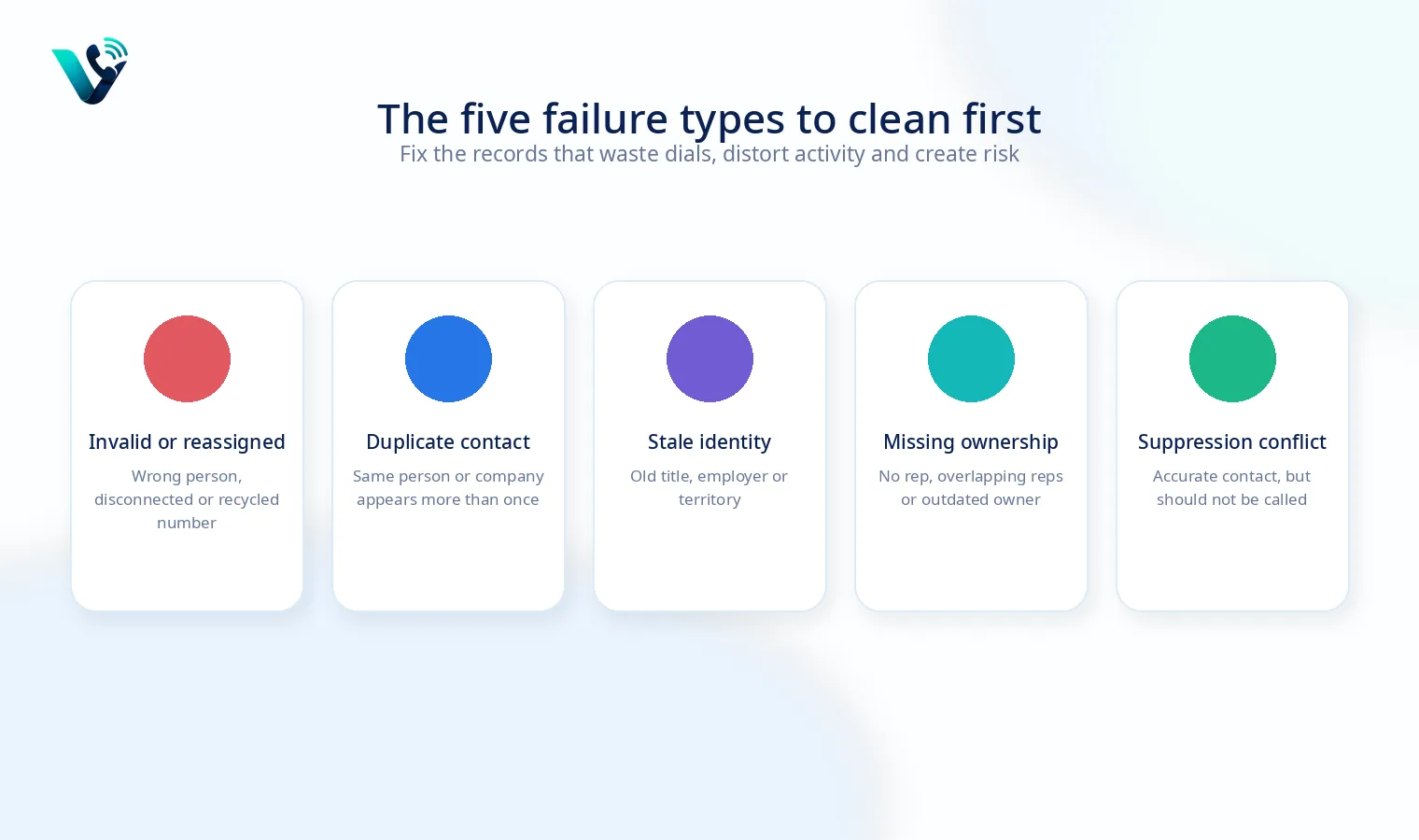
Failure type |
What it looks like |
Why it matters |
|
Invalid or reassigned number |
Disconnected, wrong person, recycled number |
Wastes attempts and can create complaints |
|
Duplicate contact |
Same person or company appears more than once |
Creates repeated outreach and distorted activity |
|
Stale identity |
Old title, employer or territory |
Targets the wrong role and breaks routing |
|
Missing ownership |
No rep, overlapping reps or outdated account owner |
Creates delays and duplicate follow-up |
|
Suppression conflict |
Contact is accurate but should not be called |
Creates compliance and trust risk |
These categories should be visible in the CRM as structured states, not buried in notes. A rep who discovers a wrong number should be able to mark it invalid. An ops process can then queue the record for enrichment rather than allowing another campaign to call the same number next week.
Deduplication is a revenue workflow, not a database chore
Duplicates often enter through normal growth: Event lists, form fills, purchased data, partner referrals, manual imports and multiple enrichment vendors. The difficult duplicates are not exact copies. One record may use a personal email and another a company email. One company name may include "Ltd" while another does not. The same person may appear under an old and new job title.
A good deduplication policy needs a match hierarchy. Start with strong identifiers such as verified email or phone, then use company-domain and name matching with review rules for uncertain cases. When records merge, preserve activity history, opt-outs, ownership notes and attribution. The point is not only to reduce row count; it is to create one reliable customer timeline.
Treat job changes and company changes as data decay
B2B data decays continuously because people move roles, companies merge, offices close and responsibilities change. List hygiene therefore cannot be a quarterly clean-up project only. Build decay detection into the workflow. Repeated hard bounces, wrong-person dispositions, failed calls and LinkedIn or enrichment signals can move a record into a review state.
Do not automatically overwrite history when enrichment finds a new role. Preserve the old relationship and create the correct new contact or employment state. A former champion moving to another company can become a future opportunity, while the old account still needs a new stakeholder. Good data hygiene protects both stories.
Suppression is part of data quality
Sales teams sometimes treat compliance data as separate from list hygiene, but from a rep's perspective the distinction is artificial. A record is not usable if the person asked not to be called. Keep a durable suppression list that survives imports, merges and vendor refreshes. The system should screen the contact before the dialler makes it available.
Suppression should include more than formal do-not-call requests when the business needs it. Wrong numbers, deceased contacts, legal restrictions, customer-only service numbers, open disputes or market-specific exclusions may all justify a block from a particular campaign. Define the categories clearly so the same record can still be used appropriately for non-marketing service contact where lawful and necessary.
Build a list hygiene pipeline instead of a cleanup day
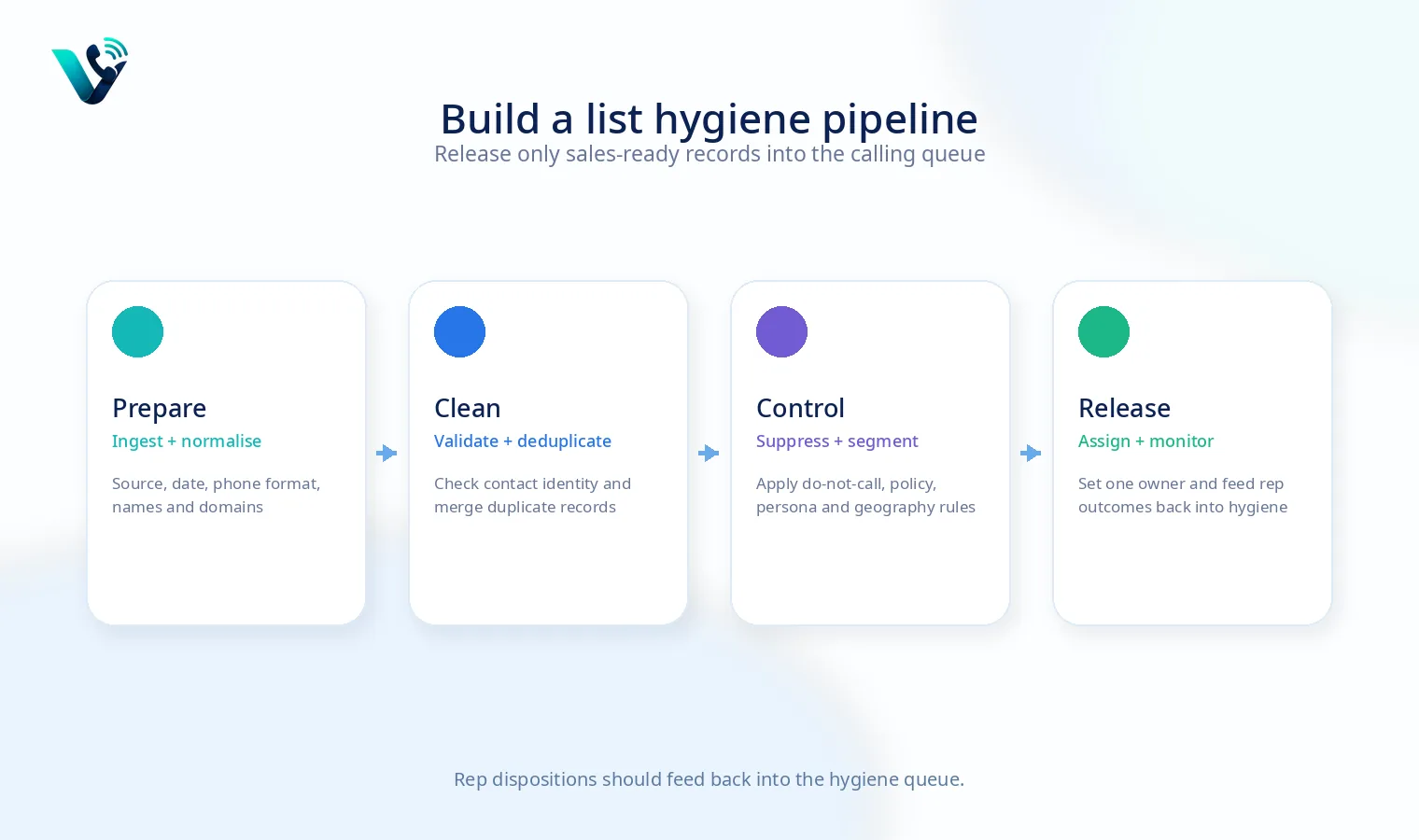
A scalable process can be designed as a pipeline. First, ingest the source with a source label and timestamp. Second, normalise names, phone formats and company domains. Third, validate or enrich the contact fields that matter for the campaign. Fourth, deduplicate against the CRM. Fifth, apply suppression and market rules. Sixth, assign territory and owner. Finally, release only sales-ready records into the calling queue.
- Ingest: Preserve source, import date and campaign origin.
- Normalise: Standardise country codes, phone formats, names and domains.
- Validate: Check whether the number and business identity are still plausible.
- Deduplicate: Merge or link records without losing activity history.
- Suppress: Apply do-not-call, wrong-number and policy exclusions.
- Segment: Apply industry, persona, geography and account-fit rules.
- Assign: Set a single owner and next action.
- Monitor: Feed rep dispositions back into the hygiene queue.
Score list quality before you score rep performance
A manager should know the quality of the list before using outbound metrics to judge the rep. Create a list-quality dashboard beside the sales dashboard. Useful measures include percentage of records with a valid phone, wrong-number rate, duplicate rate, stale-title rate, percentage with a clear owner, suppression rate and intended-person connect rate.
Compare these metrics by source. If one data vendor produces twice the wrong-number rate of another, that is an acquisition problem. If one event list has high connection but low fit, the issue is segmentation. If all sources degrade after six months, the business needs a refresh policy. The purpose of list hygiene reporting is to identify where waste enters the system.
The hidden cost of letting reps repair data manually
Reps will fix data when they have no alternative, but using sellers as the primary cleansing layer is expensive. They stop between calls to search LinkedIn, copy phone numbers, update job titles and decide whether two records are duplicates. Some corrections are valuable because the rep has fresh context, but the routine work should flow to an automated or operations process.
Salesforce's 2026 State of Sales material highlights manual data entry as a continuing drag on selling time. List hygiene should remove that tax before outreach and capture rep-discovered changes with one quick disposition. The rep contributes the signal; the system or ops team handles the repair.
A monthly list hygiene operating rhythm
Week one is intake control: Audit every new source and confirm field mappings before imports. Week two is decay control: Review wrong-number and stale-contact dispositions from active calling. Week three is duplicate and ownership control: Resolve conflicting records and territory gaps. Week four is source review: Compare vendors, campaigns and event lists by valid-number rate, connect rate and fit.
This rhythm keeps list hygiene close to revenue work. Sales operations does not need to scrub the entire database every month. It needs to prioritise the records entering active outreach and the failure signals being generated by reps. The highest-value correction is the one that prevents the next wasted call.
Try this on your own numbers
Local numbers in 118 countries, AI call notes and one shared inbox. Live the same day, no contract.
Operational note for sales leaders
Treat this workflow as a system that should be reviewed with real call outcomes. Document the starting point, change one important variable at a time, and keep the definitions stable long enough to compare results. That discipline prevents teams from mistaking extra activity for genuine improvement.
Managers should also collect qualitative feedback from reps. The people using the process every day will notice friction that a dashboard cannot show. Combine that feedback with outcome data before deciding whether to add more automation, more fields or more steps.
How to apply list hygiene with Votelly
Votelly can sit at the point where list quality becomes visible. Wrong numbers, no answers, connected calls, dispositions and call outcomes create fresh evidence about the database. Where CRM sync and automatic logging are configured, those outcomes should flow back to the record so the next campaign starts with better data than the previous one.
Use www.votelly.com as the product starting point, and connect the calling workflow to a CRM data policy.
Frequently asked questions
- What is list hygiene in sales?
- List hygiene is the process of keeping prospect data accurate, deduplicated, current, correctly owned and eligible for outreach before it enters sales sequences or dialling queues.
- How often should a prospect list be cleaned?
- Continuously for high-volume outbound teams. Use pre-import checks plus ongoing triggers from wrong numbers, hard bounces, job changes, duplicate detection and suppression updates.
- What data should be validated before cold calling?
- At minimum: Contact identity, phone number, company, role or persona, market/timezone, owner, source and any do-not-call or suppression status relevant to the campaign.
- Are duplicates really harmful if the CRM can store them?
- Yes, duplicates create repeated outreach, conflicting ownership, split activity history and misleading reporting. Merge or link them while preserving important historical data.
- How does list hygiene affect connect rate?
- Cleaner phone data reduces failed and wrong-number attempts, so a larger share of dials can reach valid prospects. Targeting quality still determines whether those connects are commercially useful.
- How can Votelly support list hygiene?
- Votelly can provide call outcomes and activity history that feed data-quality signals back into the CRM. Use those dispositions to flag wrong numbers, stale contacts and records needing review.