Following up without becoming the number they block
By Jamila Parker · · 8 min read

Persistent follow-up can create pipeline or create irritation. Learn how to space sales calls, add value, recognise stop signals and build a follow-up cadence prospects do not want to block.
Key takeaways
- Following up should continue a buyer conversation, not repeat the same request at a higher frequency.
- Space calls based on context: A promised callback deserves precision, while cold outreach needs more breathing room.
- Change the reason for each touch by adding a useful insight, answer, example or next-step option instead of saying "just checking in".
- Stop immediately when a prospect asks not to be contacted, and treat repeated avoidance or negative signals as a reason to slow or end the cadence.
- Measure contact quality, positive outcomes, opt-outs and blocks together so persistence does not look successful simply because activity is high.
Following up is where good sales discipline and bad sales behaviour can look dangerously similar. Both involve another call after the first attempt. The difference is whether the new contact has a reason to exist. A useful follow-up makes it easier for the prospect to decide, supplies missing information or arrives when the buyer asked for it. An irritating follow-up repeats the same pitch, ignores a clear signal, calls again too quickly or treats silence as permission to escalate frequency.
The goal is not to find the maximum number of touches a prospect will tolerate. It is to create a sequence in which each call earns the right to the next one. Research supports coordinated, multi-channel outreach rather than raw call volume alone. Gong's cadence guidance emphasises that touchpoints should change in purpose across the sequence and that teams should know when to cut their losses. Cognism's 2026 outbound reporting also describes phone-led outreach working alongside email and LinkedIn rather than as a single-channel barrage. A respectful follow-up system uses that principle: Call when the phone is the best next action, switch channels when context is better delivered another way, and stop when the buyer's answer is already clear.
The first follow-up starts before the first call ends
The easiest follow-up call is the one the prospect expects. When a live conversation ends, agree on the next step while both people are still present. If the buyer asks for pricing on Thursday, confirm whether you should call Friday afternoon or Monday morning. If they want to involve a colleague, agree on who sends the invite and when. A specific commitment turns follow-up from interruption into fulfilment.
After the call, record the promise in the CRM with a due date and context. The rep should not need to reconstruct the conversation from memory three days later. A short note such as "send security overview, call Tuesday 10:00 local time, buyer wants procurement questions answered" is more useful than a generic task called "follow up".
Cold follow-up needs spacing, not pressure
Cold outreach is different because there is no existing promise. The prospect may be busy, may not recognise the number or may simply not have a reason to respond yet. Calling repeatedly in a tight window increases the chance that the number feels intrusive. Space attempts across different days and, where lawful, different contact windows. Give the buyer enough time to notice the voicemail or email before another call arrives.
A practical cadence changes the job of each touch. The first call can establish relevance. A voicemail can make the number less anonymous. An email can provide the one proof point that is awkward to explain in a voicemail. A later call can reference the business problem, not the absence of a reply. By changing the purpose, following up feels like a sequence of useful signals rather than the same request repeated.
Use a reason-to-call ladder
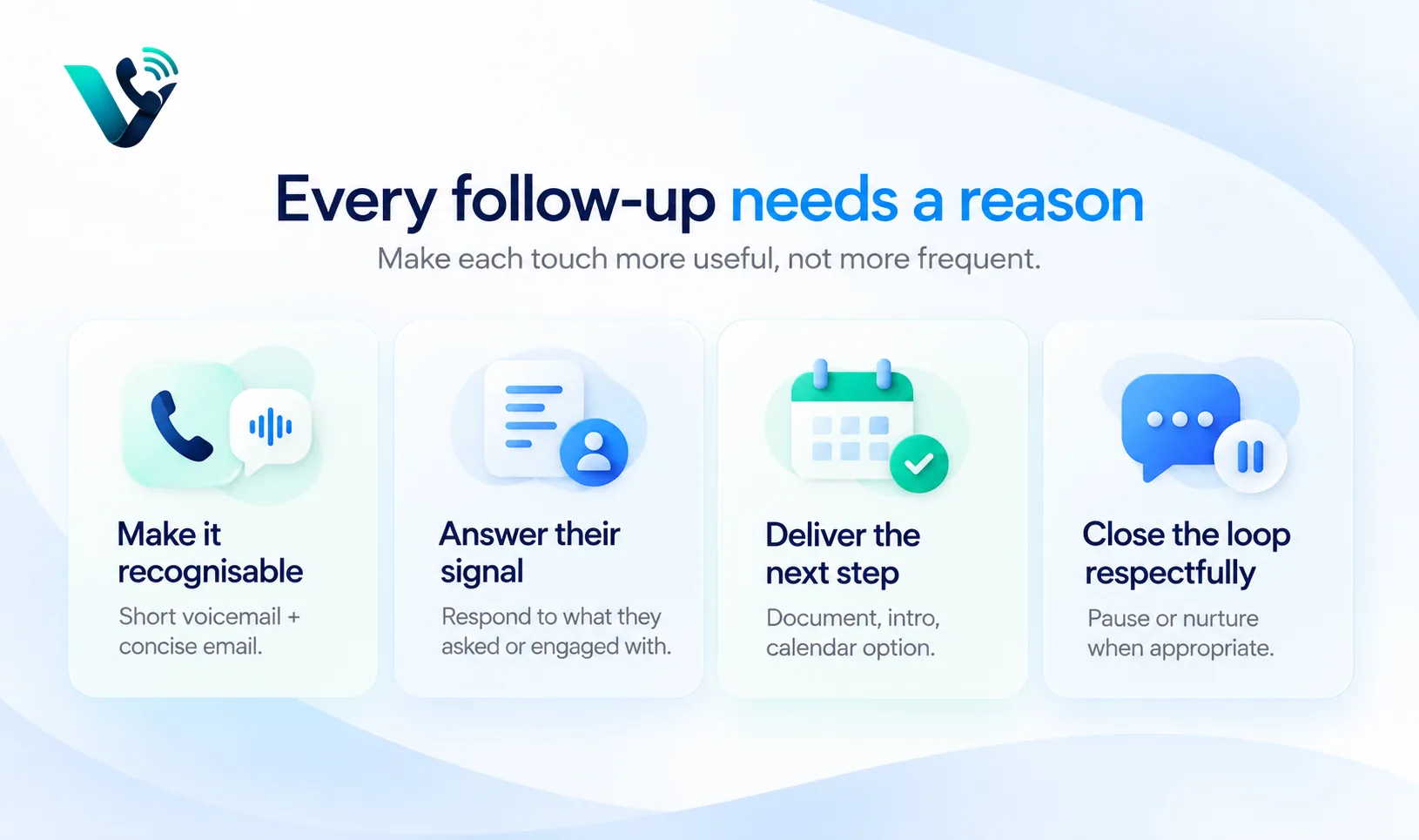
Before every follow-up call, the rep should be able to finish the sentence: "I am calling again because..." If the only answer is "they did not reply", the contact probably needs a better reason. Build a reason-to-call ladder that becomes more useful as the cadence progresses.
Follow-up stage |
Reason to contact |
Useful addition |
|
After first attempt |
Make the outreach recognisable |
Short voicemail plus a concise email |
|
After engagement |
Answer the signal they gave |
Pricing detail, technical answer, relevant case example |
|
After live conversation |
Deliver the agreed next step |
Document, stakeholder intro, calendar option |
|
After delay |
Check whether timing changed |
Simple yes/No timing question |
|
Final touch |
Close the loop respectfully |
Permission to pause and reconnect later |
A reason-to-call ladder also prevents lazy messaging. "Just checking in" makes the rep's need the centre of the contact. "You mentioned your team is moving from three regional phone systems; I pulled together the migration questions that usually slow that project down" gives the buyer something concrete.
Read negative signals before the block happens
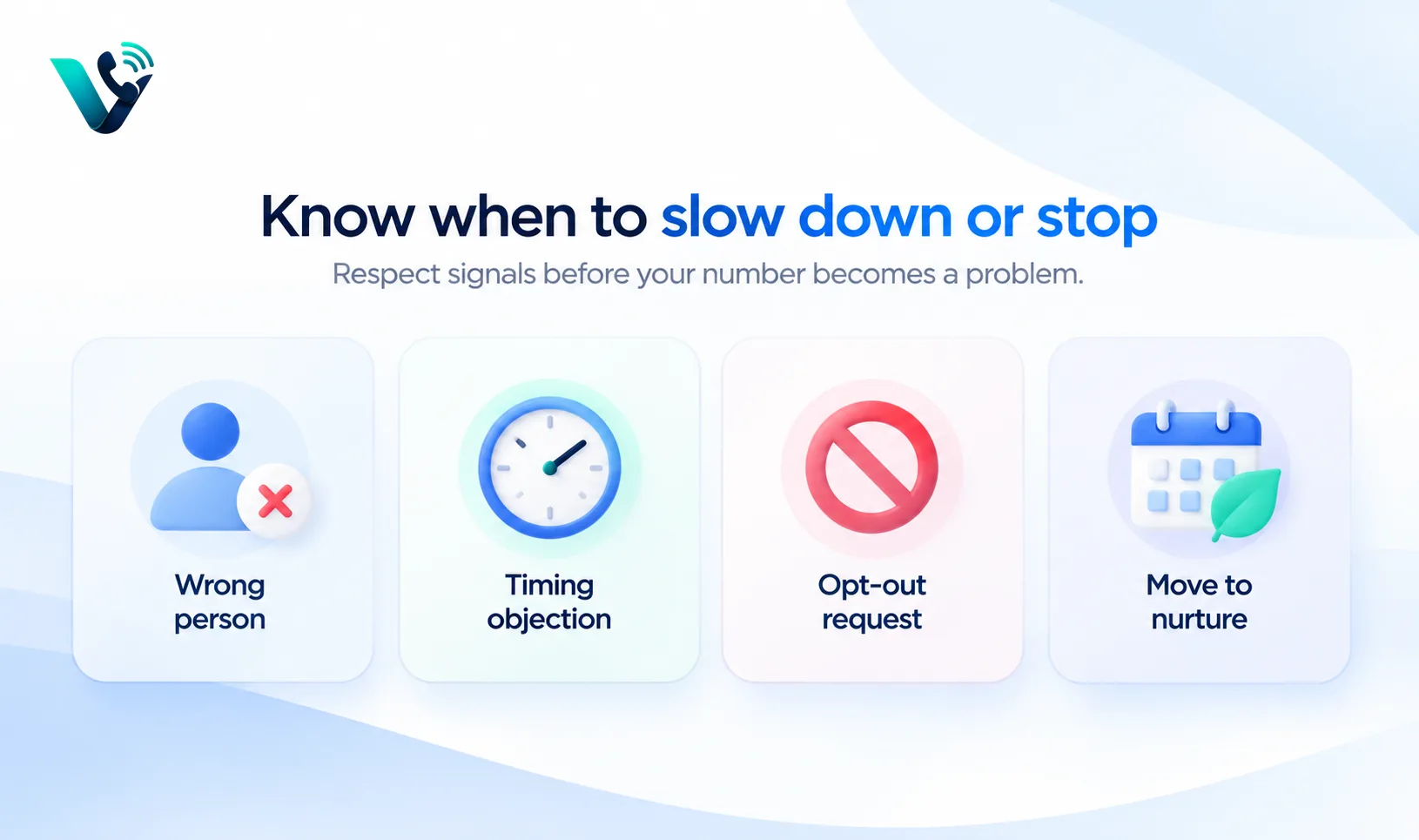
Prospects do not always say "stop calling" immediately. Some signals are softer: They answer and say they are not the right person, repeatedly decline without suggesting another time, send a terse reply, or tell the rep the timing is wrong. Those signals should change the cadence. A wrong-person response calls for a referral question or record correction, not another attempt to the same contact. A timing objection may justify a future date. A clear lack of interest should reduce or end outreach.
There is also a hard line. If a person asks not to be called, the sales workflow should suppress future calls rather than leave the decision to the next rep. In regulated markets, internal do-not-call handling is part of compliance, not just etiquette. The CRM should store the preference in a structured field that every sequence checks.
Do not use voicemail as a repeated mini-pitch
Voicemail can help a follow-up cadence because it makes an unfamiliar number identifiable and gives the prospect a reason to understand the next email or call. But repeating a 45-second pitch every time trains the buyer to delete the message. Keep most prospecting voicemails short. State who you are, why the call may be relevant and what the buyer can do next.
Gong's sales-engagement benchmark guidance notes that leaving voicemail can improve the likelihood of an email reply in its dataset. That is a good reason to coordinate channels, not a reason to leave a message on every attempt. Use voicemail when it adds recognition or context, then let later calls speak for themselves unless the reason has changed.
Match persistence to intent
Not every prospect deserves the same follow-up intensity. An inbound demo request, pricing-page lead or referral usually has stronger demonstrated intent than a completely cold account. The higher-intent contact can justify faster response and tighter follow-up because the buyer has already raised their hand. A cold account should be treated with more patience.
Create simple intent tiers in the CRM. High intent might include an inbound request, recent conversation or explicit callback. Medium intent can include meaningful engagement with content or a referral. Low intent can include a cold list with no response. The cadence can then control call spacing, channel mix and when the record exits active outreach.
Build a graceful exit into every cadence
A sales cadence should have an end condition before it begins. Without one, silence becomes an excuse for infinite follow-up. Define the number of attempts, the time span and the signals that stop the sequence. The final message does not need theatrics. It can simply say that you do not want to crowd the prospect, that you will pause outreach, and that they can reply or call if the timing changes.
Gong's cadence guidance explicitly recommends knowing when to cut losses and formalising the end of outreach. That is good pipeline hygiene too. A prospect who is not ready today can be moved to a future nurture date instead of staying in an active calling queue forever.
Measure whether following up is creating trust or friction
Activity metrics alone reward persistence even when the buyer experience is getting worse. Track attempts per prospect alongside connect rate, positive disposition rate, meetings booked, opt-outs, explicit complaints, wrong-number corrections and any number-block or spam-label signals you can observe. A cadence that lifts meetings while sharply increasing opt-outs may need a different audience or spacing rule.
Review the data by cadence stage. If the first three touches create almost all positive outcomes and touches seven through ten mostly create opt-outs, shorten the sequence. If voicemail followed by email produces more replies than repeated calling, shift the mix. The objective is not a universal number of follow-ups; it is a sequence whose later steps still justify their cost.
A simple 30-day follow-up experiment
Days 1-7: Establish the existing pattern. Record attempts per prospect, time between calls, connects, replies, positive dispositions, opt-outs and meetings. Do not change the cadence yet. The first week gives you a baseline for both performance and buyer friction.
Days 8-14: Change the reason for later touches. Replace generic check-ins with a relevant proof point, answer or timing question. Keep the total audience and first-touch message stable so you can see whether the later-stage quality changes outcomes.
Days 15-21: Test channel mix. For one segment, pair a call with voicemail and email; for another, use call plus email without voicemail. Compare replies and positive conversations, not only pickups. The point is to find which combination makes the phone call more recognisable.
Days 22-30: Shorten the cadence where later attempts create more opt-outs than value. Create a nurture date for accounts with plausible future timing. At the end of the month, keep the sequence that creates the most qualified next steps with the lowest unnecessary friction.
Try this on your own numbers
Local numbers in 118 countries, AI call notes and one shared inbox. Live the same day, no contract.
How Votelly can support a lower-friction follow-up workflow
Votelly's calling layer can support a structured follow-up process by keeping calls on a consistent business number, logging activity automatically where the live integration supports it, and giving reps a shared history instead of relying on personal phones. The phone system should make the agreed next action easier, not simply make it possible to place more calls.
Use www.votelly.com as the product starting point, then connect calling to CRM ownership, dispositions and suppression. The cleanest workflow is one where a rep can see the previous call, use the right number, record the outcome once and let the next task appear only when the prospect is still eligible for follow-up.
Frequently asked questions
- How many times should a salesperson follow up by phone?
- There is no universal number. Use a defined cadence, buyer intent and response signals. Stop immediately on an opt-out and end low-value sequences when later touches stop producing useful outcomes.
- How long should I wait before a follow-up call?
- If the buyer gave a specific callback time, follow it precisely. For cold outreach, space attempts across different days and local-time windows instead of calling repeatedly in a short period.
- What should I say instead of "just checking in"?
- Add a reason: Answer a question, share a relevant example, clarify a next step, or ask a simple timing question tied to the buyer's situation.
- Should I leave a voicemail every time?
- Usually no, use voicemail when it adds recognition or context. Repeating the same voicemail on every attempt can create noise without adding value.
- When should a sales cadence stop?
- Stop on an explicit opt-out, confirmed bad fit, wrong person with no referral path, or when the predefined cadence ends without a meaningful signal. Move future-interest accounts to nurture rather than endless calling.
- How can Votelly help with sales follow-up?
- Votelly can provide business calling, shared history and call logging where supported, while the CRM controls ownership, next actions and suppression. Confirm live integration behaviour for the exact workflow you plan to publish.