Territory calling across three continents from one office
By Jamila Parker · · 8 min read

One outbound team can cover North America, Europe and Asia-Pacific from a single office, but only with buyer-local scheduling, local number strategy, clean handoffs and market-specific compliance checks.
Key takeaways
- International territory calling should run on buyer local time, not the headquarters clock.
- Use separate territory queues, number identity and reporting so North America, Europe and APAC do not become one blended outbound campaign.
- Local virtual numbers can support market presence, but they should not imply a physical office that the business does not operate.
- Calling rules differ by market, so consent, suppression, caller identification and permitted calling times need market-specific review.
- A single office can cover three continents effectively when shifts, handoffs, CRM context and callback ownership are designed before launch.
International territory calling from one office sounds simple: Buy numbers in several markets, give the team a dialler and assign countries. In practice, the difficult part is not placing the call. It is coordinating time zones, buyer expectations, local number identity, staffing, compliance, CRM ownership and follow-up so customers experience a local, professional sales process even though the reps sit in one location.
A useful operating model separates North America, Europe and Asia-Pacific into distinct territories with their own calling windows, number strategy and performance data. The office can remain centralised while the customer experience adapts to each market. Votelly’s current website positions virtual numbers, browser-based calling, sales-team workflows and remote-team routing as parts of a global business-calling platform, which makes this topic a natural fit for the brand.
Design the territory around the buyer’s clock
The first rule of global sales calling is that the prospect’s local time matters more than the rep’s local time. A 10 a.m. calling block in Hong Kong reaches London before business hours and New York in the middle of the night. Build calling windows from the target market backwards, then decide whether the office needs staggered shifts, split territories or handoffs between reps.
Do not rely on one static timezone field. Daylight-saving changes can move the practical overlap by an hour, and not every country changes clocks on the same date. Store the prospect timezone or reliable geographic signal in the CRM, then let the calling workflow filter eligible records by local time. Review timezone logic before seasonal clock changes.
A three-continent day from one office
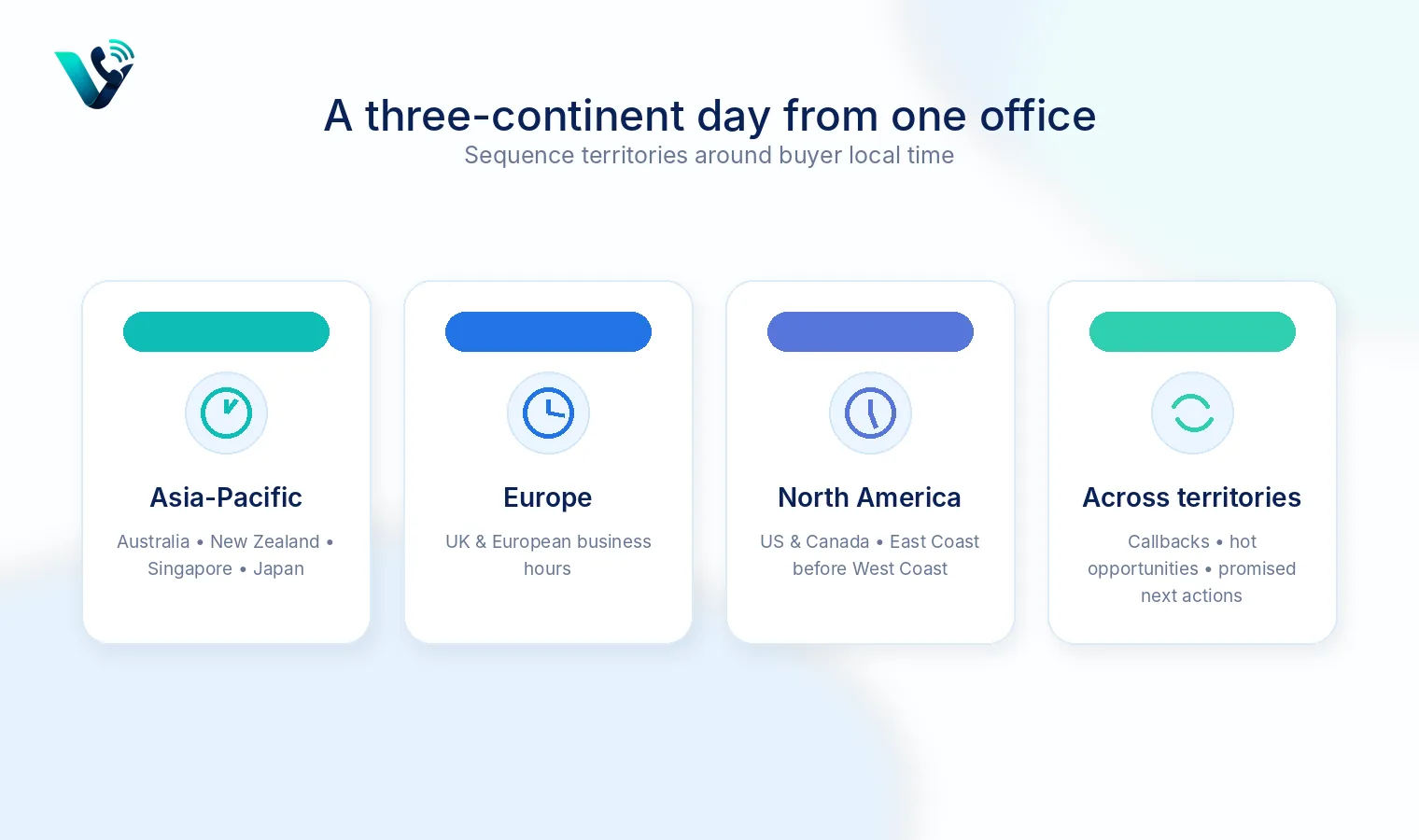
Office phase |
Primary territory |
Operational focus |
|
Early shift |
Asia-Pacific |
Australia, New Zealand, Singapore, Japan and nearby active markets |
|
Mid shift |
Europe |
UK and European business hours; scheduled callbacks and account follow-up |
|
Late shift |
North America |
US and Canada as local business hours open; prioritise East Coast before West Coast |
|
Handoff windows |
Across territories |
Transfer open callbacks, hot opportunities and promised next actions |
The table is a planning model, not a universal timetable. The exact hours depend on where the office is located. The important point is sequencing. Instead of asking one rep to call three continents randomly, group territories so the list, messaging and local-time logic remain stable for a meaningful block.
Use local number strategy carefully
Virtual phone numbers can give a business a local or market-relevant contact route even when the sales team works elsewhere. Votelly currently publishes virtual number coverage in 118 countries and positions local, national and toll-free numbers as part of its platform. For international territory calling, that can support recognisable caller identity, return calls and regional campaign tracking.
Local presence should not become a false-location claim. If the team does not operate an office in a country, do not present the local number as proof of a physical branch. Use accurate language: The company serves the market and provides a local contact number. Some markets also have documentation or local-presence requirements for certain number types, so confirm eligibility before building a campaign around a specific number.
Separate territory queues and ownership
Create a clear owner for each market, account or segment. When every rep can call every country, duplicates become more likely and follow-up gets messy. Territory rules can be geographic, account-based, language-based or a combination. The CRM should show who owns the next call, which number identity should be used and what happens when the primary owner is unavailable.
High-intent interactions need explicit handoff rules. If an APAC rep books a callback during a time they will be offline, decide whether they keep ownership and work a shifted hour or transfer the callback to another qualified rep. The customer should not have to repeat context because the company’s internal clock changed.
Build market-specific compliance into the workflow
International cold calling is not one legal category. Rules can differ by country, whether the number belongs to an individual or business, whether the call is live or automated, whether the contact has objected, the purpose of the call and other factors. The safest operating model stores suppression and permission context with the contact and uses market-specific review rather than assuming one country’s process works everywhere. This section is operational guidance, not legal advice.
North America example: United States
The US Federal Trade Commission’s Telemarketing Sales Rule regulates telemarketing and includes requirements around disclosures, calling times, caller ID, do-not-call requests and other practices. The FTC notes that most business-to-business solicitation calls are exempt from many TSR provisions, but important exceptions and other federal or state rules can still apply. A sales team should therefore classify the campaign correctly and obtain legal or compliance guidance rather than treating “B2B” as a blanket exemption.
Europe example: United Kingdom
The UK Information Commissioner’s Office publishes guidance on live direct marketing calls under PECR and specifically discusses when organisations can make live marketing calls to people and businesses, how objections should be handled and how bought-in or public data should be treated. The ICO notes that guidance is under review following legal changes, which is a useful reminder to re-check current rules before a new campaign rather than copying an old playbook.
Asia-Pacific example: Australia
Australia’s Do Not Call Register and telemarketing standards provide a clear example of why local-time logic and caller identification matter. Official guidance sets permitted telemarketing calling windows, requires identification information and expects a return-contact number. The register rules and exemptions depend on the number and situation. An overseas sales floor still needs to respect Australian requirements when campaigns fall within scope.
Create a territory call plan before giving reps a list
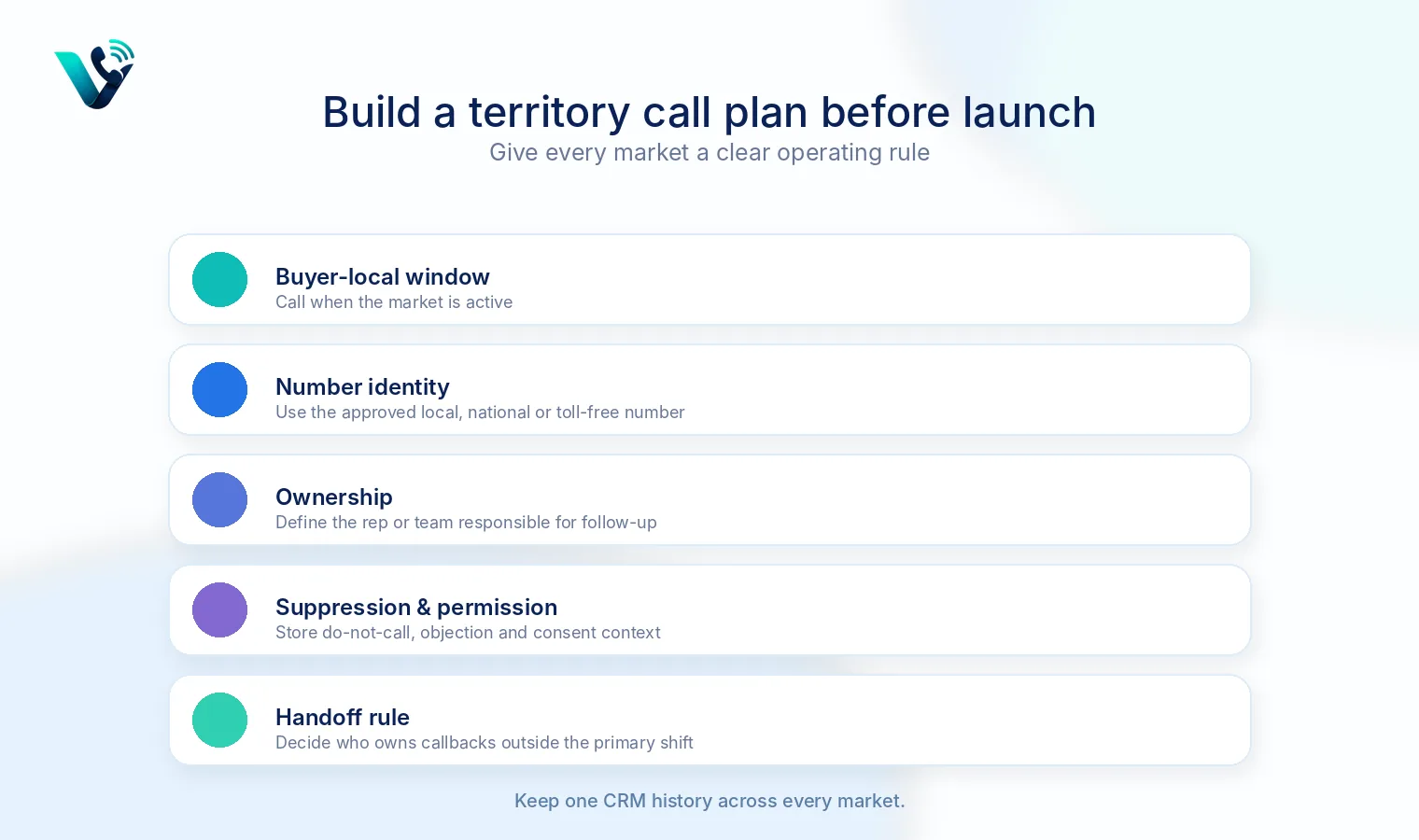
For each territory, document the eligible contact type, calling purpose, local calling window, approved number identity, language, suppression source, CRM owner, retry policy and escalation path. Add the relevant compliance review date. This turns global outbound sales from a collection of rep habits into an auditable operating process.
- Territory: Country or region covered by the campaign.
- Buyer-local window: Times when the campaign is allowed and commercially sensible to run.
- Number identity: The approved local, national or toll-free number used for that market.
- Ownership: The rep or team responsible for follow-up and callbacks.
- Suppression and permission: Do-not-call, objection, consent or account context relevant to the campaign.
- Handoff rule: What happens when a callback falls outside the owner’s shift.
Use one CRM history across every market
A central office has one major advantage: The team can share one operating system. Keep call outcomes, transcripts or notes, promised follow-up and account ownership in the same CRM history regardless of which number was used. If Europe calls a multinational account in the morning and North America calls another stakeholder later, both reps should see the same commercial context.
Avoid separate spreadsheets for each country unless they feed a controlled system. Fragmented lists make suppression, duplicate prevention and handoffs harder. Global territory calling becomes safer and more productive when the contact record carries source, market, timezone, owner, outcome and next action together.
Measure markets separately before combining them
Do not compare three continents using one blended connect rate. Phone-number quality, buyer behaviour, calling windows, seniority and market familiarity can all change performance. Track intended-person connect rate, conversations, positive dispositions, meetings, held meetings and list error rate by territory. Add callback completion and handoff delay so managers can see whether the central-office model is creating service gaps.
When one market underperforms, diagnose the stage. Low answer rates may point to data, timing or caller identity. Healthy answers but weak meetings may point to targeting or messaging. Strong meetings but poor show rates may point to qualification or follow-up. The answer should not automatically be “make more calls.”
Try this on your own numbers
Local numbers in 118 countries, AI call notes and one shared inbox. Live the same day, no contract.
How Votelly can fit the operating model
Votelly’s live website describes virtual numbers in 118 countries, a sales-team workflow, a power dialler, call analytics and a remote-team solution. Those are relevant internal links for a global territory article because they map to the operational layers described here: Local numbers, centralised dialling, reporting and teams calling from one location or several. Keep every product-specific statement aligned with the current live page rather than assuming a feature from a different provider.
The central-office advantage
A single office can create strong consistency. Training, coaching, list operations and management are easier to coordinate when the team works together. The model becomes difficult only when headquarters convenience is allowed to override customer local time. Design the day around the markets, build reliable handoffs and keep territory data separate enough to learn from it.
Revisit the territory plan quarterly as staffing, number availability, daylight-saving rules and market priorities change. Global calling is a living operating model, not a one-time setup.
International territory calling works when the customer does not feel the complexity behind the call. The right number appears, the call arrives at a sensible time, the rep knows the account, objections and opt-outs are respected, and any promised follow-up reaches the customer even if another continent takes ownership. That is the standard for covering three continents from one office without turning global expansion into timezone chaos.
Frequently asked questions
- Can one sales team call North America, Europe and APAC from one office?
- Yes, the operating model needs buyer-local calling windows, territory ownership, local or appropriate number identity, CRM context and handoff rules for callbacks that fall outside a rep’s shift.
- Should international cold calls use local phone numbers?
- Local virtual numbers can support market-relevant caller identity and return calls where permitted, but number eligibility and customer-facing location claims should be accurate. Check requirements for the exact number type and country.
- How should a team handle time zones for outbound calling?
- Store reliable timezone or location data, filter call lists by buyer local time, and review daylight-saving changes. Build separate blocks for APAC, Europe and North America instead of mixing markets randomly.
- Are international B2B cold calling rules the same everywhere?
- No, rules differ by jurisdiction, call type, contact type, purpose and other factors. Maintain market-specific compliance procedures and obtain appropriate legal guidance.
- Which metrics should be compared by territory?
- Track intended-person connect rate, conversations, positive outcomes, meetings booked and held, list errors, callback completion and handoff delay separately by market.
- How can Votelly support global territory calling?
- Votelly’s current website describes virtual numbers in 118 countries, sales-team calling, a power dialler, analytics and remote-team workflows. Check the live product and country pages for exact availability.