Call Disposition Codes That Actually Tell You Something
By Jamila Parker · · 7 min read

Build call disposition codes that capture outcomes, trigger the right follow-up and create useful reporting instead of a long list of vague labels.
Key takeaways
- Disposition codes should describe outcomes, not vague topics.
- Every code should change reporting, routing or the next action.
- Keep the list small enough for reps to use consistently.
- Automate mechanical outcomes and reserve judgement for human decisions.
- Audit code quality before trusting dashboards built from it.
What call disposition codes are
Call disposition codes are standard labels applied after a call to record what happened. Examples include no answer, voicemail, callback requested, meeting booked, not interested, wrong number and do not call. They turn a call log from a list of timestamps into structured data the CRM and dialler can use.
The best codes answer two questions: What was the outcome, and what should happen next? A label such as billing or sales only describes a topic. Billing refund completed or Sales callback Friday describes an outcome that can change the workflow.
For outbound teams, good call disposition codes also protect sequences. A contact who booked a meeting should leave the cold call queue. A wrong number should stop future attempts. A do-not-call request should trigger suppression immediately.
Why most disposition lists become useless
Disposition lists often grow one code at a time. A manager adds Interested, another adds Warm lead, a third adds Follow-up, and soon reps have several options that mean almost the same thing. When people cannot tell which one to choose, reporting becomes inconsistent.
The opposite problem is a list that is too small. If every unsuccessful call becomes not interested, the team cannot distinguish a clear no from bad timing, wrong person, voicemail or a data error.
The answer is not a universal number of codes. It is a small controlled vocabulary where each option is distinct enough to change a decision.
Use outcome-based codes
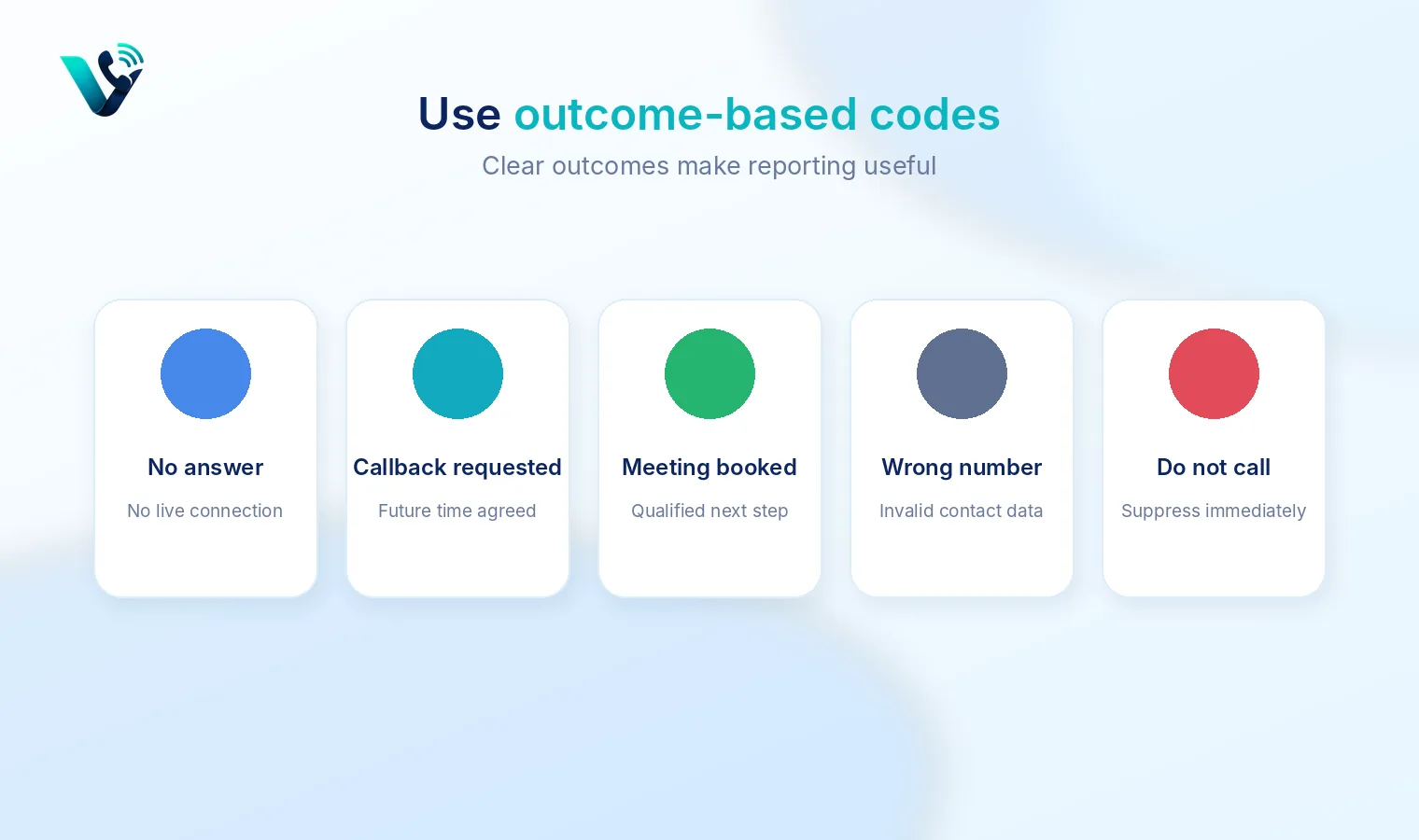
An outcome-based code tells the team where the conversation ended. For outbound sales, a practical set may include no answer, voicemail left, connected not interested, callback requested, meeting booked, wrong number, referred to another contact and do not call.
For inbound calls, the set can look different: Resolved, follow-up required, sales opportunity, escalated, misrouted or abandoned. The code library should reflect the call type instead of forcing every team into the same list.
Outcome-based call disposition codes are easier to report because the label already tells the dashboard what happened. Topic information can live in a separate field or tag when it is useful.
A practical outbound disposition set
Code |
Meaning |
Next action |
|
No answer |
No live connection |
Return according to attempt policy |
|
Voicemail left |
Message delivered |
Continue cadence at the next planned step |
|
Callback requested |
Prospect gave a future time |
Create a dated callback and pause generic sequence |
|
Meeting booked |
Qualified next step agreed |
Create meeting and update lead/opportunity |
|
Not interested |
Clear no without future trigger |
Stop current sales sequence |
|
Wrong number |
Data is invalid |
Remove from dialling and correct record |
|
Referred |
Another contact owns the issue |
Create or link the correct contact |
|
Do not call |
Recipient objected |
Suppress according to policy and applicable law |
The exact names can change. What matters is that the rep and the automation interpret them the same way.
Do not mix contact status with call outcome
A call outcome is what happened on one interaction. A lead status is the broader state of the prospect or opportunity. Mixing the two creates confusion.
For example, Qualified might be a lead status, while Meeting booked is the outcome of the call that moved the lead there. Customer is not a call disposition. Callback requested is not necessarily the permanent status of the account.
Keeping these concepts separate lets the business report on both activity and pipeline without forcing one field to do two jobs.
Automate mechanical outcomes where possible
Diallers can often detect outcomes such as no answer, busy signal or some voicemail events. Automating these can reduce wrap time and improve consistency. More nuanced outcomes still need human judgement.
A system should not automatically mark not interested from a short call unless the business has a reliable method and a review process. The consequence of the code may be to stop future contact, so false automation can remove viable prospects or fail to respect clear objections.
The ideal model uses automation for what the phone system knows and the rep for what only the conversation reveals.
Make every code trigger a rule
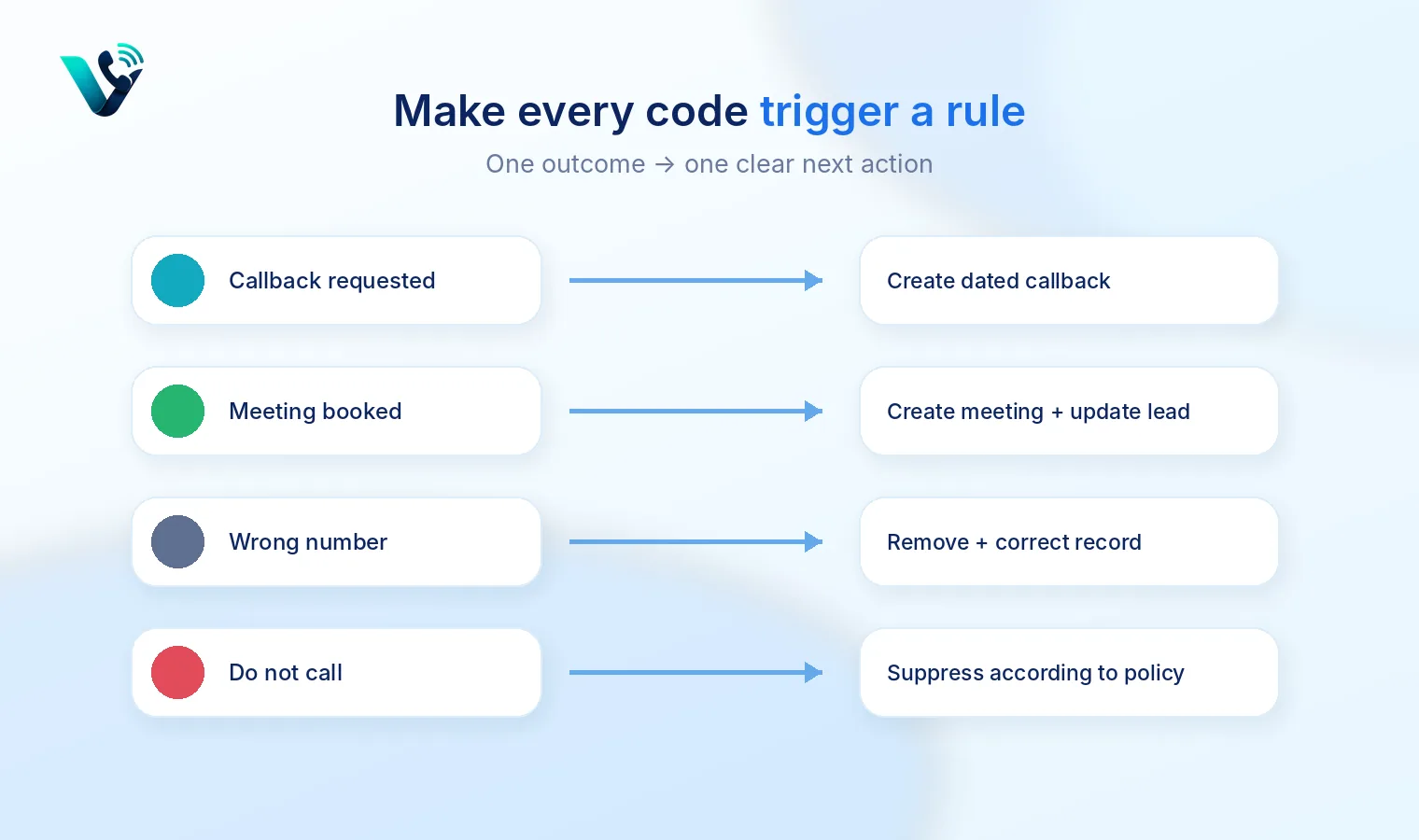
Call disposition codes become operational when they cause the right next step. A callback code creates a task at the agreed date. Meeting booked stops the current outbound sequence. Wrong number creates a data-cleaning flag. Do not call enters suppression.
This makes post-call work faster because the rep chooses the outcome once instead of updating several disconnected fields.
It also reduces forgotten promises. If callback Friday is stored only in free-text notes, it is easy to miss. A disposition plus structured date can create a visible obligation.
Keep the list short enough to use accurately
Ten clear options usually produce better data than thirty overlapping options, although the correct number depends on the call type. Add a new code only when the new outcome changes follow-up, reporting or compliance.
If managers keep asking for more detail, consider a second field such as objection reason or issue category rather than expanding the disposition list indefinitely.
The rep should be able to choose the right code in seconds. If a definition requires a paragraph to explain the difference from another code, the taxonomy probably needs simplification.
Audit disposition quality
A dashboard is only as reliable as the inputs. Review a sample of calls against the chosen codes. Look for reps who overuse one label, codes that are frequently confused and outcomes that do not match the next action.
- Percentage of calls with a disposition.
- Share of calls using each code.
- Callbacks completed on time.
- Do-not-call suppression applied correctly.
- Meeting-booked calls that created meetings in CRM.
- Wrong-number records removed from active lists.
If the data is inconsistent, fix the definitions and coaching before building more dashboards from it.
Use dispositions for coaching and list improvement
Call disposition codes can show patterns beyond rep performance. A campaign with many wrong numbers has a data-quality problem. A segment with many not-right-person outcomes may have an ICP or role-targeting problem. A high voicemail rate can change the optimal calling window.
Managers should therefore review dispositions by list, campaign, time window and segment. The point is not to punish reps for the code distribution; it is to understand what the outbound system is encountering.
When the taxonomy is stable, dispositions become one of the simplest sources of structured feedback from live customer conversations.
Try this on your own numbers
Local numbers in 118 countries, AI call notes and one shared inbox. Live the same day, no contract.
A simple governance rule
Assign one owner for the disposition taxonomy. Reps and managers can request changes, but the list should not be edited casually by every team. Document each code in one sentence and define the automation it triggers.
Review the list quarterly or when the sales process changes. Remove unused codes, merge duplicates and test whether the remaining options still describe real outcomes.
Good call disposition codes disappear into the workflow: Reps choose them quickly, automation responds correctly, and reporting becomes easier to trust.
How to migrate from a messy disposition list
If the team already has dozens of overlapping codes, do not delete them overnight. Export the existing list and map each old code to a smaller set of new outcomes. Review historical usage so important distinctions are not lost accidentally.
Run the old and new taxonomy side by side for a short transition period if necessary, then update automations, reports and training materials together. A renamed code is not complete if the CRM dashboard still expects the old value.
After launch, review the first few weeks closely. The new call disposition codes should reduce rep hesitation and improve consistency; if people keep using one catch-all option, the definitions or workflow may still be unclear.
Frequently asked questions
- What are call disposition codes?
- They are standard labels that describe the outcome of a call so the CRM or dialler can report on it and trigger the correct next action.
- How many call disposition codes should we have?
- Use the smallest set that captures distinct outcomes. Add a code only when it changes follow-up, reporting or compliance.
- Should dispositions describe topics or outcomes?
- Outcomes are usually more actionable. Use a separate tag or field for topic when needed.
- Can dispositions be automated?
- Mechanical outcomes such as no answer can often be automated. Nuanced outcomes such as interest, objection or escalation usually require human judgement.
- What is the difference between disposition and lead status?
- Disposition describes one call outcome. Lead status describes the broader state of the prospect or opportunity.
- How do I know if disposition data is reliable?
- Audit samples of calls, compare codes with follow-up actions and look for overused or confusing labels before relying on the dashboard.