Singapore and Hong Kong Numbers for APAC Expansion
By Jamila Parker · · 8 min read

Compare Singapore and Hong Kong business numbers for APAC expansion, including numbering plans, virtual routing, portability, documentation and customer experience.
Key takeaways
- Singapore’s national numbering plan covers PSTN, radio and IP-based networks.
- Hong Kong has a formal numbering plan and distinct IP telephony service classes.
- Portability can depend on the service class and number type.
- Choose numbers around customer geography, routing and service requirements.
- Connect APAC numbers to CRM ownership and response-time reporting.
Singapore and Hong Kong numbers can both support APAC expansion, but they should be evaluated as distinct telecom services. The source highlights managed numbering frameworks in both markets and important differences around service class and portability. A good APAC rollout compares the exact number type, documents, routing, capabilities and migration path before choosing a provider.
Why Singapore and Hong Kong are useful APAC communication hubs
Singapore and Hong Kong are both established business markets with mature telecom infrastructure, but their numbering systems should not be treated as interchangeable. A company expanding across APAC may want a number that customers recognise locally while its sales team works from another city or country. The practical question is not simply “Can I buy a Singapore or Hong Kong number?” It is which number category is available, what service class it represents, what documents the provider needs, and what happens when a customer calls outside local business hours.
Both markets can provide a recognisable contact point for customers, but the business case should be specific. Decide whether the number is for a country launch, regional support, a sales campaign or a broader APAC operation. Then measure whether the local contact route improves response and qualified conversations rather than buying one number per market automatically.
Singapore: Numbering includes IP-based networks
IMDA states that Singapore’s National Numbering Plan provides rules and guidelines for the use and assignment of numbers to telecommunications services delivered over the public switched telephone network, radio network and Internet or other IP-based networks. That is important for cloud telephony because it shows that IP delivery sits within a managed numbering framework. Businesses should still confirm the provider’s current allocation process, supported number ranges and any eligibility or documentation conditions before purchasing a number.
The source notes that Singapore's numbering framework covers services delivered over PSTN, radio and IP-based networks. For a Singapore virtual number buyer, the practical step is to confirm the supported range and allocation process with the provider. Cloud delivery does not remove the need to understand the number category, documentation and exact inbound/outbound capabilities.
Singapore number portability
Singapore has fixed number portability guidelines covering the implementation of fixed number portability for certain fixed voice services. For a business with an existing number, portability can be an important part of the decision to move to a cloud phone system. However, the exact eligibility depends on the number and service arrangement. Ask the new provider to validate the number before cancelling the old service. A port is a controlled migration, not a simple forwarding rule.
If a Singapore business already has an established number, portability may be more valuable than replacing it. Ask the new provider to validate the number and service arrangement before cancelling anything. Treat the port as a controlled migration with ownership documents, a planned cutover and immediate post-port testing rather than as a simple forwarding change.
Hong Kong: Numbering and IP telephony classes
OFCA publishes the Numbering Plan for Telecommunications Services in Hong Kong and guidance on IP telephony. Its consumer guidance distinguishes Class 1 and Class 2 IP telephony. The distinction matters because Class 2 service is not obliged to provide number portability, while Class 1 service supports portability. This is a strong example of why businesses should ask not only whether a provider offers a “virtual number,” but which regulated service class the number belongs to.
Hong Kong demonstrates why “virtual number” is too broad a label for procurement. The source distinguishes IP telephony service classes with different portability expectations. Ask the provider which class the service belongs to, whether the number can be ported, what features apply and how that class affects the long-term flexibility of the business phone setup.
Choose local numbers around customer expectations
For APAC expansion, a Singapore number may be appropriate for a Singapore-focused launch, while a Hong Kong number may be useful when Hong Kong customers or regional operations are a distinct segment. If the business serves several countries, do not automatically buy one number per country. Start with the markets where a local contact point will affect trust, response time or conversion. Use tracking numbers only when the measurement value justifies the extra complexity.
Use Singapore and Hong Kong numbers where a local contact point supports a real customer segment. A company serving several APAC markets does not need a separate number everywhere on day one. Start with markets where local access, language, response time or attribution can change the customer experience, then add numbers when the operational reason is clear.
Remote routing across APAC time zones
A Singapore or Hong Kong number can be routed to a distributed team if the provider supports the required destinations. Build routing around local business hours, language and product expertise. An APAC customer should not have to guess whether a missed call will be returned tomorrow or next week. Set a clear after-hours path and create a callback task when a human cannot answer immediately. The phone system should be designed around the service promise, not just the number acquisition step.
Route calls around Singapore or Hong Kong local business hours even when the answering team is elsewhere. Add language and product skill after the time filter, then create after-hours and callback paths. This keeps the customer experience predictable and avoids making a distributed team feel permanently on call.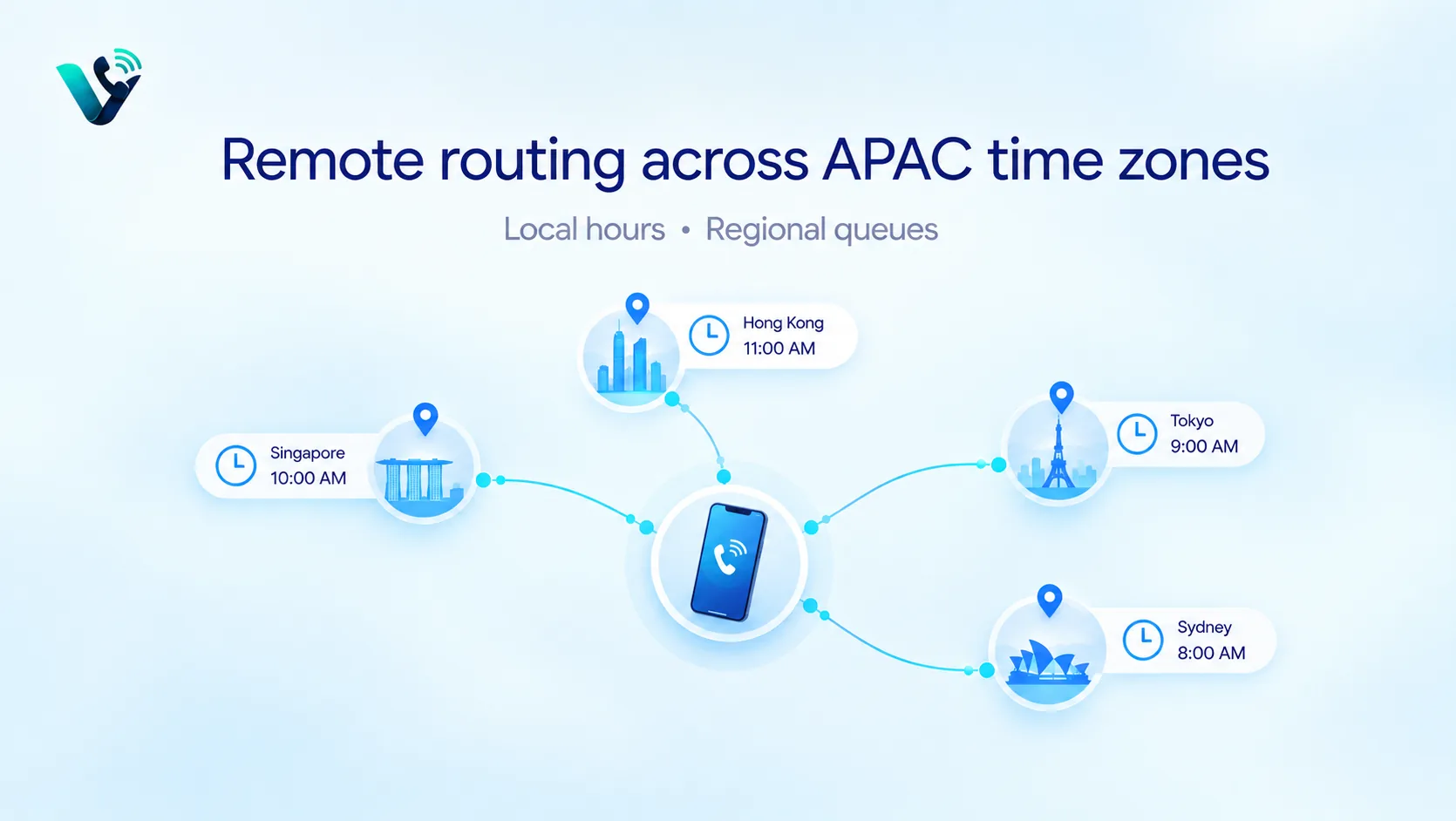
Voice, SMS and caller ID are separate capabilities
A local-looking number does not guarantee that SMS, caller ID, outbound calling or verification will work in the same way. Confirm the exact capabilities of the number. Twilio’s number catalogue, for example, distinguishes voice and SMS connectivity as separate capabilities. This is a useful industry principle even when a different provider is selected verify the exact number’s features before designing a workflow around them.
CRM and APAC lead ownership
International expansion becomes difficult when every country uses a separate phone dashboard. Put the resulting lead into one CRM process. Capture country, source, number dialled, owner, status and next action. LeadMino can be used as the central lead-management layer so a Singapore or Hong Kong call becomes part of the same sales pipeline as web forms and other channels. This makes regional reporting possible without forcing the sales team to learn a different process for every market.
Use one CRM process across both markets. Capture country, source, number dialled, owner, call outcome and next action so Singapore and Hong Kong leads enter the same operational pipeline. This lets regional managers compare response and conversion without forcing salespeople to work from separate country dashboards.
Portability and migration planning
If the business already owns a Singapore or Hong Kong number, ask about porting before replacing it. For Hong Kong, OFCA explicitly describes portability arrangements and distinguishes service classes. For Singapore, IMDA publishes fixed-number portability guidance. The migration plan should include ownership verification, cutover timing, forwarding during transition, CRM updates and customer communications. Never cancel the old service before the new provider confirms the port and test calls succeed.
When replacing an existing APAC phone setup, build the migration around continuity. Validate portability, keep the old service active, configure the new queue and CRM integration before cutover, and assign a test owner. If a number cannot be ported, plan how long the old and new customer identities need to coexist.
APAC expansion checklist
Confirm number type, service class, eligibility, documents, voice capability, SMS capability, caller ID, routing hours, portability and CRM integration. Then test from the local market and from the remote team. Singapore and Hong Kong both provide formal numbering frameworks, so a strong APAC strategy starts with the regulatory category and ends with a measurable customer journey. The number is infrastructure; the real business asset is the workflow built around it.
Before launch, confirm the country, number category, service class where relevant, documentation, voice/SMS/caller ID capabilities, portability, local-time routing, fallback path and CRM fields. Test calls at normal and after-hours times and verify that public website information matches the real service model.
Try this on your own numbers
Local numbers in 118 countries, AI call notes and one shared inbox. Live the same day, no contract.
Common mistakes to avoid
- Treating Singapore and Hong Kong as one telecom market: Validate numbering, service class and provider conditions separately.
- Buying numbers before defining the customer segment: Use local numbers where they improve access, response or attribution.
- Ignoring portability until cancellation: Validate the existing number before ending the old service.
- Assuming all features come with the number: Check voice, SMS, caller ID and verification independently.
- Creating separate lead processes per market: Use common CRM ownership with country-specific fields.
Practical implementation checklist
Area |
Purpose |
Check |
|
Singapore |
IMDA National Numbering Plan |
Check range and portability |
|
Hong Kong |
OFCA numbering + IP telephony classes |
Confirm service class and portability |
|
APAC |
Remote routing |
Use local hours and regional queues |
Frequently asked questions
- What is the main thing to check about Singapore and Hong Kong numbers?
- Check the exact number type, provider eligibility, required documentation and the communication features you actually need.
- Can a remote team use the number?
- Often yes, if the provider supports the routing and the number is eligible for the intended service.
- Does a virtual number automatically support SMS?
- No. SMS capability is separate and should be verified for the exact number.
- Do I need a local office?
- Not necessarily, but some number types or markets can require local presence or address evidence.
- Can I connect the number to a CRM?
- Yes. Connecting calls and messages to a CRM helps preserve ownership, source, status and next action.
- What should I test before publishing it?
- Test inbound and outbound calling, caller ID, business hours, overflow, SMS if needed, and the CRM workflow.
- Do I need both a Singapore and Hong Kong number for APAC expansion?
- Not necessarily. Start with the markets where a local contact route supports a clear customer or measurement need.
- What should an APAC routing rule include?
- Local business hours, language, product skill, primary queue, overflow and a defined after-hours callback path.