Speed to Lead: What Happens After Five Minutes
By Jamila Parker · · 7 min read

Speed to lead is the time between an inbound enquiry and a meaningful response. Learn what the five-minute research actually measured and how to build a fast response workflow.
Key takeaways
- Speed to lead measures the time from inbound intent to meaningful response.
- The famous five-minute figures relate to contact and qualification odds, not guaranteed sales.
- Fast acknowledgement is useful, but human response and ownership still matter.
- Routing, notifications and rep availability are usually the real bottlenecks.
- Measure response time by source, shift and owner instead of relying on one average.
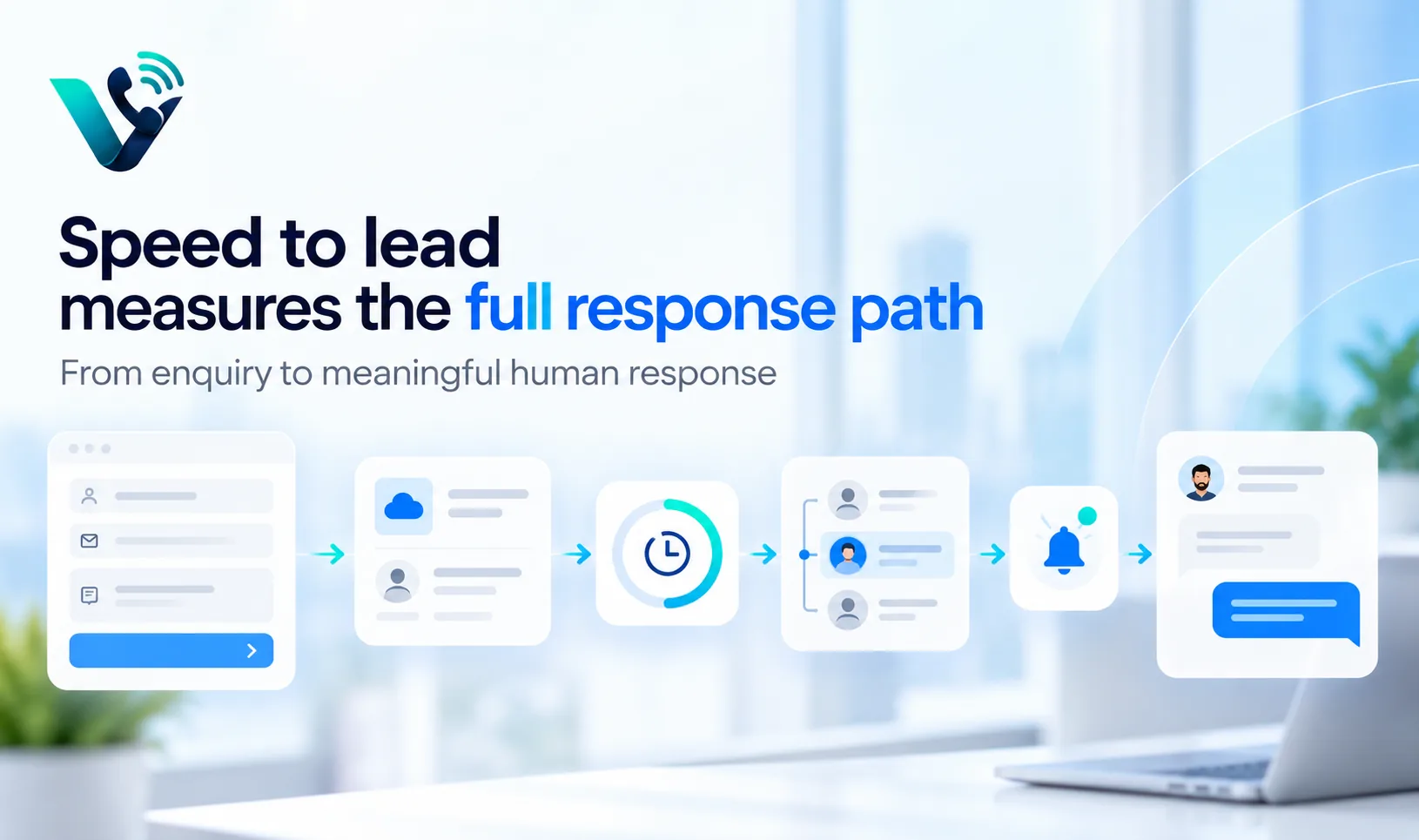
Speed to lead is the elapsed time between a prospect raising their hand and the business making a meaningful response. The trigger might be a web form, quote request, inbound call, chat message or another explicit enquiry. The clock includes everything that happens between the event and the response: Form processing, CRM creation, routing, notification, rep availability and the actual call or reply.
That is important because teams often measure only the last step. A rep may call within sixty seconds of receiving a notification, but if the lead sat unassigned for twenty minutes first, the real speed to lead was twenty-one minutes.
The metric is therefore an operational measure of the whole inbound system. It exposes where interest is being lost before a salesperson even has the chance to speak.
What the five-minute research actually says
The most repeated speed-to-lead statistics come from older lead-response research and later company audits. The commonly cited comparison says contact and qualification odds were dramatically better when leads were called within five minutes rather than thirty. Those findings are often repeated as if they guarantee higher close rates, but the original work focused on contact and qualification, not a universal sales conversion promise.
A separate Harvard Business Review analysis of companies responding to web leads found that firms responding within an hour were much more likely to qualify a lead than firms that waited longer. The direction is consistent: Faster response is associated with better access to the prospect while intent and context are fresh.
The responsible takeaway is not “five minutes guarantees a sale”. It is that inbound intent decays quickly, and a slow response adds avoidable friction before the sales conversation even begins.
What changes after five minutes
After a few minutes, several things can happen. The prospect returns to their original task. They submit another form. A competitor responds. The context that made them enquire is no longer at the top of their attention. None of these guarantees the lead is lost, but each makes the first conversation harder.
The rep may also lose an informational advantage. A person who submitted a form thirty seconds ago remembers exactly what they were looking at and why. A person called tomorrow may need the company and offer explained again.
Speed to lead therefore protects context as much as attention. Fast response lets the rep begin from the prospect’s recent action rather than rebuilding the conversation from scratch.
Acknowledgement is not the same as human contact
An instant confirmation email or text is useful because it tells the prospect the enquiry arrived and sets expectations. It should not be counted as equivalent to a live conversation when measuring sales response.
Use two clocks if necessary: Time to acknowledgement and time to meaningful human response. Automation can make the first nearly instant. The second depends on routing, staffing and rep behaviour.
This distinction prevents a dashboard from declaring success because an autoresponder fired in ten seconds while the lead still waited hours for a salesperson.
The workflow that makes fast response possible
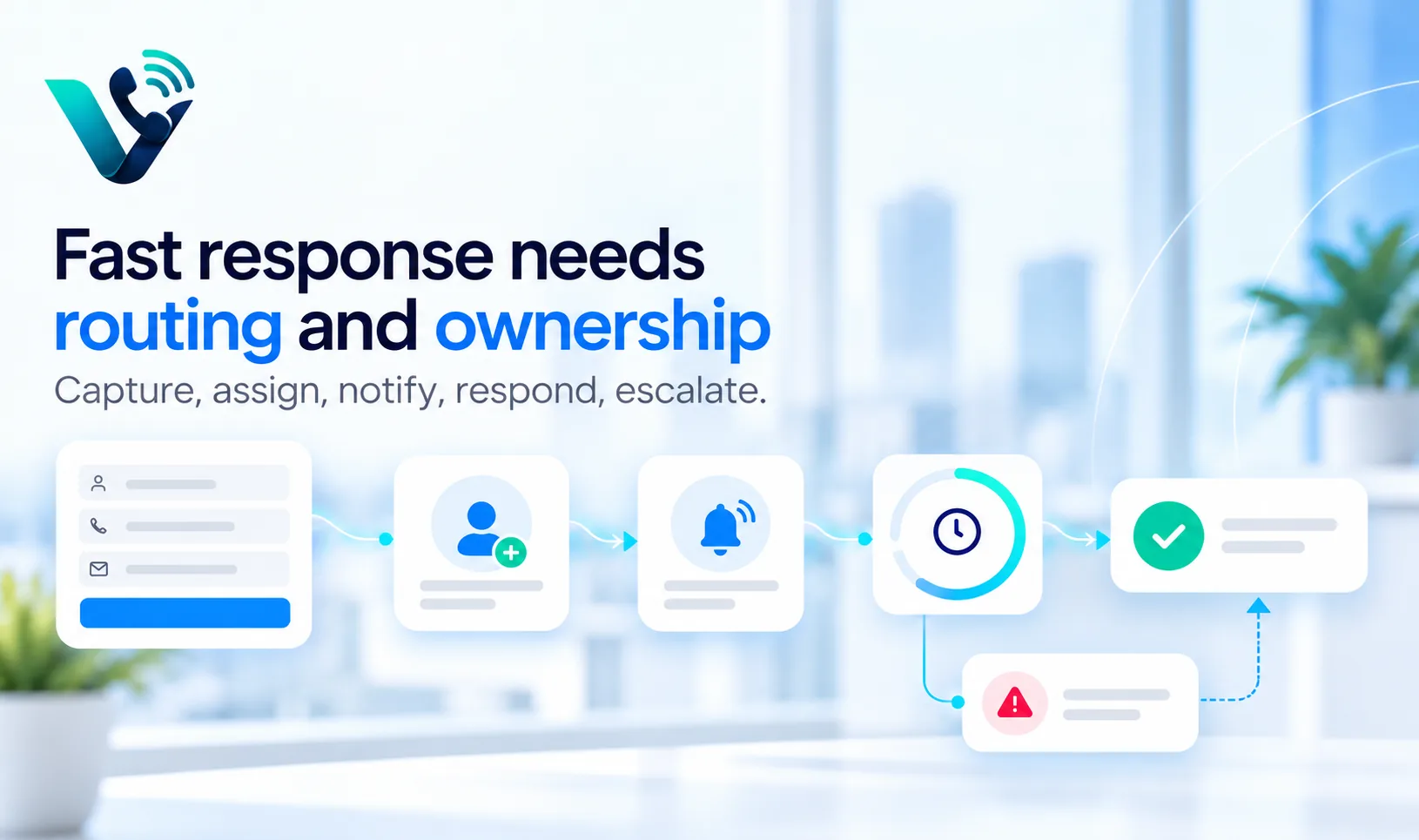
- Capture the inbound event with an accurate timestamp.
- Create or update the lead in CRM automatically.
- Identify source, territory, language, product and any other routing fields.
- Assign the lead to one available owner or a controlled queue.
- Notify the owner in a channel they actively monitor.
- Start an SLA timer and escalate if the first action does not happen.
- Record the first meaningful response so the real speed-to-lead metric is visible.
Every manual handoff adds latency. A spreadsheet export, shared email inbox or manager assignment step can consume the entire five-minute window before the rep even sees the lead.
Routing is often the hidden delay
A team can hire fast reps and still have slow speed to lead if assignment is unclear. Round robin, territory routing, named-account ownership, language, product speciality and availability can all affect who should receive the lead.
The routing rule should decide quickly and have a fallback. If the preferred owner is unavailable, the system needs to know whether to reassign, send to a queue or escalate. Leaving the lead assigned to somebody who is in a three-hour meeting is technically correct ownership and practically slow response.
Keep routing logic simple enough to test. Ten layers of conditions can produce elegant diagrams and unexpected delays.
Set a response SLA that matches the business
A five-minute target is a useful operational benchmark for high-intent inbound leads during staffed hours, but not every business needs the same SLA. Complex enterprise enquiries, after-hours forms and low-intent content downloads may require different handling.
Define the target by source and intent. A pricing request can have a shorter SLA than a newsletter signup. An inbound call should have a different workflow from an ebook download. The important part is that the target is explicit and measurable.
If the team cannot staff a five-minute human response around the clock, set honest business-hour expectations and use acknowledgement plus scheduling outside those hours.
Use escalation instead of reminders alone
A notification is not an SLA. If the rep misses it, the lead still waits. Build escalation around the response target: Remind the owner, reassign after a threshold, notify a team lead or move the lead into a shared queue.
The escalation should not create duplicate contact. Once another rep takes ownership, the previous assignment and sequence should update so two people do not call the same lead at once.
This is where CRM state matters. Speed without ownership can create a chaotic customer experience.
Measure the distribution, not only the average
An average speed to lead can hide slow tails. If nine leads are answered in one minute and one waits two hours, the average may still look acceptable while one real customer had a poor experience.
- Median response time.
- Percentage responded to within 5 minutes.
- Percentage within 15 minutes and 1 hour.
- Slowest decile or percentile.
- Response time by source, rep, shift and region.
- Qualified outcome by response-time band.
The final metric is especially useful because it connects operational speed with sales quality without pretending timing is the only factor.
Try this on your own numbers
Local numbers in 118 countries, AI call notes and one shared inbox. Live the same day, no contract.
What to fix before buying more leads
If marketing volume is healthy but pipeline conversion is weak, audit the response path before increasing spend. Check whether leads are created automatically, whether routing is fast, whether reps see notifications, whether after-hours enquiries have a plan and whether first attempts are actually recorded.
A slow system can make good leads look poor because the prospect is contacted after the strongest intent has passed. Improving speed to lead often means removing handoffs rather than changing the script.
The most effective workflow makes fast response normal instead of depending on heroic reps watching every channel manually.
After-hours speed to lead needs a different promise
Many teams set an aggressive daytime SLA and then ignore what happens overnight. That creates a hidden split in customer experience. An enquiry at 2 p.m. may receive a call in two minutes while the same enquiry at 8 p.m. waits until the next afternoon.
Decide what the business can honestly support. An instant acknowledgement can confirm receipt, show the next staffed window and offer a booking link. If the company runs follow-the-sun teams, route by region and availability rather than keeping every after-hours lead with the daytime owner.
Report after-hours leads separately so they do not distort the daytime metric. The goal is not to fake a five-minute response around the clock; it is to make the service promise visible and consistent.
Coach first-response quality as well as speed
Fast response is only useful if the rep can handle the conversation. Give reps the lead source, page or offer, requested product and any form answers before they call. That prevents the first thirty seconds being wasted on questions the prospect already answered.
A simple opening can reference the action: “You just requested pricing for the business phone plan, so I wanted to make sure I understand what you need.” That feels like a response to intent rather than a generic sales call.
Review recordings or notes from the fastest calls. If speed improves but discovery quality falls, the team may be optimising the clock at the expense of the conversation.
Frequently asked questions
- What is speed to lead?
- It is the time between an inbound enquiry and the business’s first meaningful response.
- Why is five minutes important?
- Frequently cited lead-response research found much stronger contact and qualification odds for very fast responses, especially compared with waits of thirty minutes or more. It did not prove a universal close-rate guarantee.
- Does an automated email count as response?
- It can count as acknowledgement, but teams should usually track meaningful human response separately.
- What causes slow speed to lead?
- Common causes include manual CRM entry, unclear routing, unavailable owners, weak notifications, after-hours gaps and no escalation rule.
- Should every lead have a five-minute SLA?
- Not necessarily, set targets based on intent, source, staffing and customer expectations.
- How should speed to lead be reported?
- Use median and response-time bands by source, rep, shift or region, and compare those bands with qualified outcomes.