UAE Virtual Phone Number for International Business
By Jamila Parker · · 8 min read

Learn how a UAE virtual phone number can support international sales and customer service, including +971 formats, routing choices, and TDRA compliance considerations.
Key takeaways
- A UAE number can give customers a familiar +971 contact point, but number availability and documentation vary by provider and number type.
- VoIP is a regulated telecommunications activity in the UAE; use licensed or TDRA-approved routes rather than assuming any internet calling service is permitted.
- Choose routing, IVR, business hours and failover before publishing the number so the customer experience is consistent from day one.
- Treat “instant activation” claims cautiously until the carrier confirms eligibility, KYC and the exact number range.
Quick Answer: Can An International Company Use A UAE Virtual Number?
Yes, an international business can use a UAE-facing phone number when the service is provisioned through an eligible telecommunications route and the chosen number type is available to that business. A virtual number is not simply a random +971 caller id: It is a real numbering resource delivered through a carrier or cloud communications platform and routed to the people or systems that answer the call.
For a sales or support team outside the UAE, the practical value is straightforward. Customers can call a UAE number while agents answer in another office, contact centre, browser softphone or sip system. The important qualifier is compliance. The UAE telecommunications and digital government regulatory authority (tdra) treats voip as a regulated telecommunications activity, so companies should verify that their provider is using an authorised or approved service path.
How UAE Virtual Phone Numbers Work
A UAE virtual number separates the public telephone number from the physical device that answers it. The number can terminate on cloud pbx infrastructure, an ivr, a queue, a sip trunk or selected forwarding destinations. That makes it useful for international companies that need a UAE contact point without making every call ring a desk phone in one office.
The country code is +971. Geographic calling identity may also be associated with emirate-level fixed-line codes, while other ranges serve mobile or service-specific purposes. The exact ranges a provider can supply depend on its carrier relationships and regulatory permissions. Instead of choosing a number solely because it looks familiar, match the range to the real business use case and confirm whether inbound, outbound, sms, emergency calling and caller-id presentation are supported.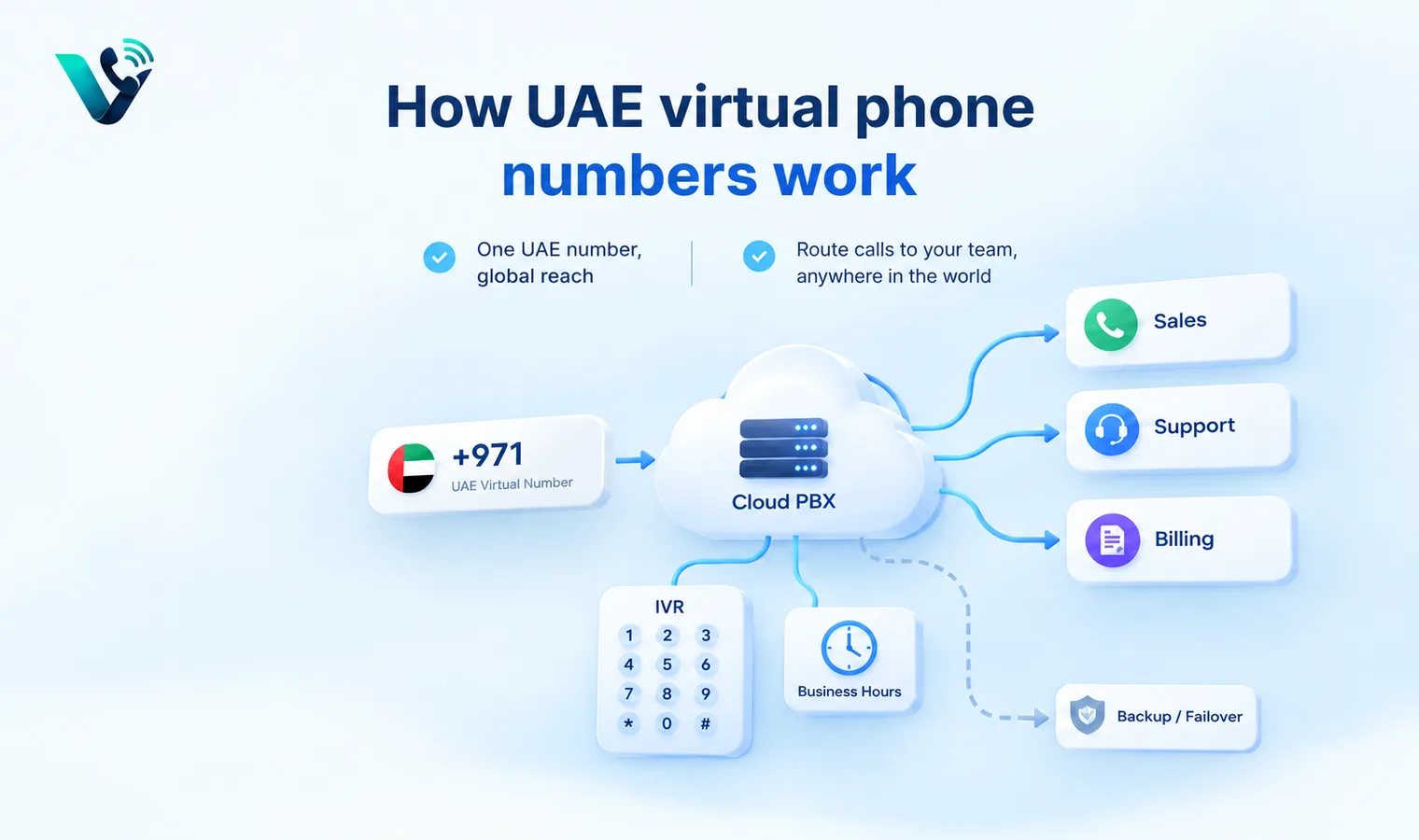
Why International Businesses Use A UAE Number
The strongest use cases are usually sales, customer support, partner communication and market testing. A UAE contact number can remove the friction of asking a local customer to make an international call. It also gives marketing pages, invoices, account portals and support emails one consistent regional contact point.
For outbound teams, a local-looking identity may improve recognition, but it should not be treated as a guaranteed answer-rate tactic. Call outcome depends on consent, timing, list quality, caller reputation, relevance and carrier filtering. The better goal is consistency: Use one properly provisioned business identity, identify the company clearly, honour opt-outs, and avoid aggressive dialling patterns that can trigger complaints or spam labelling.
Number, Routing And Team Design
Before ordering the number, decide what should happen when someone calls. A small team may use direct forwarding during UAE business hours and voicemail after hours. A larger team may use an ivr with sales, billing and support options, skills-based queues, overflow routing and a backup destination if the main contact centre is unavailable.
International teams should also plan time zones. If a dubai customer calls at 10:00 local time, the system should know which agents are available and what language or department should answer. Using business-hours rules, queue announcements and scheduled failover prevents a local number from creating a local expectation that the company cannot meet.
UAE Compliance: The Part Businesses Should Not Skip
Tdra states that voip services are telecommunications services and that providing them to subscribers is a regulated activity requiring a licence or exemption. Tdra also explains that third parties can provide voip in collaboration with UAE licensees or with approval. This is why an overseas company should ask its provider how the UAE number and voice route are authorised rather than assuming any generic sip or app-based setup is acceptable.
Documentation can also vary by number type. Providers may request company registration details, authorised-user identification, address information, intended use or other kyc material. Requirements can change, and a carrier may reject a use case even when a competitor advertises a similar number. Confirm eligibility before printing the number on packaging, paid ads or contracts.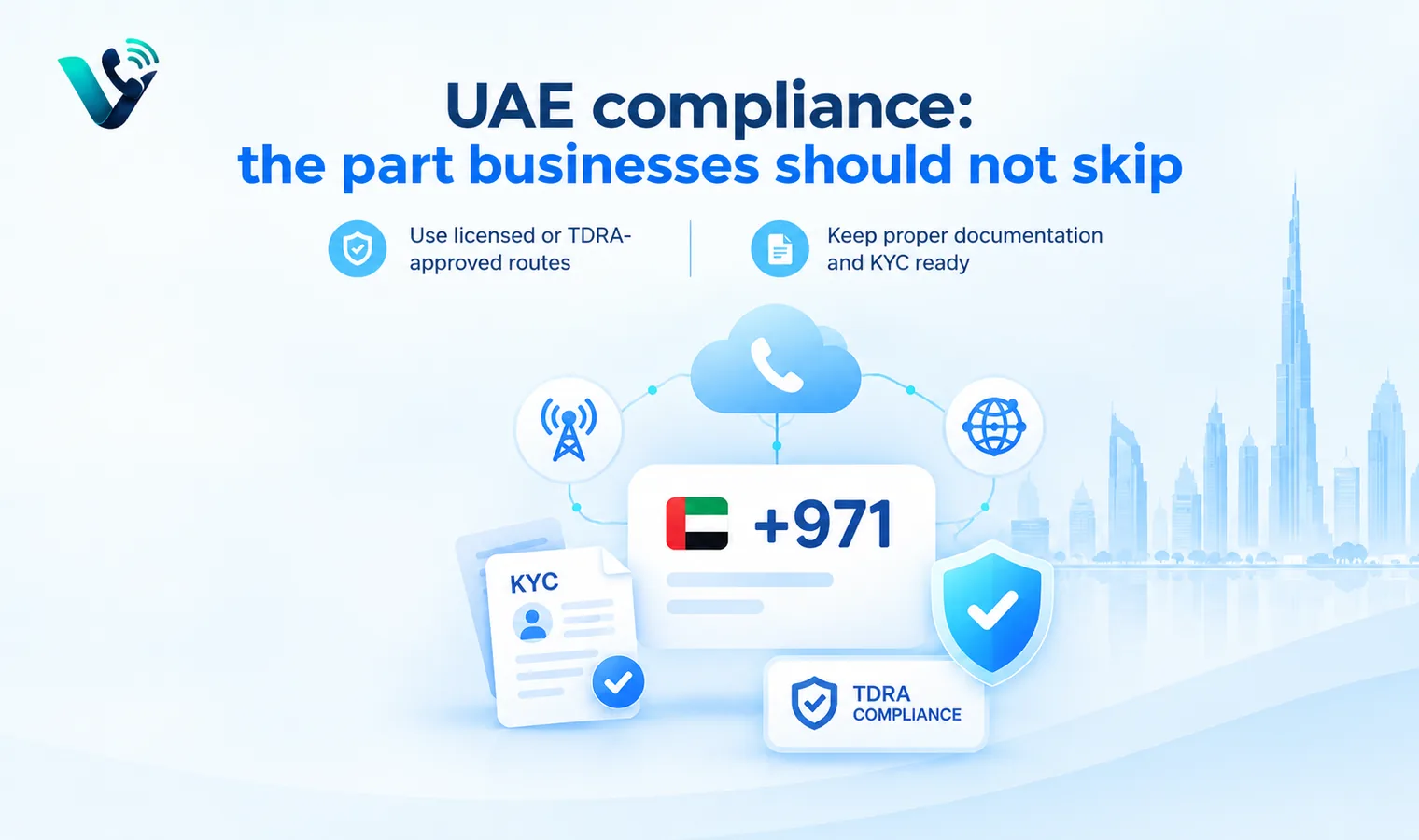
What To Check Before Buying
Start with coverage and capability rather than price. Ask whether the number supports inbound calls, outbound caller id, concurrent calls, call recording, emergency calling, sms and portability. Then ask where the media is routed, whether there is regional infrastructure, what happens during an outage and how quickly support can replace or reroute a number.
For compliance-sensitive markets, request a clear document checklist and a written explanation of any geographic-presence requirement. Also verify billing: Monthly number rental is only one component. Inbound minutes, outbound minutes, forwarding to the pstn, recording storage, sip channels and international destinations can materially change the real cost.
A Practical Setup Workflow
First, define the use case: Support, sales, partnerships, campaigns or a general switchboard. Second, choose the suitable number category and submit the required business documents. Third, configure routing, ivr prompts, business hours and fallback destinations. Fourth, test inbound calls from UAE networks and test outbound caller-id presentation where supported.
Finally, publish the number only after call quality and failover have been tested. Track answer rate, abandoned calls, average wait time, first-call resolution and complaints. If the number is used for outbound prospecting, monitor caller-id reputation and contact policy separately from inbound support performance.
Common Mistakes To Avoid
A common mistake is purchasing a number before confirming the underlying use case. A number suitable for receiving customer calls may not support the outbound identity, messaging or verification workflow a company expects. Another mistake is routing every call to one overseas mobile, which creates single-point failure and poor reporting.
The biggest risk is treating telecom compliance as a checkout-box issue. UAE voip rules are specific enough that businesses should rely on an authorised provider and current tdra guidance. Build the communications workflow around legitimate customer service and transparent business identity, not around masking origin or bypassing restrictions.
How To Use The Number Across Sales, Support And Websites
Use one published UAE number consistently across the website, proposals, email signatures and support pages unless there is a reason to separate functions. Consistency helps customers recognise the contact identity and makes operational ownership clearer. If sales and support need different numbers, document the purpose of each and make the ivr or page copy explicit so callers choose the right route.
For paid campaigns, avoid creating many short-lived numbers without a governance plan. Campaign attribution can be achieved with dedicated numbers, but every additional number needs monitoring, billing control and eventual retirement. A smaller set of stable numbers often produces cleaner brand recognition and caller-reputation data.
Procurement Questions To Ask Before Committing
When evaluating UAE virtual phone number for international business, ask the provider to answer the commercial and technical questions in writing. Confirm the exact number type, current inventory, monthly rental, inbound and outbound call rates, included channels, overage pricing, minimum term, cancellation process and whether the number can be ported later. Then ask which capabilities are tied to the exact number rather than to the platform in general. This distinction matters because a dashboard may support sms, recording or outbound caller id even when a particular country range does not.
Compliance questions deserve the same treatment. Ask which carrier or licensed operator supplies the number, what kyc or business documents are required, whether a local address or entity is needed, and whether any intended-use restriction applies. A UAE number can give customers a familiar +971 contact point, but number availability and documentation vary by provider and number type. A provider that can explain these dependencies clearly is usually easier to work with than one that promises universal instant activation without qualifying the number type or market.
Try this on your own numbers
Local numbers in 118 countries, AI call notes and one shared inbox. Live the same day, no contract.
Test The Complete Customer Journey Before Launch
A successful UAE virtual phone number for international business deployment should be tested from the customer side, not only from the admin portal. Place calls from the networks your customers are likely to use, listen for post-dial delay, confirm two-way audio, press ivr keys, transfer between agents, leave voicemail and trigger after-hours routing. If the workflow includes outbound calling, verify that the intended caller id is presented correctly and that callbacks return to a monitored destination. If sms is important, test sending and receiving with the real number instead of assuming support from a feature list.
Also test failure conditions. Temporarily make the primary queue unavailable and confirm that overflow or failover works. Check what happens when all agents are busy, when a call arrives outside business hours and when the destination system is offline. Voip is a regulated telecommunications activity in the UAE; use licensed or tdra-approved routes rather than assuming any internet calling service is permitted. These tests are inexpensive compared with discovering a broken route after the number has been printed on a campaign, customer portal or product packaging.
Bottom Line
A UAE virtual phone number can be a useful regional contact layer for an international company, but the value comes from the combination of a valid +971 number, reliable routing and compliant provisioning. Verify eligibility first, then design the call flow as carefully as any other customer-facing channel. That produces a more durable result than simply choosing the cheapest number that appears in a search result.
Frequently asked questions
- Can a foreign company get a UAE virtual phone number?
- Often yes, depending on the number type, provider, carrier eligibility and documentation. Confirm the exact requirements before purchase.
- Is VoIP legal in the UAE?
- VoIP is regulated in the UAE. TDRA states that VoIP services offered to subscribers are regulated activities and should be provided through licensed, collaborating or approved arrangements.
- What is the UAE country code?
- The international country code for the United Arab Emirates is +971.
- Can a UAE virtual number forward calls overseas?
- Many business deployments route calls to cloud PBX, SIP or international teams, but the available routing methods depend on the provider and regulatory setup.
- Can I use a UAE virtual number for outbound sales?
- Potentially, if the provider supports outbound caller ID and the use complies with applicable telecom, consent and marketing rules. Avoid assuming inbound capability automatically includes outbound presentation.
- What should I ask a UAE number provider before buying?
- Ask about number type, KYC, regulatory route, inbound/outbound support, caller ID, SMS, emergency calling, portability, concurrent calls, pricing, call quality and failover.