UCaaS vs CCaaS vs CPaaS: Which One Are You Buying
By Jamila Parker · · 5 min read

UCaaS equips employees to communicate, CCaaS runs customer-service operations, and CPaaS gives developers communication building blocks. Many companies need more than one.
Key takeaways
- UCaaS serves employee calling, meetings and messaging; CCaaS serves structured customer interactions; CPaaS provides APIs developers embed into software.
- They overlap, but the buyer, operating model and success metrics are different.
- A company can use UCaaS for staff, CCaaS for agents and CPaaS for custom notifications or voice workflows at the same time.
- Choose from the problem outward instead of forcing all communications into one category.
The three acronyms in one table
Ucaas vs ccaas vs cpaas.
Model |
Primary user |
What you buy |
Typical examples |
|
UCaaS |
Employees |
Cloud calling, meetings, chat and collaboration |
Teams Phone, Zoom Workplace/Phone, 8x8 business communications |
|
CCaaS |
Customer-service/sales agents and supervisors |
Queues, omnichannel routing, WFM, quality, analytics, AI |
Genesys Cloud CX, Talkdesk, Five9 |
|
CPaaS |
Developers/product teams |
Voice, messaging, number and verification APIs |
Twilio and other communications API platforms |
UCaaS: communications for the workforce
Unified communications as a service brings employee communication into a managed cloud suite. Business calling is often combined with meetings, chat, presence and directory features. The key outcome is workforce communication: can people reach colleagues and customers from the same identity on desktop, mobile and room devices?
UCaaS is a natural replacement for a general corporate PBX, especially for hybrid work. It can include auto attendants and queues, but its centre of gravity is employee collaboration rather than running a high-volume customer-service operation.
CCaaS: an operating platform for customer interactions
Contact centre as a service is built around queues, service levels, agent states, skills, supervisors, recording, quality management, workforce management and increasingly digital channels and AI. Talkdesk, Five9 and Genesys are examples of vendors with enterprise CCaaS platforms.
The buyer is often a customer-service or contact-centre leader working with IT. Success is measured through answer speed, resolution, abandonment, quality, customer satisfaction, conversion and workforce efficiency. That is a different problem from giving every employee a phone extension.
CPaaS: communications as software building blocks
Communications platform as a service exposes APIs and infrastructure so developers can put calling, messaging, phone numbers, verification or conversational experiences inside another application. Twilio’s programmable voice and SIP services illustrate the model. Instead of configuring a prebuilt queue screen, a team can write logic that decides what a call does based on application data.
CPaaS is powerful when communication is part of the product. It also shifts product and operational responsibility to your engineering team. You are buying primitives and flexibility, not necessarily a finished employee or agent workspace.
Where the categories overlap
The lines have blurred. UCaaS vendors sell contact-centre modules. CCaaS platforms add employee collaboration and AI. CPaaS vendors offer prebuilt products as well as APIs. A procurement label therefore should not decide architecture.
A common pattern is UCaaS for 800 general employees, CCaaS for 80 service agents and CPaaS for automated appointment reminders. Another company may use one vendor for UCaaS and CCaaS to simplify identity and call transfers. Compare integration quality and total operation, not logo count alone.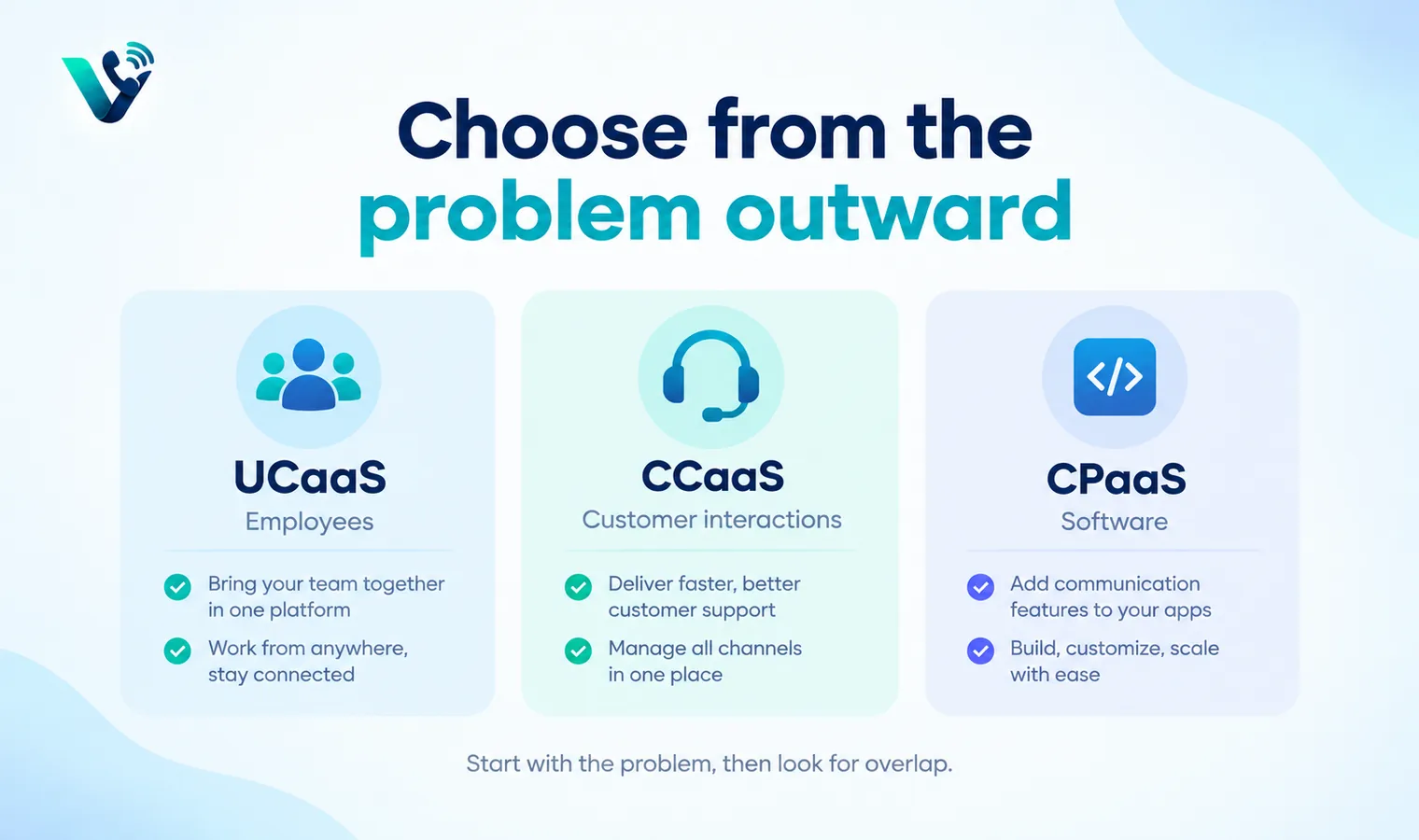
A simple buying decision
If the question is “How will employees call and collaborate?” start with UCaaS. If it is “How will we route, supervise and optimise customer interactions?” start with CCaaS. If it is “How will our software make calls or send messages automatically?” start with CPaaS.
Then look for overlap. General staff may not need expensive contact-centre licences, and customer-service agents may not need a separate UCaaS phone seat if the CCaaS desktop covers external calling. Licence architecture can save substantial cost when roles are mapped correctly.
What this means when choosing a business phone provider
Translate the technical concept into an operational requirement. Ask the provider to show the setting or workflow in a live tenant, explain which plan includes it, and identify any country, number, device or network limitations. The same technical term can hide very different implementations. A simple queue, for example, may be enough for a five-person team while a contact centre needs skills, priority, callbacks, supervisor controls and detailed reporting. Document the outcome you need before comparing terminology, then test it with a real call rather than accepting a diagram as proof.
Common implementation mistakes
Most failures happen around the edges: number porting is scheduled before routing is tested; remote users are not told how emergency location works; Wi-Fi is assumed to be fine because ordinary web browsing works; recording is enabled without a retention or consent policy; or an integration is purchased without checking what fields it actually writes back. Treat the phone system as an end-to-end service that includes carrier, network, devices, users, identity, data and support. A short pre-launch checklist and named owner for each area prevents far more problems than adding another advanced feature.
A simple validation checklist
Test inbound and outbound calls on desktop and mobile, hold and transfer, voicemail, caller ID, business hours, no-answer behaviour and at least one failure path. If the design uses queues or IVR, call every branch of the flow. If it uses an API or CRM, verify both successful write-back and what happens when the destination is unavailable. Review call-quality data during the pilot and ask users about audio, delay and ease of use. Finally, confirm support escalation and a rollback route before moving a high-value published number.
Try this on your own numbers
Local numbers in 118 countries, AI call notes and one shared inbox. Live the same day, no contract.
Security, privacy and policy checks
Confirm how the service encrypts signalling and media, how administrators control access, and how recordings, transcripts and messages are retained. If SSO or automated user provisioning matters, test the exact identity workflow rather than assuming an enterprise logo means it is included in your tier. Review recording-consent obligations and data-location requirements with the people responsible for privacy and compliance. Also ask how fraud, compromised credentials and unusual international calling are detected. Security features are most useful when administrators can understand and operate them without specialist intervention.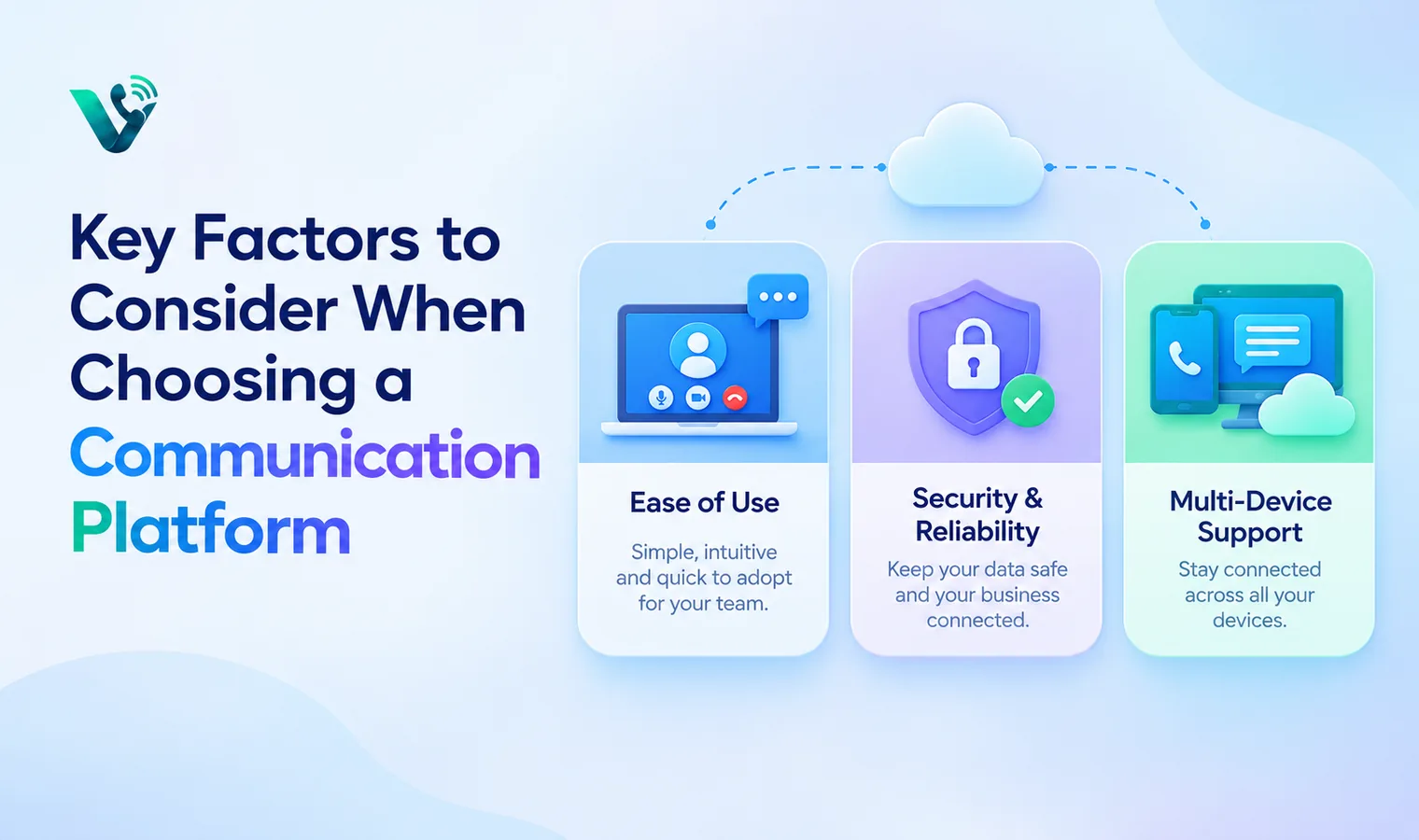
Support and day-two administration
The system still needs to be easy after the implementation team leaves. Have your own administrator add and remove a user, change a number, edit a holiday schedule, update routing, find a recording, export a call report and troubleshoot a poor-quality call. Then review support hours, severity definitions, escalation channels and any extra cost for faster response. For a business phone system, day-two administration and support are part of the product: a small monthly saving can disappear quickly if every routine change becomes a ticket or a consultant task.
Frequently asked questions
- What does UCaaS stand for?
- Unified communications as a service, typically cloud calling, meetings, messaging and collaboration for employees.
- What does CCaaS stand for?
- Contact centre as a service, cloud software for routing, supervising and analysing customer interactions.
- What does CPaaS stand for?
- Communications platform as a service, developer APIs and infrastructure for embedding voice, messaging and related capabilities into software.
- Can one vendor provide all three?
- Some vendors span multiple categories, but product depth and commercial packaging vary.
- Do I need UCaaS if I have CCaaS?
- Often general employees still need UCaaS while contact-centre agents use CCaaS. Integration between them can be important.
- Is Twilio UCaaS or CPaaS?
- Twilio is widely associated with CPaaS and communications APIs, although its portfolio includes additional packaged communication products.