UK Virtual Phone Number for International Businesses
By Jamila Parker · · 9 min read

A UK virtual phone number can give international businesses an accessible British contact point while calls route to teams anywhere. Compare 01/02, 03 and 080 numbers, caller ID and compliance.
Key takeaways
- UK 01 and 02 numbers are geographic, 03 numbers are non-geographic and charged like 01/02, while 080 numbers are free-to-caller under Ofcom rules.
- A virtual UK number can route to an international team, but the business should use valid, dialable caller ID and avoid misleading location claims.
- Number portability and provider requirements differ by number type, so confirm ownership and migration options before publishing widely.
- Ofcom has strengthened measures against spoofed UK caller IDs on calls arriving from abroad, making correct caller-ID configuration increasingly important.
A UK virtual phone number for international businesses can make it easier for customers in Britain to contact a company without dialling an overseas number. The number looks and works like a UK telephone number, while a cloud or VoIP platform routes the call to a team in the UK, Europe, Asia or any other supported destination.
That flexibility is useful for international sales, customer support, recruitment, travel, professional services and companies testing the UK market before building a local call centre. But choosing a UK number involves more than picking a familiar prefix. Different number ranges communicate different things to customers and can have different charging, allocation and caller-ID rules.
A strong setup starts by choosing the right number type, using it transparently and designing the routing around the customer's experience.
How UK virtual phone numbers work
A virtual number is not permanently attached to one physical telephone line. Incoming calls reach the provider's network, where software applies the rules configured by the business. The call can then ring a desk phone, browser, mobile application, SIP device, call queue or international destination.
The UK customer does not need to know the internal architecture. They dial a standard UK number and receive the same business greeting and support flow they would expect from a local communications system.
The business can also change agents or offices without changing the published number, which is valuable when entering a market gradually.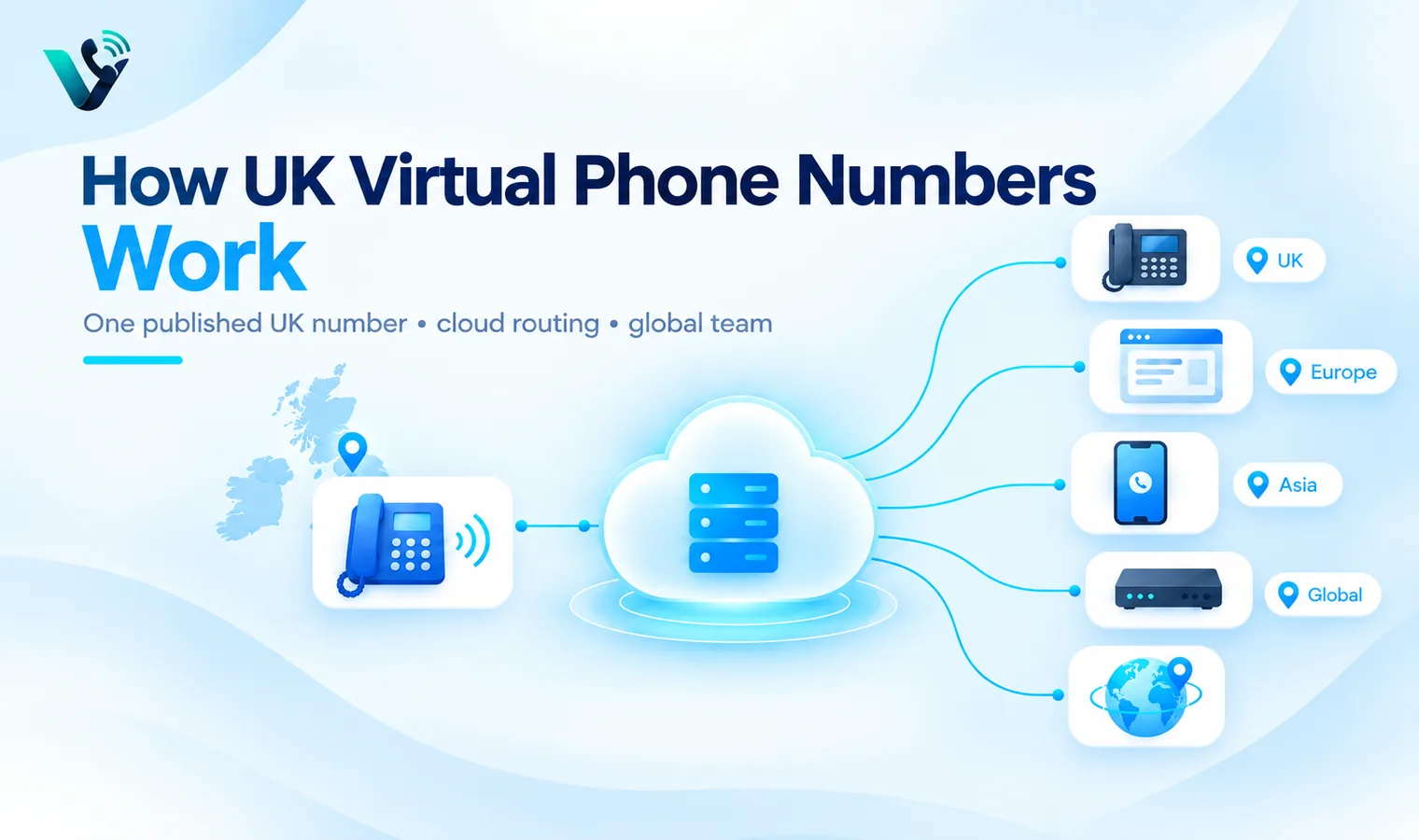
UK number types international businesses should understand
01 and 02 geographic numbers
Ofcom identifies numbers beginning 01 and 02 as geographic numbers. Their area codes are associated with locations in the UK, such as London or Manchester regions.
A geographic number can make sense when the business genuinely serves a specific region, has a branch there or wants a local contact point. However, businesses should not treat an area code as a licence to claim a physical office that does not exist.
Providers may require evidence related to number allocation or use, particularly for geographic resources. Ask the provider what documentation is required for the exact area code you want.
03 non-geographic numbers
UK 03 numbers are non-geographic. Ofcom states that calls to 03 numbers cost no more than calls to geographic 01 and 02 numbers and must be included in inclusive minutes and discount schemes in the same way.
For an international company serving the whole UK, 03 can provide one national identity without tying the business to a particular city. That can be useful for national support, memberships, charities and organisations with distributed teams.
080 free-to-caller numbers
080 numbers are free-to-caller under the UK system. They are often used for customer service, helplines and campaigns where the business wants to remove the caller's direct cost barrier.
A freephone identity can support national reach, but it is still important to check provider pricing for inbound traffic because the business usually bears the associated service cost.
Which UK number type should an international business choose?
Start with the customer's mental model. If you are building a local London sales presence, a relevant geographic number may make sense. If you provide a UK-wide service and do not want to signal one city, 03 can be cleaner. If the objective is a national customer-support or response line where free calling matters, consider 080.
Some companies operate a combination: local geographic numbers for regional sales teams and a national 03 or 080 number for general enquiries. VoIP routing can send all of them into the same underlying platform.
The best number is not the one that merely looks most local. It is the one that accurately represents how the business serves customers.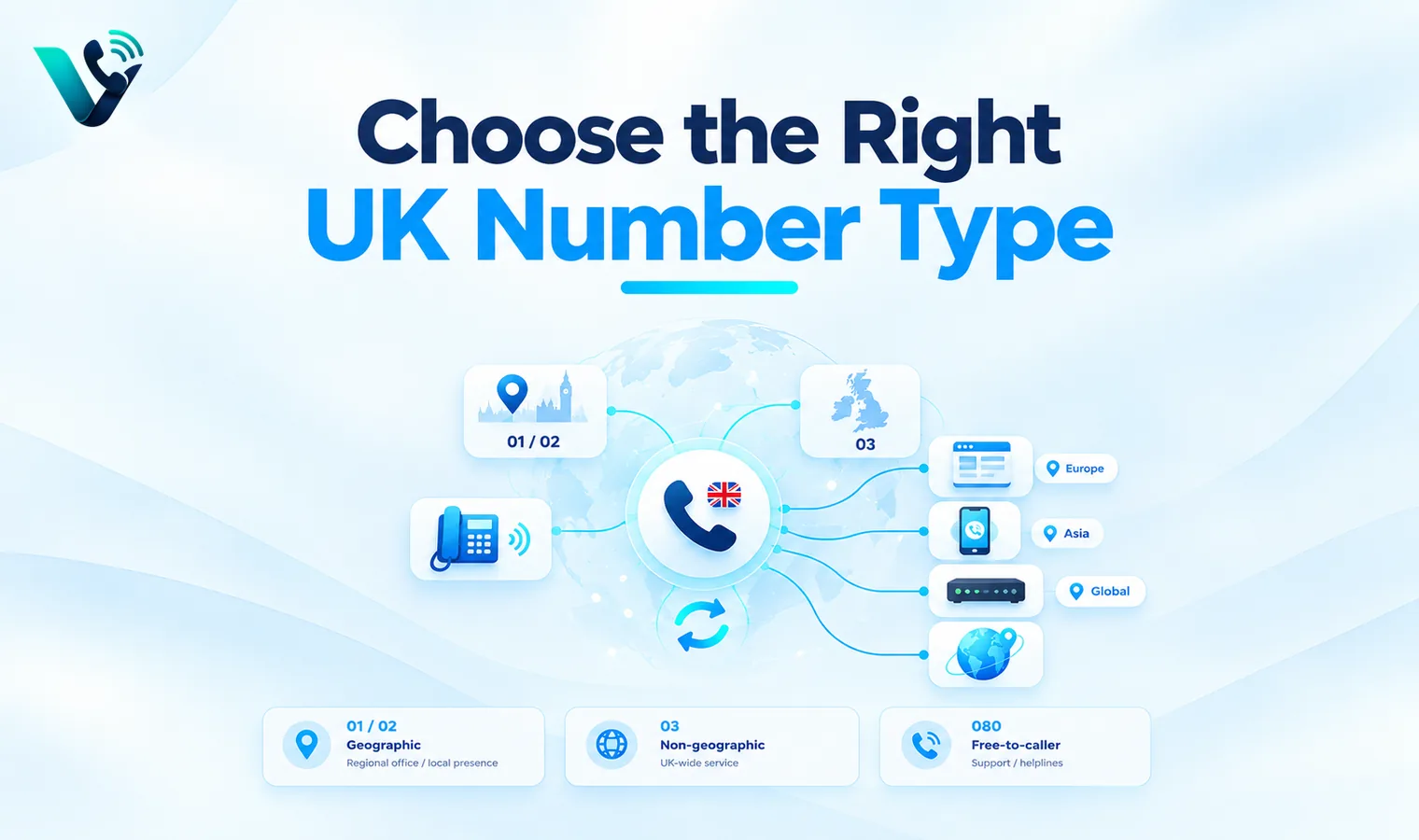
Caller ID rules matter for outbound UK calls
When your team calls customers back, the displayed caller ID should be configured correctly. Ofcom's guidance for caller-line identification requires a valid, dialable number that uniquely identifies the caller in the relevant context.
That means businesses should avoid presenting numbers that cannot receive a return call, invalid numbers or unrelated identities. If a call comes from an international contact centre but is presented as a UK business number, the organisation should have the right to use that number and route callbacks appropriately.
This is especially important because UK authorities and networks have been tightening controls against spoofed caller IDs.
Ofcom's action on scam calls from abroad
Ofcom has continued work to reduce scam calls arriving from overseas while displaying spoofed UK numbers. Its updated measures require stronger blocking of certain calls from abroad that falsely present UK landline or mobile identities.
For legitimate international businesses, the lesson is not that overseas routing is prohibited. It is that the caller-ID chain needs to be configured with the provider so legitimate calls are distinguishable from spoofed traffic.
Ask your VoIP provider how it handles UK caller-ID presentation for agents outside the country, what validation it performs, and whether any call routes risk having the UK CLI removed or blocked.
Can you receive UK calls outside the UK?
Yes, subject to the provider's service terms and the number's allocation rules. That is the central value of virtual routing. A London or national UK number can ring a support team in another country, an outsourced answering service, or a follow-the-sun group that changes by time of day.
The routing plan might send calls to a UK team during local office hours and then to another authorised support centre for after-hours coverage. Customers still use the same published number.
Be transparent in legal and business information. A UK phone number is a contact channel, not proof of a registered office, tax residence or regulated establishment.
Number portability in the UK
Businesses often invest heavily in a number through websites, advertising and customer records. Before doing that, understand number portability. Ofcom regulates portability so customers can retain eligible numbers when switching providers, but the exact process and feasibility can depend on the number type, service and providers involved.
Ask a prospective provider whether your number can later be ported out, what account information must match, and what lead time applies. Keep invoices and assignment records that demonstrate your relationship to the number.
If you are bringing an existing UK number to a new VoIP system, do not cancel the old service before the port completes. Configure the destination call flows first and test after cutover.
Inbound routing features worth configuring
A UK virtual number becomes much more useful when the routing matches customer intent. Consider:
- A concise UK-English greeting and IVR;
- Business hours set to UK local time;
- Regional sales queues where relevant;
- Skills-based support routing;
- Overflow after a defined wait time;
- Voicemail and email or ticket notifications;
- Holiday schedules for UK bank holidays;
- Failover to a backup destination;
- Call recording only where lawful and appropriate.
If teams are international, pay particular attention to time zones. A customer who calls at 10:00 London time should not hear an "after hours" message because the PBX was accidentally configured to the administrator's overseas time zone.
Outbound marketing and privacy considerations
A UK virtual number does not remove the rules that may apply to direct marketing calls. Businesses should review the UK requirements relevant to their audience, purpose, consent status and any preference services or sector rules.
Keep suppression lists, honour objections and make the caller's identity clear. If you use automated or recorded communications, the compliance analysis can be different from ordinary person-to-person calls.
For recordings and analytics, consider data-protection obligations as well. If call data or recordings are processed outside the UK, the business may need to evaluate contractual, privacy and security requirements beyond the telephone number itself.
UK virtual number for sales teams
For sales, stability is usually better than a huge rotating pool of numbers. Assign numbers by market or team, keep callbacks functional, and use the same identity long enough for reputation systems and customers to associate it with the business.
A local geographic number can be effective when a representative is genuinely responsible for that region. A national 03 number can simplify campaigns where prospects are distributed across the country.
Measure connect rate, conversation quality, complaints and conversion. Do not assume a London number will outperform every other identity simply because London is familiar.
UK virtual number for customer support
Support customers value recognition and reliability. Publish the number prominently, keep it consistent across invoices and help pages, and route it to a queue with clear service hours.
If the support team calls customers back, try to present the same or a clearly related number. A customer who called one number and receives a callback from an unexpected overseas identity may ignore the call.
Branded-calling features are evolving across networks and devices, but the foundation remains the same: valid caller ID, accurate business identity and a working return path.
Try this on your own numbers
Local numbers in 118 countries, AI call notes and one shared inbox. Live the same day, no contract.
A practical setup checklist
- Decide whether you need 01/02, 03, 080 or a combination.
- Confirm number availability and any address or documentation requirements.
- Define UK-local business hours and holiday schedules.
- Build IVR, queue, overflow and voicemail routing.
- Confirm how outbound UK caller ID is validated for international agents.
- Review number portability before investing in advertising.
- Confirm SMS support separately if you need messaging.
- Review direct-marketing and privacy rules for the intended use.
- Test calls from multiple UK mobile and fixed networks.
- Monitor caller-ID reputation and customer feedback after launch.
Note: UK numbering, caller-ID and direct-marketing requirements can change. Always check current Ofcom and other relevant regulatory guidance plus your provider's terms before deployment.
Final takeaway
A UK virtual phone number for international businesses can create a convenient British contact point without forcing every call to be answered in Britain. The technology is simple; the important decisions are how the number represents the business and how reliably it connects customers.
Choose a number type that fits the market, configure valid caller ID, preserve portability, route around UK time zones and use the number transparently. That combination creates the real advantage: customers can reach your business through a familiar UK channel while your team operates globally.
Common UK business number types
Range |
Type |
Typical business use |
|
01 / 02 |
Geographic |
Regional office, local sales or service presence |
|
03 |
Non-geographic, charged like 01/02 |
National organisation or UK-wide service |
|
080 |
Free-to-caller |
Customer support, helplines, national response campaigns |
Frequently asked questions
- Can an international company get a UK virtual phone number?
- Often yes, subject to provider onboarding, number availability and any allocation or documentation requirements for the chosen range.
- What is the difference between UK 01/02 and 03 numbers?
- 01 and 02 are geographic ranges associated with locations. 03 numbers are non-geographic and are charged to callers in the same way as 01/02 under Ofcom rules.
- Are UK 080 numbers free to call?
- Yes, 080 numbers are free-to-caller in the UK. The business should still check its provider’s inbound service charges.
- Can a UK virtual number ring an overseas team?
- Yes, where the provider supports international or VoIP routing. Configure time zones, quality and caller-ID settings carefully.
- Can I show a UK number when calling from abroad?
- A legitimate provider may support this when the business is authorised to use the number. The CLI should be valid and dialable, and current anti-spoofing controls must be respected.
- Can I port a UK number to another provider?
- Many eligible UK numbers can be ported, subject to the number type and providers. Confirm portability and required account details before changing service.