US Virtual Phone Number for International Businesses
By Jamila Parker · · 9 min read

A US virtual phone number lets an international business give American customers a familiar contact point while routing calls to teams anywhere. Learn number types, setup, caller ID and compliance basics.
Key takeaways
- A US virtual number can route American calls to teams outside the United States without requiring a traditional office phone line in the same place.
- Choose local or toll-free based on customer experience, not only appearance; confirm documentation and availability with the provider.
- Caller authentication, number reputation, emergency-calling obligations and messaging rules are separate issues that must be configured correctly.
- For outbound use, a US number does not remove telemarketing, consent or do-not-call obligations.
An international company can sell to US customers without opening a traditional phone office in every state. A US virtual phone number for international businesses gives customers a familiar American number while the actual calls route through a cloud or VoIP platform to staff in another city or country.
That makes virtual numbers useful for international sales, customer support, reservations, recruitment and market entry. But the setup should be planned around more than just obtaining an area code. Number type, caller ID, call routing, emergency services, messaging capability and outbound-calling rules all affect the customer experience.
The goal is not to pretend the company is physically somewhere it is not. The goal is to make communication with US customers simple, reliable and locally accessible.
What is a US virtual phone number?
A virtual phone number is a telephone number whose calls are routed using software and carrier networks rather than being permanently attached to one physical desk line. The number can point to a VoIP user, call queue, mobile application, SIP endpoint, IVR or other destination supported by the provider.
For an international company, that means a person in the United States can dial a US number while the answering team may be located in London, Kathmandu, Sydney or several countries at once. The caller interacts with a normal phone number; the routing behind it is cloud-based.
Virtual does not mean "fake". A legitimate number is assigned through a provider and must be used within the applicable numbering, caller-ID and communications rules.
Local US number or toll-free number?
Local geographic numbers
A local US number uses an area code associated with a geographic numbering-plan area. This can be helpful if the business serves a particular city or region, has customers concentrated there, or wants separate numbers for local branches and campaigns.
A local number can also make callbacks convenient for customers who recognise the area code. However, mobile number portability and population movement mean an area code does not prove where a person or business is physically located today.
Providers may have different documentation and inventory rules for number assignment, so confirm what is required for the desired area code.
Toll-free numbers
US toll-free numbers use prefixes such as 800 and other toll-free codes. They are commonly used for national sales, support and reservations because they are not tied to one city from the customer's perspective.
A toll-free number can be a strong choice for an international company that wants one US identity across all states. Toll-free numbers have their own administration framework, and your provider should explain activation, routing and portability arrangements.
Which is better?
If the company is entering one metro market, a local number may fit the brand. If it serves customers nationwide, a toll-free number may be simpler. Many businesses use both: Local numbers for regional campaigns and one toll-free main line for national support.
How a US virtual number routes international calls
The typical call path is straightforward. A customer dials the US number. The carrier network delivers the call to the virtual-number provider. The provider applies your rules and sends the call to the configured destination.
Those rules can include:
- Time-of-day and holiday schedules;
- An ivr such as "press 1 for sales";
- Round-robin or longest-idle queues;
- Simultaneous ringing across several agents;
- Overflow to another country or outsourced team;
- Voicemail-to-email or transcription;
- Failover to a backup number if the main route is unavailable;
With a well-designed cloud system, customers do not need to know where the agent is sitting. They simply need clear audio, reasonable wait time and a reliable callback path.
What international businesses should prepare before ordering
Start with a clear business identity. Providers may request company information, contact details, identification or address documentation depending on the number type, risk controls and service offered.
Decide who will answer the calls and during which US time zones. A number advertised as US customer support creates an expectation of availability that should match the website and service-level promise.
Map each number to a specific business purpose. Avoid accumulating unused numbers because unmanaged inventory can create billing, reputation and compliance problems.
Finally, decide whether the number will be voice-only or also used for SMS. Messaging capability and registration are not identical to voice service, and some number types or use cases require additional steps.
Caller ID and outbound calling from a US virtual number
A virtual number can often be presented as outbound caller ID when the provider has verified that the business is authorised to use it. In the US, caller-authentication frameworks such as STIR/SHAKEN are designed to reduce illegal spoofing by helping providers authenticate caller-ID information on IP networks.
Do not confuse authentication with reputation. A call can be properly authenticated and still be labelled spam if recipients report it or the calling pattern looks unwanted. Businesses making outbound calls should monitor number reputation and use stable, callable identities.
If an international sales team is calling US prospects, the same practical rules apply:
Relevant targeting, reasonable cadence, accurate identity and a working callback route are better long-term strategies than cycling through large pools of disposable numbers.
Does a US virtual number make a company "local"?
It gives customers a US contact point, but it should not be used to make false claims about a physical office. A website can honestly say "US phone support" or list a US contact number while separately stating the company's actual business address.
That distinction protects trust. Customers care less about where the server routes the call than whether the business is transparent, reachable and responsive.
For local-search profiles or regulated services, address verification follows its own rules. A virtual phone number should not be treated as evidence of a physical location where none exists.
US emergency calling considerations
Some forms of interconnected VoIP service in the United States are subject to FCC emergency-calling requirements, including enhanced 911 obligations. The exact responsibility depends on the service architecture and how the provider classifies and delivers the service.
If employees in the US will use the VoIP system as their business telephone service, ask the provider how emergency calling is configured, how dispatchable location information is maintained and what happens when a user changes location.
For an international company using a US number only as an inbound route to an overseas contact centre, the architecture may be different. Do not assume the same 911 setup applies to every virtual-number scenario; get the provider's written guidance for your deployment.
Messaging and SMS are a separate decision
A number that supports voice does not automatically support every type of business messaging. US application-to-person messaging is subject to carrier and ecosystem requirements designed to identify senders and reduce abuse. Toll-free and local-number messaging can follow different verification or registration processes.
If SMS is important, tell the provider before ordering. Ask whether the number supports inbound and outbound messaging, which countries your team can access it from, what registration is required for the intended traffic, and what content or consent rules apply.
Do not build a customer-verification workflow around SMS until you have confirmed delivery, sender registration and provider policy.
Outbound sales and telemarketing compliance
A US number does not exempt an international caller from US rules that may apply to calls or texts made to US consumers. Telemarketing, robocalling, prerecorded messages and do-not-call requirements can depend on the method of contact, consent, recipient type and campaign.
If the business will use automation, prerecorded content or high-volume marketing, obtain compliance advice appropriate to the campaign. Do not rely on the fact that the number is legitimately assigned as evidence that the outreach itself is permitted.
For ordinary one-to-one business communications, keep records of opt-outs and use clear identification. Compliance and good reputation usually point in the same direction: Contact people who have a reason to hear from you and stop when they ask you to stop.
Choosing a provider for a US virtual number
Evaluate more than the monthly number price. Ask about:
- Number ownership and portability;
- Local and toll-free inventory;
- Inbound and outbound per-minute rates;
- International forwarding or sip routing;
- Caller-id verification and authentication support;
- Spam-label remediation assistance;
- Call recording and retention options;
- Sms availability and registration;
- Emergency-calling features where relevant;
- Uptime, failover and support coverage;
- Apis, crm integration and reporting;
The cheapest number can become expensive if every operational feature is an add-on or if support cannot resolve a routing problem during US business hours.
A sensible setup for an international team
A simple architecture might use one national toll-free number for general enquiries, local numbers in priority sales markets, and direct inward numbers for key account managers. All numbers can feed the same cloud PBX.
The IVR can route based on purpose, while time rules send calls to the region currently online. For example, a US daytime queue might ring an Americas team first, then overflow to a global support team. After hours, voicemail and ticket creation can preserve the enquiry.
Make sure callbacks display an approved business number that the customer recognises. If a customer calls the New York number and receives a callback from an unrelated random area code, the experience loses some of the benefit you created.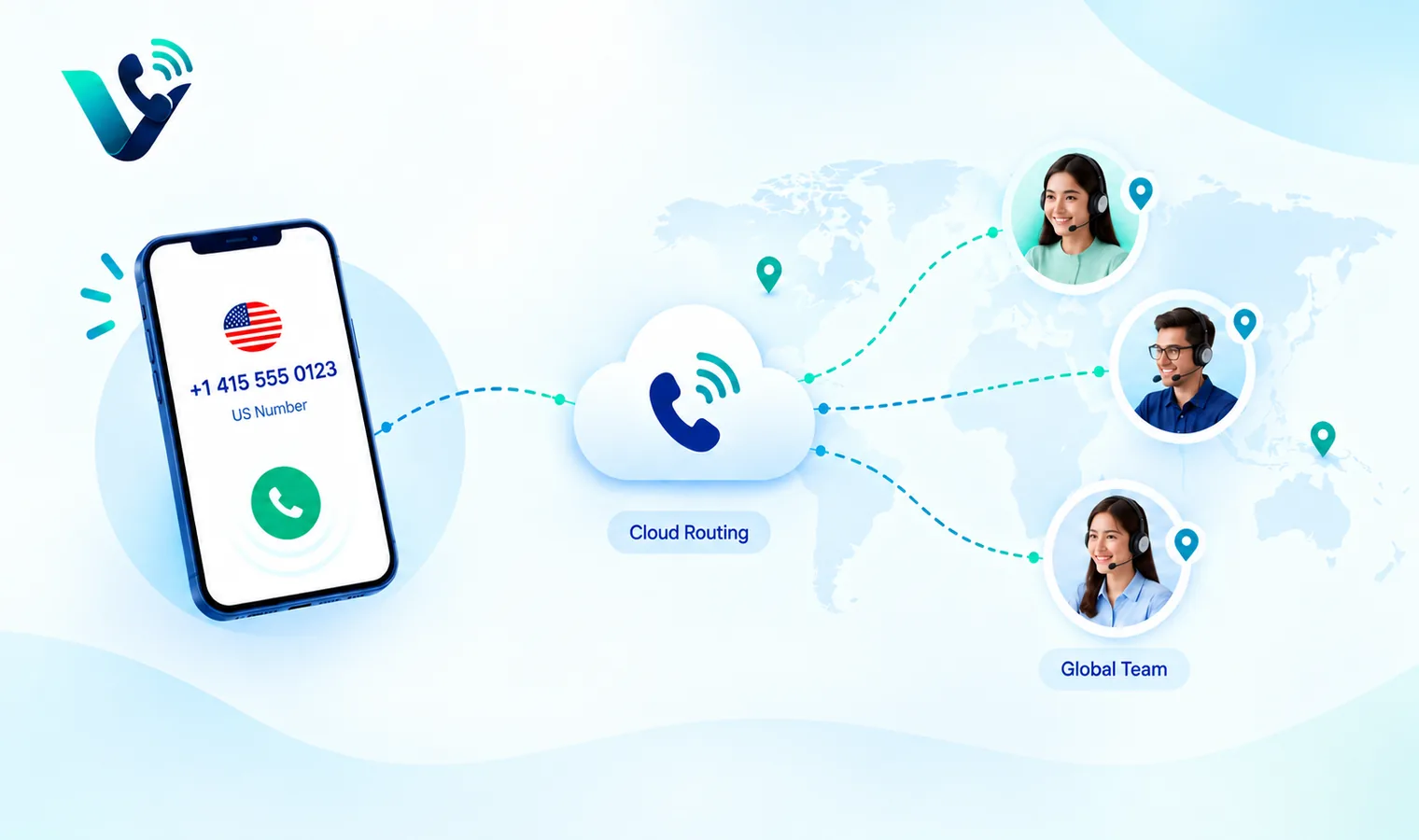
Try this on your own numbers
Local numbers in 118 countries, AI call notes and one shared inbox. Live the same day, no contract.
Launch checklist
- Choose local, toll-free or a combination based on the target market.
- Verify provider documentation and number availability.
- Configure call flows, hours, voicemail and failover.
- Confirm outbound caller-ID authorisation.
- Review STIR/SHAKEN support for applicable US calls.
- Decide whether SMS is required and complete any relevant registration.
- Review emergency-calling requirements for US-based VoIP users.
- Review outbound telemarketing and consent requirements before campaigns.
- Test inbound and outbound calls from multiple networks.
- Publish the number consistently and monitor reputation.
Note: Telecom, messaging and telemarketing rules can change. Provider features also vary. Verify the exact requirements for your number type and traffic before launch.
Final takeaway
A US virtual phone number for international businesses is useful because it separates customer identity from physical call handling. Customers get an accessible US number, while the company can route calls to the best team anywhere in the world.
The strongest setup combines the right number type with transparent business identity, reliable routing, appropriate caller authentication, healthy reputation and market-specific compliance. Build those foundations first and the virtual number becomes more than a local-looking prefix it becomes a dependable US communications channel.
US local vs toll-free virtual numbers
Option |
Best fit |
Key consideration |
|
Local US number |
Specific city/region, branch or campaign |
Area code is geographically associated but does not prove physical location |
|
US toll-free number |
Nationwide sales or support |
One national identity; toll-free administration and routing apply |
|
Both |
Multi-region business |
Use local market entry plus a stable national support identity |
Frequently asked questions
- Can an international business get a US virtual phone number?
- Often yes, subject to the provider’s onboarding, number availability, documentation and permitted use. Requirements vary by number type and provider.
- Do I need a US office to use a US virtual number?
- Not necessarily for every number or provider. However, you should not use a virtual number to make false claims about a physical office, and some services or number types may have documentation requirements.
- Is a local US number better than toll-free?
- A local number can fit a specific market, while toll-free is useful for a nationwide identity. The better choice depends on where customers are and how the number will be marketed.
- Can I make outbound calls using the US virtual number?
- Often yes when the provider verifies your authority to use the caller ID. Outbound telemarketing and consent rules still apply.
- Does STIR/SHAKEN guarantee my calls will not show as spam?
- No. STIR/SHAKEN authenticates caller-ID information; spam reputation is a separate assessment influenced by behaviour and feedback.
- Can a US virtual number receive SMS?
- Some numbers and providers support SMS, but business messaging can require additional registration or verification. Confirm the exact messaging use case before ordering.